
Question 153 marksEasy
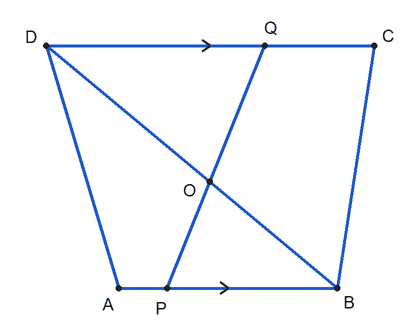
In the given figure, AB ∥ DC, BO = 6 cm and DQ = 8 cm; find: BP × DO.
Confirming your payment
Sign up now and get 250 free tokens.
Similarity · Question 15 of 120
In the given figure, AB ∥ DC, BO = 6 cm and DQ = 8 cm; find: BP × DO.
Solution:
Concept: When two straight lines cross at a point O and the segments joining their ends are parallel, the two triangles formed at O are similar (AA). The angles at O are vertically opposite, so they are equal, and the parallel lines make equal alternate angles with each crossing line.
Given: AB ∥ DC, BO = 6 cm, DQ = 8 cm; we need BP × DO.
Step 1 — Find two pairs of equal angles.
PQ and DB cross at O, so ∠BOP = ∠DOQ (vertically opposite). AB ∥ DC and DB crosses them, so ∠OBP = ∠ODQ (alternate angles).
Step 2 — Name the similar triangles.
By AA, ΔOBP ~ ΔODQ, with B matching D and P matching Q.
Step 3 — Write the ratio and cross-multiply.
Corresponding sides are in the same ratio, so BP is to DQ as BO is to DO:
Cross-multiplying puts the two lengths we want on one side:
Step 4 — Put in the lengths.
BO = 6 cm and DQ = 8 cm:
Watch out: We cannot find BP and DO separately, but we do not need to: cross-multiplying gives their product at once.
Therefore, BP × DO = 48 cm².