
Question 143 marksEasy
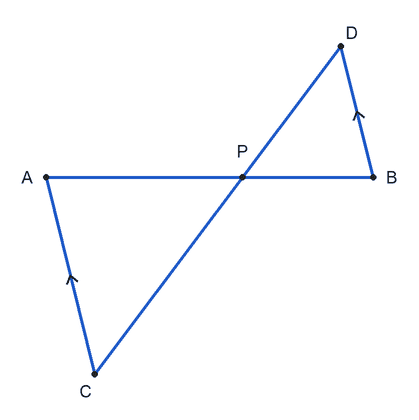
In the figure, given below, straight lines AB and CD intersect at P; and AC ∥ BD. Prove that :
(i) ΔAPC and ΔBPD are similar.
(ii) If BD = 2·4 cm, AC = 3·6 cm, PD = 4·0 cm and PB = 3·2 cm; find the lengths of PA and PC.
Confirming your payment
Sign up now and get 250 free tokens.
Similarity · Question 14 of 120
In the figure, given below, straight lines AB and CD intersect at P; and AC ∥ BD. Prove that :
(i) ΔAPC and ΔBPD are similar.
(ii) If BD = 2·4 cm, AC = 3·6 cm, PD = 4·0 cm and PB = 3·2 cm; find the lengths of PA and PC.
Solution:
Concept: When two straight lines cross at a point O and the segments joining their ends are parallel, the two triangles formed at O are similar (AA). The angles at O are vertically opposite, so they are equal, and the parallel lines make equal alternate angles with each crossing line.
Given: AB and CD meet at P; AC ∥ BD; BD = 2.4 cm, AC = 3.6 cm, PD = 4 cm, PB = 3.2 cm.
Step 1 — Part (i): find two pairs of equal angles.
AB and CD cross at P, so ∠APC = ∠BPD (vertically opposite angles). AC ∥ BD and AB is a line crossing them, so ∠PAC = ∠PBD (alternate angles).
Step 2 — Part (i): conclude.
Two angles of ΔAPC equal two angles of ΔBPD, so ΔAPC ~ ΔBPD by AA, with A matching B, P matching P and C matching D.
Step 3 — Part (ii): write the ratios.
Corresponding sides of the similar triangles are in the same ratio:
The last ratio has both lengths known:
Step 4 — Part (ii): find PA.
Since , PA is 1.5 times PB:
Step 5 — Part (ii): find PC.
Since , PC is 1.5 times PD:
Watch out: PA is on line AB, so it is compared with PB (the other part of AB), and PC with PD.
Therefore, (i) ΔAPC ~ ΔBPD; (ii) PA = 4.8 cm and PC = 6 cm.