
Question 1153 marksMedium
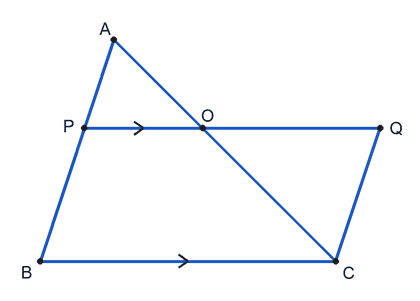
In triangle ABC, AP : PB = 2 : 3. PO is parallel to BC and is extended to Q so that CQ is parallel to BA. Find :
(i) area Δ APO : area Δ ABC. (ii) area Δ APO : area Δ CQO.
Confirming your payment
Sign up now and get 250 free tokens.
Similarity · Question 115 of 120
In triangle ABC, AP : PB = 2 : 3. PO is parallel to BC and is extended to Q so that CQ is parallel to BA. Find :
(i) area Δ APO : area Δ ABC. (ii) area Δ APO : area Δ CQO.
Solution:
Concept: The ratio of the areas of two similar triangles equals the square of the ratio of their corresponding sides: if the sides are in the ratio , the areas are in the ratio .
Given: AP : PB = 2 : 3, PO ∥ BC, and PO produced meets Q with CQ ∥ BA.
Step 1 — Part (i): ratio of ΔAPO to ΔABC.
PO ∥ BC, so ΔAPO ~ ΔABC. AP is 2 parts and PB is 3, so AB is 5 parts and AP : AB = 2 : 5:
Step 2 — Part (ii): show ΔAPO ~ ΔCQO.
CQ ∥ BA, so CQ ∥ AP. PQ and AC cross at O, so ∠AOP = ∠COQ (vertically opposite) and ∠OAP = ∠OCQ (alternate angles). So ΔAPO ~ ΔCQO, with AO matching CO.
Step 3 — Part (ii): find AO : OC.
In ΔABC, PO ∥ BC, so by BPT O divides AC in the same ratio as P divides AB:
Step 4 — Part (ii): ratio of the areas.
The areas go as the square of AO : CO:
Watch out: In part (i) use AP : AB = 2 : 5 (part to whole); in part (ii) use AO : OC = 2 : 3 (the two parts of AC).
Therefore, (i) 4 : 25 and (ii) 4 : 9.