
Question 1203 marksMedium
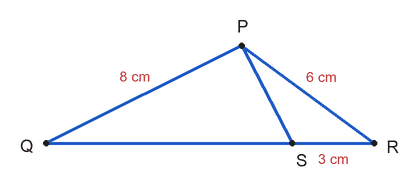
PQR is a triangle. S is a point on the side QR of ΔPQR such that ∠PSR = ∠QPR. Given QP = 8 cm, PR = 6 cm and SR = 3 cm.
(i) Prove ΔPQR ~ ΔSPR.
(ii) Find the lengths of QR and PS.
(iii)
Confirming your payment
Sign up now and get 250 free tokens.
Similarity · Question 120 of 120
PQR is a triangle. S is a point on the side QR of ΔPQR such that ∠PSR = ∠QPR. Given QP = 8 cm, PR = 6 cm and SR = 3 cm.
(i) Prove ΔPQR ~ ΔSPR.
(ii) Find the lengths of QR and PS.
(iii)
Solution:
Concept: AA rule: If two angles of one triangle are equal to two angles of another triangle, the third angles are equal too (the angles of a triangle add up to 180°), so the triangles are similar. Their corresponding sides are then in the same ratio.
Given: S is on QR with ∠PSR = ∠QPR; QP = 8 cm, PR = 6 cm, SR = 3 cm.
Step 1 — Part (i): find two pairs of equal angles.
In ΔPQR and ΔSPR, ∠QPR = ∠PSR (given) and ∠R is common. So ΔPQR ~ ΔSPR by AA, with P matching S, Q matching P and R matching R.
Step 2 — Part (ii): write the ratios.
PR (in ΔPQR) matches SR, and both are known:
Step 3 — Part (ii): find QR and PS.
QR is twice PR, and PQ is twice SP:
Step 4 — Part (iii): ratio of the areas.
The areas go as the square of the side ratio 2:
So the ratio is 4 : 1.
Watch out: Write the triangles in matching order. Find which angle equals which first, then read the corresponding sides from the same positions in the two names.
Therefore, (i) ΔPQR ~ ΔSPR; (ii) QR = 12 cm and PS = 4 cm; (iii) 4 : 1.