
Opening your dashboard
Class 10 Chemistry Chapter 3: Acids, Bases and Salts Solutions
90 textbook questions with step-by-step answers, free to read, for ICSE 2026-27.
Get talked through Ch 3, not just shown the answer
Reading a finished solution is not the same as being able to do it. The AI tutor takes one question at a time and works it with you, in your own words, until you can.
- Ask it out loud, in your own words
- It gives you the next step, not the answer
- Stuck on part (ii)? Start there
90 questions with solutions
1–5 marks · Mixed difficulty
The first 48 solutions are on this page. This chapter is a long one, so the rest open on their own page to keep this one quick to load.
- 15 marks
Question 1
(a) What do you understand by the term acid ?
(b) Name the positive ion formed when an acid is dissolved in water.
(c) Draw the structure of this ion.
Solve with AIWritten solution
Solution:
Concept: An acid gives hydrogen ions in water, but a bare ion (a proton) never stays free: it at once joins a water molecule and forms the hydronium ion, .
Step 1 — (a) What an acid is.
We define an acid by the ions it gives when it dissolves in water. An acid is a compound which, when dissolved in water, gives hydronium ions () as the only positively charged ions.
For example, hydrogen chloride gives hydronium ions and chloride ions in water:
The only positive ion in the solution is ; the negative ion, , is the acid radical.

Step 2 — (b) Name the positive ion.
The positive ion is the hydronium ion, . It forms because the ion released by the acid combines with a water molecule:
Step 3 — (c) Draw the structure of the hydronium ion.
The oxygen atom of a water molecule has two lone pairs of electrons, while the ion has no electrons at all. Oxygen donates one of its lone pairs to the ion, so the shared pair comes from oxygen alone: this is a coordinate bond.
So the hydronium ion has three O–H bonds (two ordinary covalent bonds and one coordinate bond), one lone pair left on oxygen, and an overall charge of +1, shown outside the brackets.
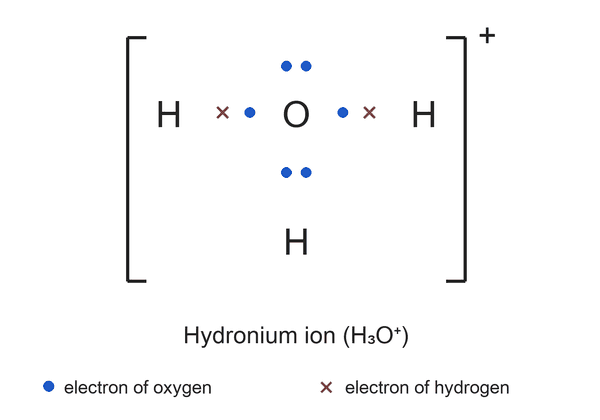
Watch out: The ion in an acid solution is written , not a free ; and in the structure, the bond to the third hydrogen uses a pair of electrons that both came from oxygen.
Therefore, (a) an acid gives as the only positive ions in water; (b) the positive ion is the hydronium ion, ; (c) it has three O–H bonds (one of them coordinate), one lone pair on oxygen and a charge of +1.
- 22 marks
Question 2
Write the ionisation of sulphuric acid showing the formation of hydronium ion.
Solve with AIWritten solution
Solution:
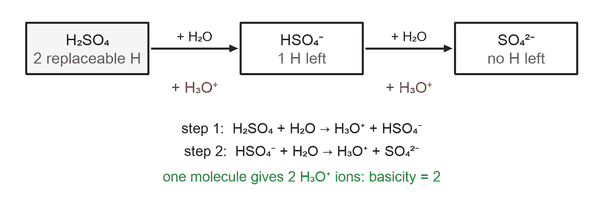
Concept: Sulphuric acid is dibasic: each molecule has two ionisable hydrogen atoms. It ionises in two steps, and each step gives one hydronium ion.
Step 1 — First ionisation.
In the first step, one hydrogen ion of the acid moves to a water molecule and forms a hydronium ion, leaving the hydrogen sulphate ion:
Step 2 — Second ionisation.
In the second step, the hydrogen sulphate ion gives up its remaining hydrogen ion to another water molecule:
Step 3 — Add the two steps.
Adding the two steps (the ion cancels) gives the overall ionisation:
Watch out: Check the charges: two ions (+2 in all) balance one ion (−2).
Therefore, one molecule of sulphuric acid gives two hydronium ions, , which is why its basicity is 2.
- 32 marks
Question 3
Water is never added to acid in order to dilute it. Why ?
Solve with AIWritten solution
Solution:
Concept: Dissolving a concentrated acid in water is a highly exothermic process: a large amount of heat is given out.
Step 1 — What happens if water is added to the acid.
When a little water is poured into a lot of concentrated acid, the first small amount of water meets a large amount of acid. All the heat produced goes into this little water, so the water boils at once.
Step 2 — Why this is dangerous.
The boiling water throws the acid solution out of the container in splashes, which can cause severe burns to the skin and eyes. The sudden local heating can also crack the glass container.
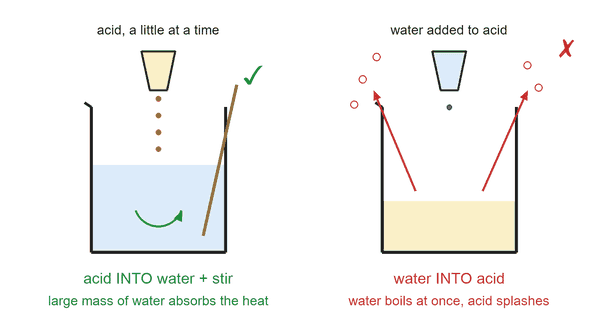
Step 3 — The safe way.
So the acid is added to water slowly, a little at a time, with constant stirring. Now each small amount of acid always meets a large mass of water, which absorbs the heat and spreads it out safely.
Watch out: Remember the order “acid into water”, never “water into acid”.
Therefore, water is never added to acid because the heat given out boils the small amount of water at once, making the acid splash and the vessel crack; the acid is always added slowly to water with stirring.
- 42 marks
Question 4
Define the term 'basicity' of an acid. Give the basicity of : nitric acid, sulphuric acid and phosphoric acid.
Solve with AIWritten solution
Solution:
Concept: Basicity counts only the ionisable (replaceable) hydrogen atoms of one molecule of an acid, not all the hydrogen atoms it contains.
Step 1 — Define basicity.
We define basicity by the number of hydronium ions one molecule can give. The basicity of an acid is the number of hydronium ions () that can be produced by the ionisation of one molecule of that acid in aqueous solution.
Step 2 — Count the ionisable hydrogens of each acid.
Each acid ionises once for every ionisable hydrogen it has, so we count those hydrogens:
Acid Formula Basicity Nitric acid 1 (monobasic) Sulphuric acid 2 (dibasic) Phosphoric acid 3 (tribasic) Step 3 — Check with the ionisation equations.
Nitric acid ionises in a single step and gives one per molecule:
Sulphuric acid ionises in two steps and phosphoric acid in three steps, each step giving one :
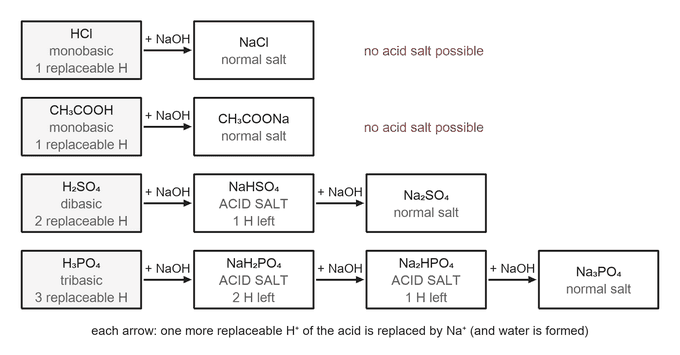
Therefore, basicity is the number of ions one molecule of the acid gives in water: nitric acid 1, sulphuric acid 2 and phosphoric acid 3.
- 54 marks
Question 5
Give two examples of each of the following :
(a) oxy-acid,
(b) hydracid,
(c) tribasic acid,
(d) dibasic acid.
Solve with AIWritten solution
Solution:
Concept: Acids are grouped by what they contain and by their basicity. Oxy-acids contain oxygen as well as hydrogen and another element; hydracids contain hydrogen and a non-metal but no oxygen. Basicity is the number of ions one molecule gives.
Step 1 — (a) Oxy-acids.
We look for acids whose formula contains oxygen: nitric acid () and sulphuric acid ().
Step 2 — (b) Hydracids.
We look for acids made of hydrogen and a non-metal only: hydrochloric acid () and hydrobromic acid ().
Step 3 — (c) Tribasic acids.
We need acids with three ionisable hydrogens per molecule: phosphoric acid () and citric acid (), which has three –COOH groups.
Step 4 — (d) Dibasic acids.
We need acids with two ionisable hydrogens per molecule: sulphuric acid () and carbonic acid ().
Watch out: One acid can belong to more than one group (sulphuric acid is both an oxy-acid and a dibasic acid), and basicity counts only ionisable hydrogens, not all of them.
Therefore, (a) HNO₃, H₂SO₄; (b) HCl, HBr; (c) H₃PO₄, citric acid; (d) H₂SO₄, H₂CO₃.
- 65 marks
Question 6
Name the :
(a) acidic anhydride of the following acids :
(i) sulphurous acid,
(ii) nitric acid,
(iii) phosphoric acid,
(iv) carbonic acid.
(b) acids present in vinegar, grapes and lemon.
Solve with AIWritten solution
Solution:
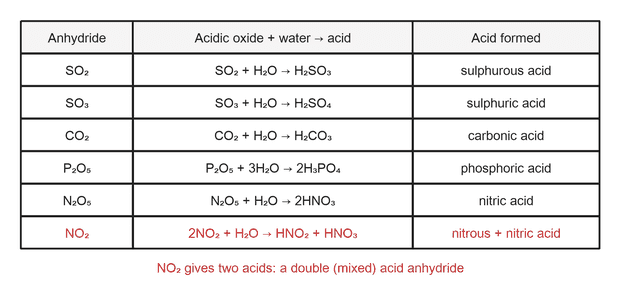
Concept: An acidic anhydride is the non-metallic oxide that dissolves in water to give the acid. To find it, take water away from the acid's formula.
Step 1 — (a)(i) Sulphurous acid.
Removing one water molecule from leaves sulphur dioxide, :
Step 2 — (a)(ii) Nitric acid.
Two molecules of minus one water molecule leave dinitrogen pentoxide, :
Step 3 — (a)(iii) Phosphoric acid.
Two molecules of minus three water molecules leave phosphorus pentoxide, :
Step 4 — (a)(iv) Carbonic acid.
Removing one water molecule from leaves carbon dioxide, :
Step 5 — (b) Acids in vinegar, grapes and lemon.
These are organic acids obtained from plants: vinegar contains acetic acid, grapes contain tartaric acid and lemons contain citric acid.
Watch out: The anhydride of nitric acid is , not (which gives two acids with water).
Therefore, (a) (i) SO₂, (ii) N₂O₅, (iii) P₂O₅, (iv) CO₂; (b) vinegar – acetic acid, grapes – tartaric acid, lemon – citric acid.
- 72 marks
Question 7
What do you understand by the statement 'acetic acid is a monobasic acid'?
Solve with AIWritten solution
Solution:
Concept: Basicity depends on the number of ionisable hydrogen atoms in one molecule, not on the total number of hydrogen atoms.
Step 1 — Count the hydrogen atoms in acetic acid.
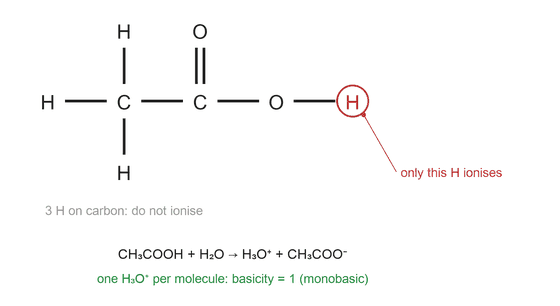
Acetic acid, , has four hydrogen atoms. Three of them are joined to carbon (in ) and do not ionise. Only one, the H of the –COOH group, is ionisable.
Step 2 — Write its ionisation.
So one molecule of acetic acid gives only one hydronium ion in water:
Step 3 — State what “monobasic” means.
An acid that gives one ion per molecule has basicity 1 and is called monobasic. It can form only a normal salt (sodium acetate, ), never an acid salt.
Watch out: Do not count all four hydrogen atoms; the three in never ionise.
Therefore, “acetic acid is monobasic” means that one molecule of acetic acid gives only one hydronium ion in water, so its basicity is 1.
- 84 marks
Question 8
Give a balanced equation for (i) reaction of nitrogen dioxide with water (ii) preparation of a non volatile acid from a volatile acid.
Solve with AIWritten solution
Solution:
Concept: is a double (mixed) acid anhydride: with water it gives two acids. A non-volatile acid can be made by oxidising a non-metal with a volatile acid such as concentrated nitric acid.
Step 1 — (i) Nitrogen dioxide and water.
Nitrogen dioxide dissolves in water to give two acids, nitrous acid and nitric acid:
Step 2 — (ii) A non-volatile acid from a volatile acid.
Phosphorus is oxidised by hot concentrated nitric acid (a volatile acid) to phosphoric acid (a non-volatile acid); brown nitrogen dioxide is given off:
Step 3 — Check that the equation is balanced.
We count each kind of atom on both sides: P is 1 on each side, H is 5 on the left and 3 + 2 = 5 on the right, N is 5 on each side, and O is 15 on the left and 4 + 1 + 10 = 15 on the right.
Watch out: In (i) the coefficient of is 2, because one N goes into and one into .
Therefore, (i) 2NO₂ + H₂O → HNO₂ + HNO₃; (ii) P + 5HNO₃ → H₃PO₄ + H₂O + 5NO₂.
- 92 marks
Question 9
What do you understand by the strength of an acid ? On which factor does the strength of an acid depend ?
Solve with AIWritten solution
Solution:
Concept: The strength of an acid is about how much it ionises in water; it is not the same as its concentration (how much acid is dissolved in a given volume).
Step 1 — Define the strength of an acid.
We measure strength by the hydronium ions produced. The strength of an acid is the measure of the concentration of hydronium ions it produces in its aqueous solution: the more ions it gives, the stronger it is.
Step 2 — Name the factor.
The strength depends on the degree of ionisation (dissociation), α, of the acid — the fraction of its dissolved molecules that ionise, usually given as a percentage:
Step 3 — Compare a strong and a weak acid.
A strong acid such as hydrochloric acid is almost completely ionised, so its solution contains practically only ions. A weak acid such as acetic acid ionises only slightly (a few per cent), so its solution contains mostly molecules and only a few ions.
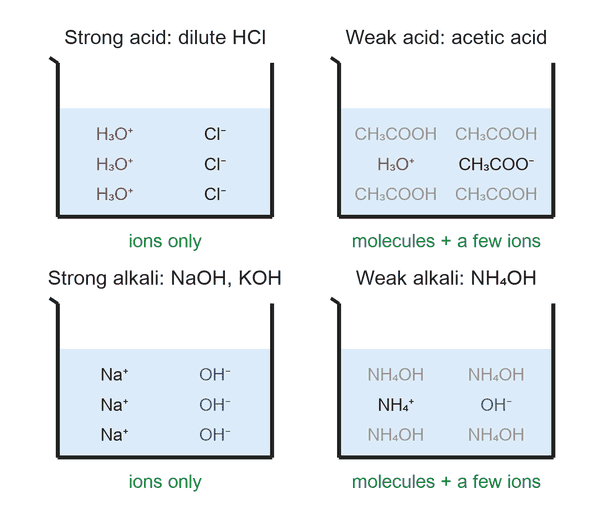
Watch out: A concentrated weak acid is still weak; strength depends on the degree of ionisation, not on the amount of acid.
Therefore, the strength of an acid is the concentration of hydronium ions it produces in water, and it depends on the degree of ionisation of the acid.
- 105 marks
Question 10
Explain the following :
(a) Carbonic acid gives an acid salt but hydrochloric acid does not.
(b) Dil. HCl acid is stronger than highly concentrated acetic acid.
(c) is not a tribasic acid.
(d) Lead carbonate does not react with dilute HCl.
(e) Nitrogen dioxide is a double acid anhydride.
Solve with AIWritten solution
Solution:
Concept: An acid salt needs more than one replaceable hydrogen; strength depends on the number of ions produced; in oxy-acids of phosphorus only the H atoms on oxygen are replaceable; an insoluble product coating a solid stops a reaction.
Step 1 — (a) Carbonic acid gives an acid salt but hydrochloric acid does not.
Carbonic acid, , is dibasic. If only one of its two replaceable hydrogens is replaced, an acid salt forms:
Hydrochloric acid is monobasic. Once its single replaceable hydrogen is replaced, the salt (NaCl) is already a normal salt, so no acid salt is possible.
Step 2 — (b) Dilute HCl is stronger than highly concentrated acetic acid.
Strength depends on the concentration of ions, not on the amount of acid present. Dilute HCl is almost completely ionised, so it gives many ions. Acetic acid, even when highly concentrated, is only feebly ionised and gives very few ions. So dilute HCl is the stronger acid.
Step 3 — (c) H₃PO₃ is not a tribasic acid.
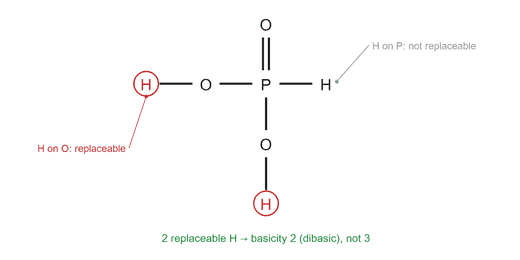
In only the two hydrogen atoms attached to oxygen (–OH) are replaceable. The third hydrogen is joined directly to phosphorus and does not ionise. So one molecule gives only two ions, and is dibasic, not tribasic.
Step 4 — (d) Lead carbonate does not react with dilute HCl.
The reaction starts, but the product, lead chloride, is insoluble in cold water. It forms a coating on the lead carbonate and stops further contact with the acid, so the reaction stops almost at once.

Step 5 — (e) Nitrogen dioxide is a double acid anhydride.
Nitrogen dioxide dissolves in water to form two acids, nitrous acid and nitric acid. An oxide that gives two acids with water is called a double (mixed) acid anhydride:
Watch out: The number of hydrogen atoms in the formula does not decide basicity; H atoms bonded directly to P (as in ) or to C (as in acetic acid) do not ionise.
Therefore, (a) only a polybasic acid like H₂CO₃ can be partly neutralised; (b) dilute HCl gives far more H₃O⁺ ions; (c) H₃PO₃ has only two replaceable H, so it is dibasic; (d) an insoluble PbCl₂ coating stops the reaction; (e) NO₂ gives two acids with water.
- 114 marks
Question 11
How is an acid prepared from a
(a) Non-metal (b) salt ? Give an equation for each.
Solve with AIWritten solution
Solution:
Concept: A hydracid can be made by combining hydrogen directly with a non-metal (synthesis). An acid can also be made from a salt by displacement: a less volatile acid drives out a more volatile acid from its salt.
Step 1 — (a) From a non-metal (synthesis).
Hydrogen combines directly with chlorine (a non-metal) in diffused sunlight to give hydrogen chloride, which dissolves in water to give hydrochloric acid:
Step 2 — (b) From a salt (displacement).
Sodium chloride (the salt of the volatile acid HCl) is heated with concentrated sulphuric acid (a non-volatile acid), and hydrogen chloride is driven off:
In the same way, nitric acid is made from sodium nitrate:
Watch out: Only a less volatile acid (such as conc. ) can drive a more volatile acid out of its salt.
Therefore, (a) from a non-metal: H₂ + Cl₂ → 2HCl; (b) from a salt: NaCl + H₂SO₄ → NaHSO₄ + HCl (below 200 °C).
- 125 marks
Question 12
Give equations to show how the following are made from their corresponding anhydrides.
(a) sulphurous acid,
(b) phosphoric acid,
(c) carbonic acid,
(d) sulphuric acid.
Solve with AIWritten solution
Solution:
Concept: An acidic anhydride (a non-metallic oxide) dissolves in water to give its acid, so each equation is “anhydride + water → acid”. Only oxy-acids can be made this way.
Step 1 — (a) Sulphurous acid from sulphur dioxide.
Sulphur dioxide dissolves in water to give sulphurous acid:
Step 2 — (b) Phosphoric acid from phosphorus pentoxide.
Phosphorus pentoxide reacts with three molecules of water to give two molecules of phosphoric acid:
Step 3 — (c) Carbonic acid from carbon dioxide.
Carbon dioxide dissolves in water to give carbonic acid:
Step 4 — (d) Sulphuric acid from sulphur trioxide.
Sulphur trioxide combines with water to give sulphuric acid:
Watch out: Sulphurous acid comes from but sulphuric acid from .
Therefore, (a) SO₂ + H₂O → H₂SO₃; (b) P₂O₅ + 3H₂O → 2H₃PO₄; (c) CO₂ + H₂O → H₂CO₃; (d) SO₃ + H₂O → H₂SO₄.
- 134 marks
Question 13
Name an acid used :
(a) to flavour and preserve food,
(b) in a drink,
(c) to remove ink spots,
(d) as an eyewash.
Solve with AIWritten solution
Solution:
Concept: Many weak acids are safe enough to be used in food, drinks and medicines.
Step 1 — (a) To flavour and preserve food.
Vinegar, used in cooking and pickles, is a dilute solution of acetic acid; it flavours food and stops microbes from growing. (Citric acid and benzoic acid are also used as preservatives.)
Step 2 — (b) In a drink.
Aerated (soda) drinks contain carbon dioxide dissolved under pressure, which forms carbonic acid; it gives the fizz and the slightly sour taste.
Step 3 — (c) To remove ink spots.
Oxalic acid is used to remove ink and rust stains from cloth.
Step 4 — (d) As an eyewash.
Boric acid is a very weak, mild antiseptic acid, so a dilute solution is used as an eyewash.
Therefore, (a) acetic acid, (b) carbonic acid, (c) oxalic acid, (d) boric acid.
- 144 marks
Question 14
Give reaction of acids with
(a) chlorides (b) nitrates
State the conditions under which they react.
Solve with AIWritten solution
Solution:
Concept: Most chlorides and nitrates react only with concentrated sulphuric acid on warming, because the less volatile acid drives out the more volatile one. A few react with dilute acids, but only when an insoluble product is formed.
Step 1 — (a) Chlorides with concentrated sulphuric acid.
The condition is concentrated sulphuric acid, warmed (below 200 °C). Hydrogen chloride is liberated and the acid salt is left:
Above 200 °C the normal salt forms instead:
Step 2 — (a) A chloride with a dilute acid.
A few chlorides react with dilute sulphuric acid because an insoluble sulphate is precipitated:
Step 3 — (b) Nitrates with concentrated sulphuric acid.
The condition is again concentrated sulphuric acid, warmed (below 200 °C). Nitric acid is liberated:
Step 4 — (b) Lead nitrate with dilute acids.
Lead nitrate reacts with dilute acids because insoluble lead chloride or lead sulphate is formed:
Watch out: With concentrated acid the temperature matters: below 200 °C the acid salt (NaHSO₄, KHSO₄) forms.
Therefore, chlorides and nitrates give HCl and HNO₃ with concentrated sulphuric acid on warming (below 200 °C); with dilute acids they react only when an insoluble salt such as BaSO₄, PbCl₂ or PbSO₄ is precipitated.
- 154 marks
Question 15
What do you understand by an alkali ? Give two examples of :
(a) strong alkalis,
(b) weak alkalis.
Solve with AIWritten solution
Solution:
Concept: An alkali is a base that dissolves in water. How strong it is depends on how completely it dissociates into ions, which decides the concentration of ions in its solution.
Step 1 — Define an alkali.
We define an alkali by the ions it gives in water. An alkali is a basic hydroxide which, when dissolved in water, produces hydroxyl () ions as the only negatively charged ions. In short, an alkali is a base soluble in water:
Step 2 — (a) Strong alkalis.
Sodium hydroxide () and potassium hydroxide () are almost completely dissociated in water, so their solutions have a high concentration of ions.
Step 3 — (b) Weak alkalis.
Ammonium hydroxide () is only feebly dissociated, so its solution contains many molecules and only a few ions. Calcium hydroxide () is also listed as a weak alkali in the book, because it is only slightly soluble and lime water therefore has a low concentration.
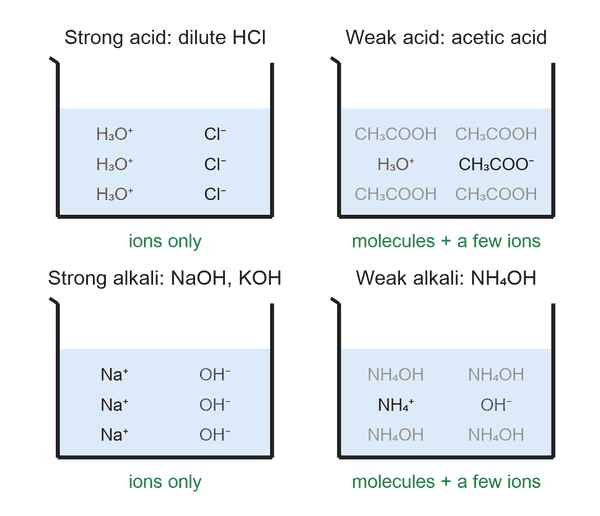
Watch out: Strictly, the small amount of calcium hydroxide that does dissolve is almost fully dissociated; its solution is weakly alkaline because so little dissolves. Ammonium hydroxide is the true example of a weak (feebly ionised) alkali.
Therefore, an alkali is a base soluble in water that gives OH⁻ as the only negative ions; (a) strong alkalis: NaOH, KOH; (b) weak alkalis: NH₄OH, Ca(OH)₂.
- 164 marks
Question 16
What is the difference between :
(a) an alkali and a base,
(b) the chemical nature of an aqueous solution of HCl and an aqueous solution of .
Solve with AIWritten solution
Solution:
Concept: Every alkali is a base, but only the water-soluble bases are alkalis. Whether a solution is acidic or basic depends on the ions it gives in water.
Step 1 — (a) Compare a base and an alkali.
We compare the two on what they are and on solubility in water:
Base Alkali A metallic oxide or hydroxide (or ammonium hydroxide) that reacts with an acid to give salt and water only. A base which is soluble in water and gives ions as the only negative ions. May or may not dissolve in water, e.g. , (insoluble). Always soluble, e.g. , . 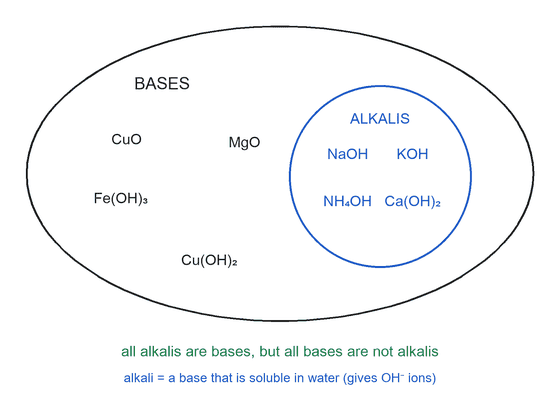
Step 2 — (b) Aqueous HCl.
Hydrogen chloride ionises in water and gives ions, so its solution is acidic: it turns blue litmus red and has a pH below 7.
Step 3 — (b) Aqueous ammonia.
Ammonia dissolves in water to form ammonium hydroxide, which produces ions, so its solution is basic (alkaline): it turns red litmus blue and has a pH above 7.
Aqueous ammonia is a weak alkali (only partly ionised), while aqueous HCl is a strong acid (almost fully ionised).
Therefore, (a) all alkalis are bases, but only bases soluble in water are alkalis; (b) aqueous HCl is acidic (gives H₃O⁺ ions), while aqueous NH₃ is basic (gives OH⁻ ions).
- 172 marks
Question 17
Name the ions furnished by :
(a) bases in solution,
(b) an acid.
Solve with AIWritten solution
Solution:
Concept: In water, bases (alkalis) give hydroxyl ions and acids give hydronium ions.
Step 1 — (a) Bases in solution.
A soluble base dissociates and gives hydroxyl ions, , for example:
Step 2 — (b) An acid.
An acid ionises in water and gives hydronium ions, (an ion joined to a water molecule), for example:

Therefore, (a) bases furnish hydroxyl ions, OH⁻; (b) acids furnish hydronium ions, H₃O⁺.
- 185 marks
Question 18
Give one example in each case :
(a) A basic oxide which is soluble in water,
(b) A hydroxide which is highly soluble in water,
(c) A basic oxide which is insoluble in water,
(d) A hydroxide which is insoluble in water,
(e) A weak mineral acid,
(f) A base which is not an alkali,
(g) An oxide which is a base,
(h) A hydrogen containing compound which is not an acid,
(i) A base which does not contain a metal ion.
Solve with AIWritten solution
Solution:
Concept: Only the oxides and hydroxides of the most active metals (sodium, potassium; calcium slightly) dissolve in water. Ammonium hydroxide is the one common base with no metal in it.
Step 1 — (a) A basic oxide soluble in water.
Sodium oxide, , dissolves in water to give an alkali:
Step 2 — (b) A highly soluble hydroxide.
Sodium hydroxide, , dissolves very readily in water.
Step 3 — (c) A basic oxide insoluble in water.
Copper (II) oxide, , is a base that does not dissolve in water.
Step 4 — (d) A hydroxide insoluble in water.
Copper (II) hydroxide, , is an insoluble pale-blue solid.
Step 5 — (e) A weak mineral acid.
Carbonic acid, , is a mineral (inorganic) acid that ionises only slightly.
Step 6 — (f) A base which is not an alkali.
Iron (III) hydroxide, , is a base but is insoluble in water, so it is not an alkali.
Step 7 — (g) An oxide which is a base.
Calcium oxide, , is a metallic oxide that neutralises acids to give salt and water.
Step 8 — (h) A hydrogen-containing compound which is not an acid.
Ammonia, (or methane, ), contains hydrogen but gives no ions in water.
Step 9 — (i) A base which does not contain a metal ion.
Ammonium hydroxide, : its positive ion is , not a metal ion.

Watch out: Containing hydrogen does not make a compound an acid; it must give ions in water.
Therefore, (a) Na₂O, (b) NaOH, (c) CuO, (d) Cu(OH)₂, (e) H₂CO₃, (f) Fe(OH)₃, (g) CaO, (h) NH₃, (i) NH₄OH.
- 192 marks
Question 19
You have been provided with three test tubes. One of them contains distilled water and the other two have an acidic solution and a basic solution respectively. If you are given only red litmus paper, how will you identify the contents of each test tube?
Solve with AIWritten solution
Solution:
Concept: Red litmus can pick out only the base. But once a strip has turned blue, that same strip can pick out the acid.
Step 1 — Find the basic solution.
We dip a strip of red litmus paper into each test tube. The solution that turns it blue is the basic solution; the other two leave it red.
Step 2 — Find the acidic solution.
We now dip this blue litmus strip into the other two test tubes. The solution that turns it red again is the acidic solution.
Step 3 — Identify the water.
The solution that causes no change in either step is distilled water, which is neutral.
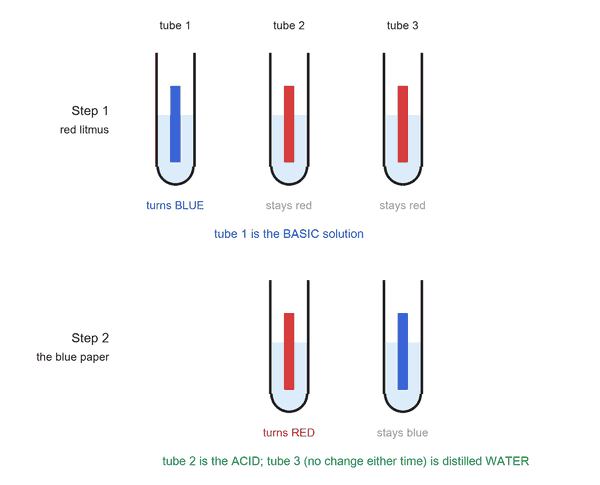
Watch out: The blue strip must be the one turned blue by the base in Step 1; no blue litmus is supplied.
Therefore, the tube that turns red litmus blue holds the base, the tube that turns that blue strip red holds the acid, and the tube that changes neither holds distilled water.
- 202 marks
Question 20
HCl, , , all contain H atoms but only HCl and show acidic character. Why ?
Solve with AIWritten solution
Solution:
Concept: Acidic character comes from producing ions in water, not merely from containing hydrogen atoms.
Step 1 — Why HCl and HNO₃ are acidic.
Hydrogen chloride and nitric acid ionise in water and give hydronium ions:
Step 2 — Why ethanol and glucose are not acidic.
Ethanol () and glucose () are covalent compounds whose hydrogen atoms are not ionisable. They dissolve in water as whole molecules and do not produce ions, so they do not turn blue litmus red.
Watch out: The –OH group of ethanol and glucose is not a hydroxide ion either; these compounds are neither acids nor bases.
Therefore, only HCl and HNO₃ show acidic character, because only they ionise in water to give H₃O⁺ ions; ethanol and glucose do not ionise.
- 215 marks
Question 21
(a) Dry HCl gas does not change the colour of dry litmus paper. Why ?
(b) Is a base or not ? Comment.
(c) Do basic solutions also have (aq) ? Explain why are they basic by taking an example?
Solve with AIWritten solution
Solution:
Concept: Acidic or basic behaviour shows only through ions in water; and a true base must give salt and water only with an acid.
Step 1 — (a) Dry HCl gas and dry litmus.
Dry hydrogen chloride is a covalent compound and contains no ions. It ionises only when water is present:
Dry litmus paper has no water, so no ions are formed and the colour does not change. (Moist blue litmus would turn red.)
Step 2 — (b) Is PbO₂ a base?
A base reacts with an acid to give salt and water only. Lead dioxide with hydrochloric acid gives chlorine as well:
Because a third product (chlorine) is formed, does not fit the definition of a base: it is not a base (it behaves as an oxidising agent).
Step 3 — (c) H⁺ ions in basic solutions.
Yes. Water itself ionises very slightly, so every aqueous solution contains some and some ions. In pure water both are mol per litre at 25 °C.
Step 4 — (c) Why a solution such as NaOH is basic.
Sodium hydroxide adds a large number of ions:
The concentration falls but never becomes zero. A solution is basic when its concentration is greater than its concentration, and that is the case here (pH above 7).
Watch out: A basic solution is not one with no ions; it is one with more ions than ions.
Therefore, (a) dry HCl has no ions, so dry litmus is unchanged; (b) PbO₂ is not a base, as it gives chlorine besides salt and water; (c) yes, basic solutions contain some H⁺(aq), but they are basic because [OH⁻] is greater than [H₃O⁺].
- 225 marks
Question 22
How would you obtain :
(a) a base from another base,
(b) an alkali from a base,
(c) salt from another salt ?
Solve with AIWritten solution
Solution:
Concept: A soluble base (alkali) precipitates an insoluble base from a salt solution; a soluble basic oxide dissolves in water to give an alkali; two soluble salts can exchange ions to precipitate a new salt.
Step 1 — (a) A base from another base.
We add sodium hydroxide solution (a base) to copper sulphate solution. A pale blue precipitate of copper (II) hydroxide (another base) forms:
Step 2 — (b) An alkali from a base.
We dissolve a soluble basic oxide in water; sodium oxide gives the alkali sodium hydroxide:
Step 3 — (c) A salt from another salt.
We mix solutions of two soluble salts so that an insoluble salt is precipitated (double decomposition). A white precipitate of silver chloride forms, which is filtered, washed and dried:
Therefore, (a) NaOH + CuSO₄ gives the base Cu(OH)₂; (b) Na₂O + water gives the alkali NaOH; (c) AgNO₃ + NaCl gives the salt AgCl by precipitation.
- 235 marks
Question 23
Write balanced equations to satisfy each statement.
(a) Acid + Active metal Salt + Hydrogen
(b) Acid + Base Salt + Water
(c) Acid + Carbonate or bicarbonate Salt + Water + Carbon dioxide
(d) Acid + Sulphite or bisulphite Salt + Water + Sulphur dioxide
(e) Acid + Sulphide Salt + Hydrogen Sulphide
Solve with AIWritten solution
Solution:
Concept: These are the typical reactions of dilute acids. In each, the hydrogen of the acid is replaced by a metal to give a salt; what else forms depends on what the acid reacts with.
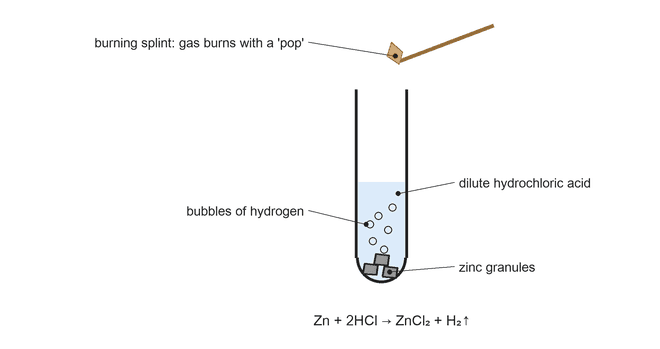
Step 1 — (a) Acid + active metal → salt + hydrogen.
Zinc, an active metal, displaces hydrogen from dilute hydrochloric acid; the gas burns with a 'pop' sound:
Step 2 — (b) Acid + base → salt + water.
Sodium hydroxide is neutralised by hydrochloric acid:
Step 3 — (c) Acid + carbonate or bicarbonate → salt + water + carbon dioxide.
A carbonate and a bicarbonate each give carbon dioxide, which turns lime water milky:
Step 4 — (d) Acid + sulphite or bisulphite → salt + water + sulphur dioxide.
A sulphite and a bisulphite each give sulphur dioxide, which has the suffocating smell of burning sulphur:
Step 5 — (e) Acid + sulphide → salt + hydrogen sulphide.
Iron (II) sulphide with dilute sulphuric acid gives hydrogen sulphide, which smells of rotten eggs:
Watch out: A carbonate needs 2HCl but a bicarbonate needs only HCl; check the balance of each equation.
Therefore, the five equations are Zn + 2HCl → ZnCl₂ + H₂; NaOH + HCl → NaCl + H₂O; CaCO₃ + 2HCl → CaCl₂ + H₂O + CO₂; Na₂SO₃ + 2HCl → 2NaCl + H₂O + SO₂; FeS + H₂SO₄ → FeSO₄ + H₂S.
- 242 marks
Question 24
The skin has and needs natural oils. Why is it advisable to wear gloves while working with strong alkalis ?
Solve with AIWritten solution
Solution:
Concept: Strong alkalis are corrosive, and they react with oils and fats.
Step 1 — What a strong alkali does to the skin.
Strong alkalis such as caustic soda () and caustic potash () react with the natural oils of the skin and turn them into soap; this reaction is called saponification.
Step 2 — Why that harms the skin.
The skin loses the oils it needs for protection, becomes dry and rough, and is burnt (corroded) by the alkali.
Step 3 — Why gloves help.
Wearing gloves keeps the alkali away from the skin, so the natural oils are not destroyed.
Therefore, gloves are worn because strong alkalis turn the skin's natural oils into soap and corrode the skin.
- 254 marks
Question 25
Complete the table :
Indicator Neutral Acidic Alkaline Litmus Purple .......... .......... Phenolphthalein Colourless .......... .......... Solve with AIWritten solution
Solution:
Concept: Litmus is purple in a neutral solution, turns red in acid and blue in alkali. Phenolphthalein is colourless in neutral and acidic solutions and turns pink only in an alkali.
Step 1 — Fill in litmus.
Litmus changes colour on both sides of neutral, so it is red in an acid and blue in an alkali.
Step 2 — Fill in phenolphthalein.
Phenolphthalein changes colour only in an alkali, so it stays colourless in an acid and turns pink in an alkali.
Step 3 — Write the completed table.
Putting both rows together:
Indicator Neutral Acidic Alkaline Litmus Purple Red Blue Phenolphthalein Colourless Colourless Pink 
Watch out: Phenolphthalein cannot tell a neutral solution from an acidic one (both colourless); litmus can tell all three apart.
Therefore, litmus is red in acid and blue in alkali; phenolphthalein is colourless in acid and pink in alkali.
- 262 marks
Question 26
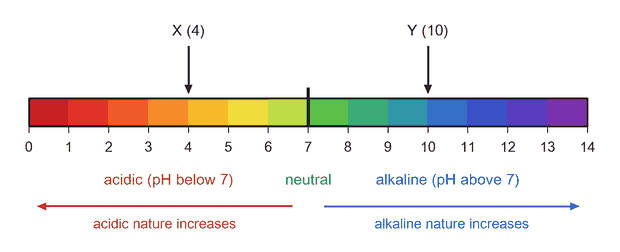
What do you understand by pH value ? Two solutions X and Y have pH values of 4 and 10 respectively. Which one of these two will give a pink colour with phenolphthalein indicator ?
Solve with AIWritten solution
Solution:
Concept: PH below 7 is acidic, 7 is neutral and above 7 is alkaline. Phenolphthalein turns pink only in an alkaline solution.
Step 1 — Define pH.
The pH of a solution is the negative logarithm to the base 10 of the hydrogen ion concentration, expressed in moles per litre:
It is a number, usually from 0 to 14, that tells how acidic or alkaline a solution is. For example, when mol/L, the pH is 4.
Step 2 — Classify X and Y.
X has pH 4, which is below 7, so X is acidic. Y has pH 10, which is above 7, so Y is alkaline.
Step 3 — Decide which gives a pink colour.
Phenolphthalein turns pink only in an alkali, so the alkaline solution Y gives the pink colour; X leaves phenolphthalein colourless.
Watch out: A lower pH means a higher concentration (more acidic), not less.
Therefore, pH is the negative logarithm of the hydrogen ion concentration, and solution Y (pH 10) gives a pink colour with phenolphthalein.
- 275 marks
Question 27
M is an element in the form of a powder. M burns in oxygen and the product obtained is soluble in water. The solution is tested with litmus. Write down only the word which will correctly complete each of the following sentences.
(a) If M is a metal, then the litmus will turn ..........
(b) If M is a non-metal, then the litmus will turn ..........
(c) If M is a reactive metal, then .......... will be evolved when M reacts with dilute sulphuric acid.
(d) If M is a metal, it will form .......... oxide, which will form .......... solution with water.
(e) If M is a non-metal, it will not conduct electricity in the form of ..........
Solve with AIWritten solution
Solution:
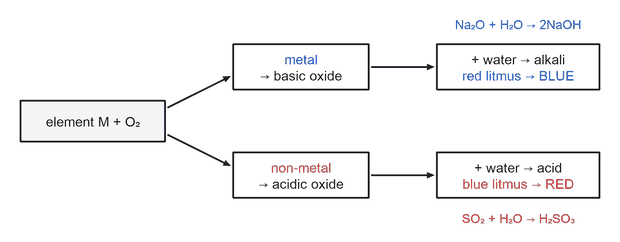
Concept: Metals form basic oxides, which give alkaline solutions; non-metals form acidic oxides, which give acidic solutions.
Step 1 — (a) M is a metal.
The metal oxide dissolves to give an alkali, e.g. , so the litmus will turn blue.
Step 2 — (b) M is a non-metal.
The non-metal oxide dissolves to give an acid, e.g. , so the litmus will turn red.
Step 3 — (c) M is a reactive metal.
A reactive metal displaces hydrogen from dilute sulphuric acid:
Step 4 — (d) The oxide of a metal.
A metal forms a basic oxide, which forms an alkaline solution with water.
Step 5 — (e) Conduction by a non-metal.
Non-metals have no free electrons, so M will not conduct electricity in the form of a powder (the form in which M is given here).
Therefore, the words are (a) blue, (b) red, (c) hydrogen, (d) basic, alkaline, (e) powder.
- 285 marks
Question 28
Distinguish between :
(a) a common acid base indicator and a universal indicator,
(b) acidity of bases and basicity of acids,
(c) acid and alkali (other than indicators).
Solve with AIWritten solution
Solution:
Concept: To distinguish two things, compare them on the same point, one point at a time.
Step 1 — (a) Common indicator and universal indicator.
A common indicator only says acid or base, while a universal indicator also says how strong:
Common acid–base indicator Universal indicator A single dye, e.g. litmus, methyl orange. A mixture of several indicator dyes. Shows only whether a solution is acidic or basic. Gives a different colour at each pH, so shows how acidic or basic it is. 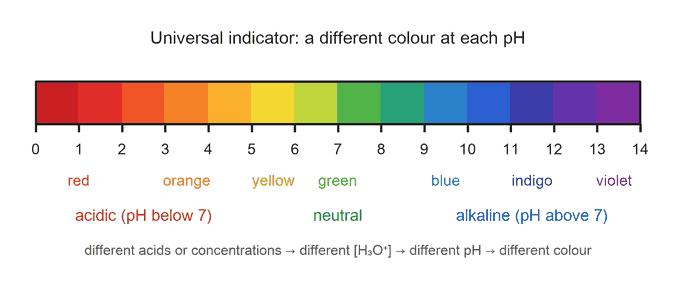
Step 2 — (b) Acidity of bases and basicity of acids.
Both count ions from one molecule, but different ions:
Acidity of a base Basicity of an acid The number of hydroxyl () ions one molecule of the base can produce, e.g. has acidity 2. The number of hydronium ions () one molecule of the acid can produce, e.g. has basicity 2. Step 3 — (c) Acid and alkali (other than indicators).
We compare the ions, taste and typical reactions:
Acid Alkali Gives ions in water; pH less than 7. Gives ions in water; pH more than 7. Sour in taste. Bitter in taste and soapy to touch. Reacts with active metals to give hydrogen. Reacts with ammonium salts on heating to give ammonia. Watch out: Never taste a laboratory acid or alkali; taste is listed only as a property described in books.
Therefore, (a) a universal indicator shows the pH, a common indicator only acid or base; (b) acidity counts OH⁻ ions per base molecule, basicity counts H₃O⁺ ions per acid molecule; (c) acids give H₃O⁺ (pH < 7), alkalis give OH⁻ (pH > 7).
- 292 marks
Question 29
What should be added to neutral solution in order to :
(a) increase the concentration of hydronium ions,
(b) decrease the concentration of hydronium ions
Solve with AIWritten solution
Solution:
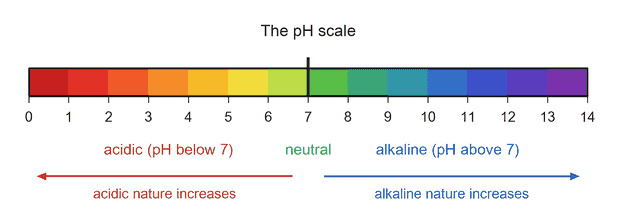
Concept: A neutral solution has pH 7. An acid adds ions; an alkali removes them, because its ions combine with to form water.
Step 1 — (a) Increase the hydronium ion concentration.
We add an acid (e.g. dilute hydrochloric acid). It ionises and adds ions, so the pH falls below 7:
Step 2 — (b) Decrease the hydronium ion concentration.
We add an alkali (e.g. sodium hydroxide solution). Its ions remove ions as water, so the pH rises above 7:
Therefore, (a) an acid is added to increase the H₃O⁺ concentration; (b) an alkali is added to decrease it.
- 302 marks
Question 30
How does tooth enamel get damaged ? What should be done to prevent it ?
Solve with AIWritten solution
Solution:
Concept: Acid formed in the mouth lowers the pH, and below a certain pH the tooth enamel is attacked.
Step 1 — Where the acid comes from.
Sugary food (sweets, chocolates) left on the teeth is broken down by bacteria in the mouth, and this produces acids.
Step 2 — How the enamel is damaged.
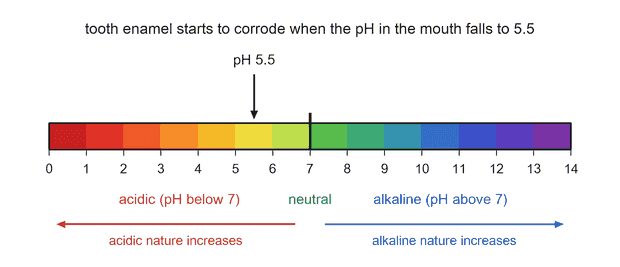
When the pH in the mouth falls to about 5.5, the tooth enamel (calcium phosphate, the hardest substance in the body) starts to corrode, and tooth decay begins.
Step 3 — How to prevent it.
We brush the teeth regularly with toothpaste, which is alkaline; it neutralises the excess acid and raises the pH. Rinsing the mouth after eating sweets also leaves less sugar for the bacteria.
Watch out: Saliva is close to neutral (about pH 6.5–7.5); it helps a little, but brushing with an alkaline toothpaste is what neutralises the acid.
Therefore, enamel is corroded when bacterial acids lower the mouth's pH to about 5.5, and it is protected by brushing with alkaline toothpaste and rinsing after sweets.
- 312 marks
Question 31
When you use universal indicator, you see that solutions of different acids produce different colours. Indeed, solutions of the same acid with different concentrations will also give different colours. Why ?
Solve with AIWritten solution
Solution:
Concept: Universal indicator responds to the hydronium ion concentration (pH) of the solution, not to the name of the acid.
Step 1 — What universal indicator is.
Universal indicator is a mixture of dyes that shows a different colour at each pH.
Step 2 — Different acids.
Different acids ionise to different extents (strong acids almost fully, weak acids only slightly), so at the same concentration they give different amounts of .
Step 3 — The same acid at different concentrations.
A more concentrated solution of the same acid gives more ions per litre than a dilute one.
Step 4 — Link to the colour.
In both cases the concentration of ions, and so the pH, is different, so the indicator shows a different colour.
Therefore, the colours differ because different acids, or different concentrations of one acid, give different H₃O⁺ concentrations, that is, different pH values.
- 325 marks
Question 32
You are supplied with five solutions : A, B, C, D and E with pH values as follows:
A = 1·8, B = 7, C = 8·5, D = 13, and E = 5
Classify these solutions as neutral, slightly or strongly acidic and slightly or strongly alkaline.
Which solution would be most likely to liberate hydrogen with :
(a) magnesium powder, (b) powdered zinc metal ?
Give a word equation for each reaction.
Solve with AIWritten solution
Solution:
Concept: The further the pH is from 7, the stronger the acid or alkali. A strong acid gives hydrogen with active metals; zinc, being amphoteric, also gives hydrogen with a strong alkali.
Step 1 — Classify the five solutions.
We compare each pH with 7:
Solution pH Nature A 1·8 strongly acidic B 7 neutral C 8·5 slightly alkaline D 13 strongly alkaline E 5 slightly acidic 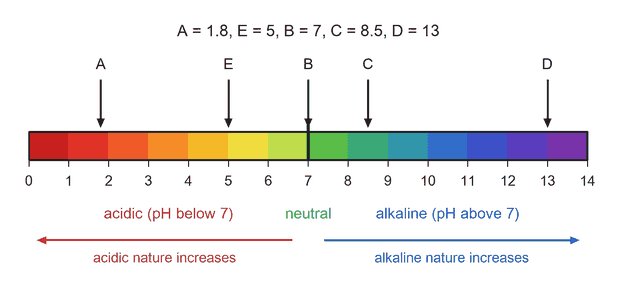
Step 2 — (a) Magnesium powder.
Magnesium is an active metal and displaces hydrogen most readily from the strong acid, solution A. Taking A as dilute hydrochloric acid:
magnesium + hydrochloric acid → magnesium chloride + hydrogen
Step 3 — (b) Powdered zinc.
Unlike magnesium, zinc also liberates hydrogen from a strong alkali, so the solution that suits zinc in particular is solution D. Taking D as sodium hydroxide solution:
zinc + sodium hydroxide → sodium zincate + hydrogen
Watch out: Zinc also gives hydrogen with the strong acid A (zinc + hydrochloric acid → zinc chloride + hydrogen); D is the answer that shows zinc's special (amphoteric) behaviour.
Therefore, A is strongly acidic, B neutral, C slightly alkaline, D strongly alkaline and E slightly acidic; (a) magnesium – solution A; (b) zinc – solution D.
- 333 marks
Question 33
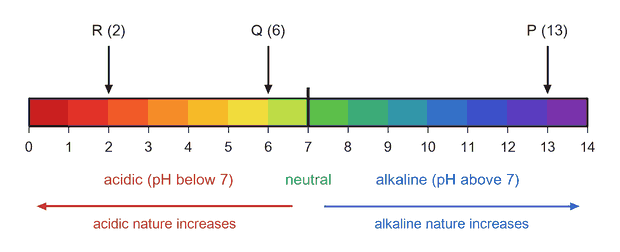
Solution P has a pH of 13, solution Q has a pH of 6 and solution R has a pH of 2. Which solution :
(a) will liberate ammonia from ammonium sulphate on heating ?
(b) is a strong acid ?
(c) contains molecules as well as ions ?
Solve with AIWritten solution
Solution:
Concept: PH 13 is a strong alkali, pH 6 a weak (slightly) acidic solution and pH 2 a strong acid.
Step 1 — Place the three solutions on the pH scale.
P (pH 13) is far above 7, Q (pH 6) is just below 7 and R (pH 2) is far below 7.
Step 2 — (a) Ammonia from ammonium sulphate.
An alkali heated with an ammonium salt liberates ammonia, so the answer is the alkali P:
Step 3 — (b) The strong acid.
R (pH 2) is far below 7, so it is the strong acid.
Step 4 — (c) Molecules as well as ions.
Q (pH 6) is a weak acid; a weak acid is only partly ionised, so its solution contains un-ionised molecules as well as ions.
Therefore, (a) P, (b) R, (c) Q.
- 345 marks
Question 34
Select the word/s given which are required to correctly complete the blanks —
[ammonia, ammonium carbonate, carbon dioxide, hydrogen, hydronium, hydroxide, precipitate, salt, water]
(i) A solution M turns blue litmus red, so it must contain (1) .............. ions; another solution O turns red litmus blue and hence it must contain (2) .............. ions.
(ii) When solution M and O are mixed together, the products will be (3) .............. and (4) ..............
(iii) If a piece of magnesium was put into solution M, (5) .............. gas would be evolved.
Solve with AIWritten solution
Solution:
Concept: M turns blue litmus red, so it is an acid; O turns red litmus blue, so it is an alkali. When mixed, they neutralise each other.
Step 1 — (i) Ions in M and O.
An acid contains (1) hydronium ions, and an alkali contains (2) hydroxide ions.
Step 2 — (ii) Mixing M and O.
Neutralisation gives (3) salt and (4) water; the and ions join to form water:

Step 3 — (iii) Magnesium in M.
Magnesium, an active metal, displaces hydrogen from an acid, so (5) hydrogen gas is evolved.
Therefore, the blanks are (1) hydronium, (2) hydroxide, (3) salt, (4) water, (5) hydrogen.
- 355 marks
Question 35
Define the following and give two examples in each case : (a) a normal salt, (b) an acid salt, (c) a basic salt.
Solve with AIWritten solution
Solution:
Concept: Normal, acid and basic salts differ in how much of the acid's replaceable hydrogen (or the base's hydroxyl groups) has been replaced.
Step 1 — (a) Normal salt.
A normal salt is formed by the complete replacement of the ionisable hydrogen atoms of an acid by a metallic or ammonium ion. Examples: sodium chloride () and sodium sulphate ():
Step 2 — (b) Acid salt.
An acid salt is formed by the partial replacement of the ionisable hydrogen atoms of a polybasic acid by a metal or ammonium ion, so it still contains replaceable hydrogen. Examples: sodium hydrogen sulphate () and sodium hydrogen carbonate ():
Step 3 — (c) Basic salt.
A basic salt is formed by the partial replacement of the hydroxyl groups of a di- or tri-acidic base by an acid radical, so it still contains OH groups. Examples: basic lead chloride () and basic magnesium chloride ():

Watch out: An acid salt can come only from a polybasic acid (HCl can never give one), and a basic salt only from a base with two or more OH groups.
Therefore, (a) normal salt: all replaceable H replaced (NaCl, Na₂SO₄); (b) acid salt: part of the H replaced (NaHSO₄, NaHCO₃); (c) basic salt: part of the OH replaced (Pb(OH)Cl, Mg(OH)Cl).
- 365 marks
Question 36
Answer the following questions related to salts and their preparations :
(a) What is a 'salt' ?
(b) What kind of salt is prepared by precipitation?
(c) Name a salt prepared by direct combination. Write an equation for the reaction that takes place in preparing the salt you have named.
(d) Name the procedure used to prepare a sodium salt such as sodium sulphate.
Solve with AIWritten solution
Solution:
Concept: The method chosen for preparing a salt depends on whether the salt is soluble or insoluble in water and on the metal in it: sodium, potassium and ammonium salts by titration; salts of active metals (Mg, Zn, Fe) by displacement; salts of unreactive metals (Cu, Pb) from an insoluble base; insoluble salts by precipitation; anhydrous chlorides by direct combination.
Step 1 — (a) What a salt is.
A salt is a compound formed by the partial or total replacement of the ionisable hydrogen atoms of an acid by a metallic ion or an ammonium ion.
Step 2 — (b) Salts made by precipitation.
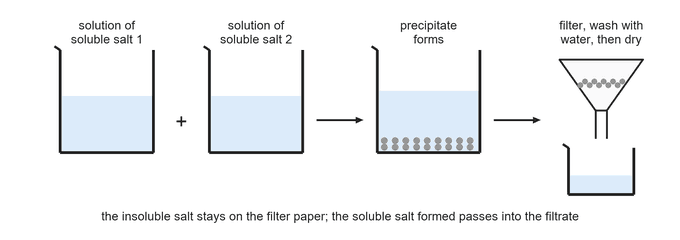
Insoluble salts (e.g. , , , ) are prepared by precipitation — mixing solutions of two soluble salts, then filtering, washing and drying:
Step 3 — (c) A salt made by direct combination.
Iron (III) chloride is made by heating iron in a stream of dry chlorine:
Step 4 — (d) Preparing a sodium salt.
Sodium sulphate is made by titration — neutralising an alkali (sodium hydroxide) with the dilute acid (sulphuric acid). Both are soluble, so the exact volumes are first found using an indicator.
Therefore, (a) a salt is formed when the ionisable H of an acid is replaced by a metal or ammonium ion; (b) insoluble salts; (c) FeCl₃: 2Fe + 3Cl₂ → 2FeCl₃; (d) titration (neutralisation of an alkali).
- 375 marks
Question 37
Explain the following methods with examples.
(a) Direct combination
(b) Displacement
(c) Double decomposition (precipitation)
(d) Neutralisation of insoluble base
(e) Neutralisation of an alkali (titration)
Solve with AIWritten solution
Solution:
Concept: The method chosen for preparing a salt depends on whether the salt is soluble or insoluble in water and on the metal in it: sodium, potassium and ammonium salts by titration; salts of active metals (Mg, Zn, Fe) by displacement; salts of unreactive metals (Cu, Pb) from an insoluble base; insoluble salts by precipitation; anhydrous chlorides by direct combination.
Step 1 — (a) Direct combination (synthesis).
The metal and the non-metal combine directly to give the salt. It is used for anhydrous chlorides and sulphides:
Step 2 — (b) Displacement.
An active metal (Mg, Zn, Fe) displaces hydrogen from a dilute acid, giving a soluble salt:
Step 3 — (c) Double decomposition (precipitation).
Solutions of two soluble salts are mixed; the ions exchange and an insoluble salt is precipitated, then filtered, washed and dried:
Step 4 — (d) Neutralisation of an insoluble base.
Excess of the insoluble base (oxide, hydroxide or carbonate) is added to a warm dilute acid; the excess is filtered off and the filtrate is evaporated and crystallised:
Step 5 — (e) Neutralisation of an alkali (titration).
The exact volumes of acid and alkali that neutralise each other are found using an indicator. The same volumes are then mixed without the indicator and the solution is evaporated. It is used for sodium, potassium and ammonium salts:

Watch out: In method (d) the base is taken in excess so that no acid is left; in method (e) neither reactant can be in excess, because a soluble excess cannot be filtered off.
Therefore, the five methods are direct combination (FeCl₃), displacement (ZnSO₄), precipitation (PbCl₂), neutralisation of an insoluble base (CuSO₄) and titration (Na₂SO₄).
- 385 marks
Question 38
How would you prepare :
(a) copper sulphate crystals from a mixture of charcoal and black copper oxide,
(b) zinc sulphate crystals from zinc dust (powdered zinc and zinc oxide),
(c) sodium hydrogen carbonate crystals.
(d) Calcium sulphate from calcium carbonate.
Solve with AIWritten solution
Solution:
Concept: Choose a reaction in which the unwanted solids can be filtered off, and avoid reactions that form an insoluble coating.
Step 1 — (a) Copper sulphate crystals from charcoal and copper oxide.
We warm the mixture with dilute sulphuric acid. Copper oxide (a base) reacts; charcoal (carbon) does not:
We filter off the charcoal (and any unreacted copper oxide), concentrate the blue filtrate by heating and cool it to get blue crystals of .
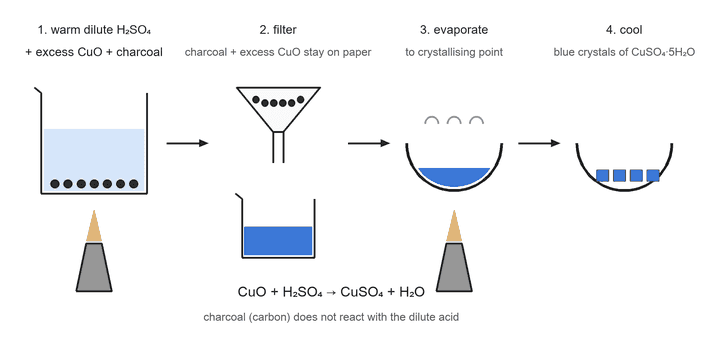
Step 2 — (b) Zinc sulphate crystals from zinc dust.
We add the zinc dust a little at a time to warm dilute sulphuric acid until no more dissolves. Both zinc and zinc oxide give zinc sulphate:
We filter off the excess solid, then concentrate and cool the filtrate to get white crystals of .
Step 3 — (c) Sodium hydrogen carbonate crystals.
We pass carbon dioxide through a cold, concentrated solution of sodium carbonate kept in ice. Sodium hydrogen carbonate is less soluble, so it crystallises out; we filter and dry the crystals:
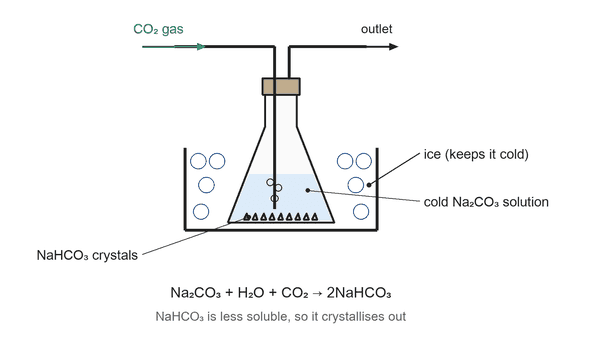
Step 4 — (d) Calcium sulphate from calcium carbonate: first dissolve the carbonate.
Dilute sulphuric acid cannot be used directly, because calcium sulphate is only sparingly soluble and would coat the carbonate and stop the reaction. So we first dissolve the calcium carbonate in dilute hydrochloric acid to get soluble calcium chloride:
Step 5 — (d) Then precipitate calcium sulphate.
We add sodium sulphate solution; calcium sulphate precipitates and is filtered, washed and dried:

Watch out: In (d), adding dilute straight to gives almost no product, because the reaction stops behind the calcium sulphate layer.
Therefore, (a) warm with dilute H₂SO₄, filter off charcoal, crystallise CuSO₄·5H₂O; (b) dissolve in dilute H₂SO₄, filter, crystallise ZnSO₄·7H₂O; (c) pass CO₂ into cold Na₂CO₃ solution; (d) CaCO₃ → CaCl₂ (dil. HCl) → CaSO₄ (Na₂SO₄ solution).
- 395 marks
Question 39
The following is a list of methods for the preparation of salts.
A – direct combination of two elements.
B – reaction of a dilute acid with a metal.
C – reaction of a dilute acid with an insoluble base.
D – titration of a dilute acid with a solution of soluble base.
E – reaction of two solutions of salts to form a precipitate.
Choose from the above list A to E, the best method for preparing the following salts by giving a suitable equation in each case :
-
Anhydrous ferric chloride,
-
Lead chloride,
-
Sodium sulphate,
-
Copper sulphate.
Solve with AIWritten solution
Solution:
Concept: Anhydrous chlorides are made by direct combination; insoluble salts by precipitation; sodium salts by titration; salts of unreactive metals such as copper from an insoluble base.
Step 1 — 1. Anhydrous ferric chloride — A.
Iron is heated in dry chlorine (direct combination); any water would spoil the anhydrous salt:
Step 2 — 2. Lead chloride — E.
Lead chloride is insoluble in cold water, so it is precipitated from two salt solutions:
Step 3 — 3. Sodium sulphate — D.
Both reactants are soluble, so the exact volumes are found by titration:
Step 4 — 4. Copper sulphate — C.
Copper is below hydrogen and does not react with dilute acids, so its insoluble oxide is used:
Watch out: Method B (metal + dilute acid) does not work for copper, and is dangerous for sodium.
Therefore, 1 – A, 2 – E, 3 – D, 4 – C.
-
- 405 marks
Question 40
Name :
(a) a chloride which is insoluble in cold water but dissolves in hot water,
(b) a chloride which is insoluble,
(c) two sulphates which are insoluble,
(d) a basic salt,
(e) an acidic salt,
(f) a mixed salt,
(g) a complex salt,
(h) a double salt
Solve with AIWritten solution
Solution:
Concept: Recall the solubility of common chlorides and sulphates, and the kinds of salts (normal, acid, basic, mixed, complex, double).
Step 1 — (a) A chloride insoluble in cold water but soluble in hot water.
Lead chloride, , dissolves in hot water and crystallises out again on cooling.
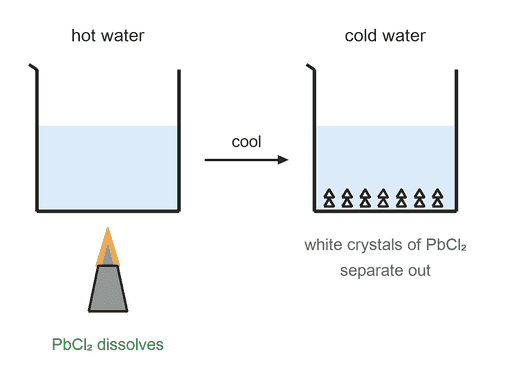
Step 2 — (b) An insoluble chloride.
Silver chloride, , is insoluble in hot and cold water.
Step 3 — (c) Two insoluble sulphates.
Barium sulphate, , and lead sulphate, .
Step 4 — (d) A basic salt.
Basic lead chloride, — it still has an OH group.
Step 5 — (e) An acid salt.
Sodium hydrogen sulphate, — it still has a replaceable H.
Step 6 — (f) A mixed salt.
A mixed salt has two different metal ions or two different acid radicals: sodium potassium carbonate, (or bleaching powder, ).
Step 7 — (g) A complex salt.
A complex salt gives a complex ion in solution: tetrammine copper (II) sulphate, .
Step 8 — (h) A double salt.
A double salt is two normal salts crystallised together: potash alum, .
Watch out: A double salt gives only simple ions in solution, while a complex salt keeps its complex ion.
Therefore, (a) PbCl₂, (b) AgCl, (c) BaSO₄ and PbSO₄, (d) Pb(OH)Cl, (e) NaHSO₄, (f) NaKCO₃, (g) [Cu(NH₃)₄]SO₄, (h) potash alum.
- 414 marks
Question 41
Fill in the blanks with suitable words :
An acid is a compound which when dissolved in water forms hydronium ions as the only ................ ions. A base is a compound which is soluble in water contains ................ ions. A base reacts with an acid to form a ................ and water only. This type of reaction is known as ..............
Solve with AIWritten solution
Solution:
Concept: Acids give as the only positive ions; alkalis give ions; together they neutralise each other to form salt and water.
Step 1 — The ions from an acid.
An acid forms hydronium ions as the only positive ions in water.
Step 2 — The ions from a soluble base.
A base that is soluble in water contains hydroxyl () ions.
Step 3 — The reaction of a base with an acid.
A base reacts with an acid to form a salt and water only, and this reaction is called neutralisation, for example:
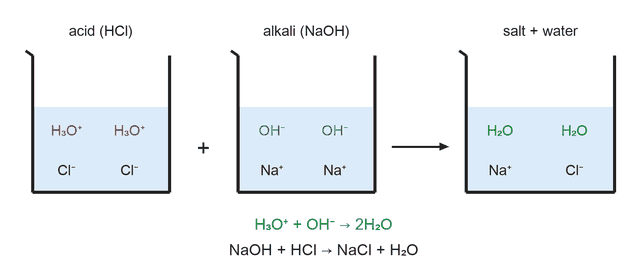
Therefore, the blanks are positive, hydroxyl (OH⁻), salt, neutralisation.
- 425 marks
Question 42
What would you observe when :
(a) blue litmus is introduced into a solution of hydrogen chloride gas,
(b) red litmus paper is introduced into a solution of ammonia in water,
(c) red litmus paper is introduced in caustic soda solution ?
Solve with AIWritten solution
Solution:
Concept: Acids turn blue litmus red; alkalis turn red litmus blue.
Step 1 — (a) Blue litmus in hydrogen chloride solution.
Hydrogen chloride dissolves in water to form hydrochloric acid. This acid produces ions, so the blue litmus turns red:
Step 2 — (b) Red litmus in ammonia solution.
Ammonia in water forms ammonium hydroxide, a weak alkali that gives ions, so the red litmus turns blue:
Step 3 — (c) Red litmus in caustic soda solution.
Caustic soda (sodium hydroxide) is a strong alkali, so the red litmus turns blue:
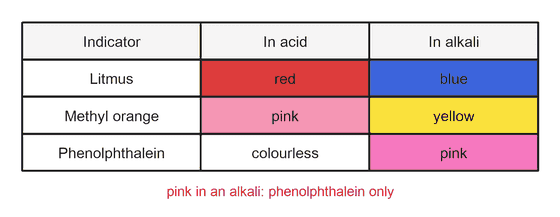
Therefore, (a) blue litmus turns red; (b) red litmus turns blue; (c) red litmus turns blue.
- 435 marks
Question 43
Explain why :
(a) it is necessary to find out the ratio of reactants required in the preparation of sodium sulphate,
(b) fused calcium chloride is used in the preparation of ?
(c) Anhydrous cannot be prepared by heating hydrated Iron (III) chloride.
Solve with AIWritten solution
Solution:
Concept: Soluble reactants cannot be separated from the product by filtration; iron (III) chloride is deliquescent and its hydrate decomposes on heating.
Step 1 — (a) The ratio of reactants for sodium sulphate.
Sodium hydroxide and sulphuric acid are both soluble. If either is in excess, it cannot be removed by filtration and stays in the salt as an impurity. So the exact ratio needed for complete neutralisation is first found on a small scale by titration, and the same ratio is then used to make the salt:
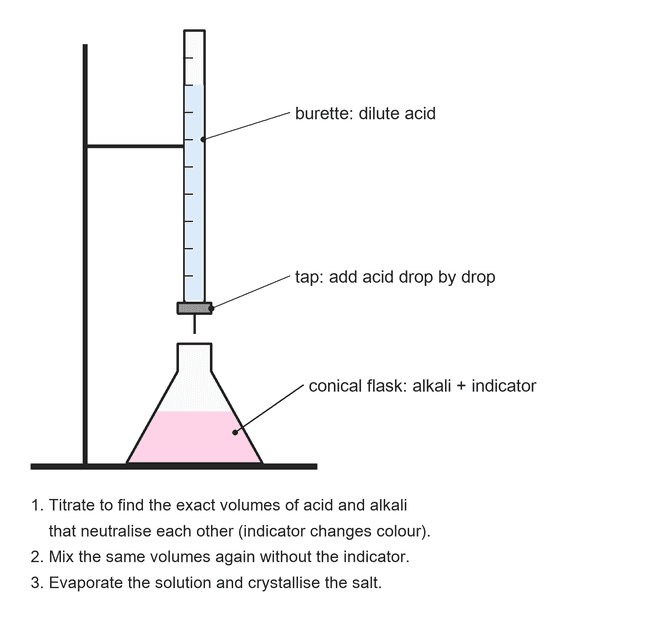
Step 2 — (b) Fused calcium chloride in the preparation of FeCl₃.
Iron (III) chloride is highly deliquescent: it absorbs moisture from the air and dissolves in it. Fused calcium chloride is a drying agent; placed in the guard tube, it stops moisture from the air entering the receiver, so the iron (III) chloride stays dry (anhydrous).
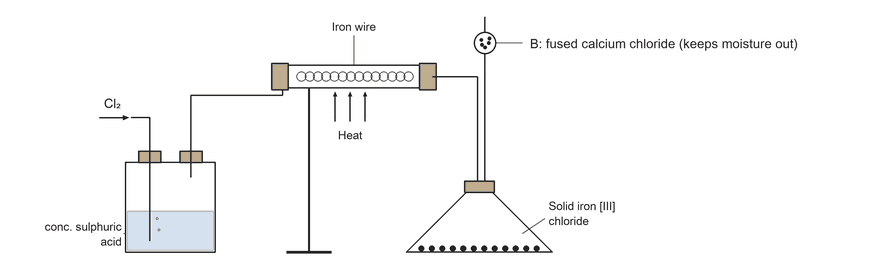
Step 3 — (c) Heating hydrated iron (III) chloride.
On heating, hydrated iron (III) chloride does not simply lose its water. It decomposes into iron (III) oxide, water and hydrogen chloride, so no anhydrous iron (III) chloride is left:
Therefore, (a) any excess of a soluble reactant cannot be filtered off, so the exact ratio is found by titration; (b) fused CaCl₂ keeps moisture away from the deliquescent FeCl₃; (c) the hydrate decomposes to Fe₂O₃ and HCl instead of losing only water.
- 445 marks
Question 44
Match the salts given in column A to their methods of preparation in column B. Write a balanced equation for each preparation.
Column A Column B Zinc sulphate Precipitation Ferrous sulphide Oxidation Barium sulphate Displacement Ferric sulphate Neutralisation Sodium sulphate Synthesis. Solve with AIWritten solution
Solution:
Concept: Match each salt to the reaction that gives it pure: an active metal's salt by displacement, a sulphide by synthesis, an insoluble sulphate by precipitation, an iron (III) salt by oxidation of the iron (II) salt, and a sodium salt by neutralisation.
Step 1 — Zinc sulphate — Displacement.
Zinc displaces hydrogen from dilute sulphuric acid:
Step 2 — Ferrous sulphide — Synthesis.
Iron and sulphur combine directly on heating:
Step 3 — Barium sulphate — Precipitation.
Barium sulphate is insoluble, so it is precipitated from two salt solutions:
Step 4 — Ferric sulphate — Oxidation.
Iron (II) sulphate is oxidised in the presence of sulphuric acid (for example by the nascent oxygen from concentrated nitric acid):
Step 5 — Sodium sulphate — Neutralisation.
Sodium hydroxide is neutralised by dilute sulphuric acid (by titration):
Therefore, zinc sulphate – displacement, ferrous sulphide – synthesis, barium sulphate – precipitation, ferric sulphate – oxidation, sodium sulphate – neutralisation.
- 454 marks
Question 45
(a) Give the pH value of pure water. Does it change if common salt is added to it ?
(b) Classify the following solutions as acids, bases or salts.
Ammonium hydroxide, barium chloride, sodium chloride, sodium hydroxide, and .
Solve with AIWritten solution
Solution:
Concept: Pure water is neutral. A salt of a strong acid and a strong base gives a neutral solution, so it does not change the pH.
Step 1 — (a) pH of pure water.
Pure water is neutral, so its pH is 7.
Step 2 — (a) Effect of adding common salt.
Sodium chloride is the salt of a strong acid (HCl) and a strong base (NaOH); it adds neither extra nor extra ions, so the pH does not change.
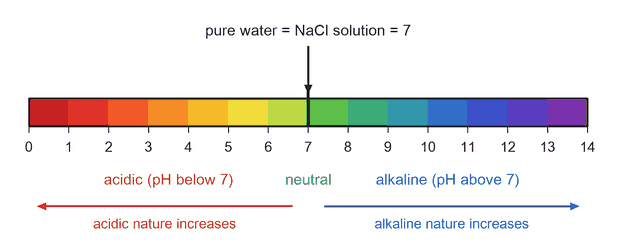
Step 3 — (b) Classify the solutions.
Acids give ions, bases give ions, and salts are made of a metal ion and an acid radical:
- Acids: ,
- Bases: ammonium hydroxide, sodium hydroxide
- Salts: barium chloride, sodium chloride
Therefore, (a) the pH of pure water is 7 and it stays 7 when common salt is added; (b) acids: H₂SO₄, HNO₃; bases: NH₄OH, NaOH; salts: BaCl₂, NaCl.
- 465 marks
Question 46
Complete the following table and write one equation for each to justify the statement :
Reactants Products Method Soluble base + Acid (dil) Salt + water Neutralisation Titration Metal + Non-metal Salt (soluble/insoluble) .................. Insoluble base + .......... Salt (soluble) + water .................. Active metal + Acid (dil) .......... + .......... .................. Soluble salt solution (A) + Soluble salt solution (B) Precipitated salt + Soluble salt .................. Carbonate/bicarbonate + Acid (dil) Salt + .......... + .......... Decomposition of carbonate Chlorides/nitrates + Acid (conc.) .......... + .......... Decomposition of chlorides and nitrates Solve with AIWritten solution
Solution:
Concept: Each row of the table is one general method of preparing salts; the equation for that row is one example of it.
Step 1 — Complete the table.
Filling each blank with the product or the name of the method gives:
Reactants Products Method Soluble base + Acid (dil) Salt + water Neutralisation Titration Metal + Non-metal Salt (soluble/insoluble) Direct combination (synthesis) Insoluble base + Acid (dil) Salt (soluble) + water Neutralisation of insoluble base Active metal + Acid (dil) Salt + Hydrogen Displacement Soluble salt solution (A) + Soluble salt solution (B) Precipitated salt + Soluble salt Precipitation (double decomposition) Carbonate/bicarbonate + Acid (dil) Salt + Water + Carbon dioxide Decomposition of carbonate Chlorides/nitrates + Acid (conc.) Salt (acid salt) + more volatile acid (HCl / HNO₃) Decomposition of chlorides and nitrates Step 2 — Equations for rows 1 to 3.
Titration, direct combination and neutralisation of an insoluble base:
Step 3 — Equations for rows 4 and 5.
Displacement and precipitation:
Step 4 — Equations for rows 6 and 7.
Decomposition of a carbonate by a dilute acid, and of a chloride by concentrated sulphuric acid:
Therefore, the blanks are: direct combination; dilute acid, neutralisation of an insoluble base; salt + hydrogen, displacement; precipitation; water + carbon dioxide; salt + volatile acid (HCl or HNO₃).
- 475 marks
Question 47
Write the balanced equations for the preparation of the following salts in the laboratory :
(a) A soluble sulphate by the action of an acid on an insoluble base,
(b) An insoluble salt by the action of an acid on another salt,
(c) An insoluble base by the action of a soluble base on a soluble salt,
(d) A soluble sulphate by the action of an acid on a metal.
Solve with AIWritten solution
Solution:
Concept: Pick a reaction of exactly the stated type for each part.
Step 1 — (a) A soluble sulphate from an insoluble base.
Black copper (II) oxide dissolves in warm dilute sulphuric acid to give blue copper sulphate solution:
Step 2 — (b) An insoluble salt from an acid and another salt.
Dilute sulphuric acid with barium chloride solution gives a white precipitate of barium sulphate:
Step 3 — (c) An insoluble base from a soluble base and a soluble salt.
Sodium hydroxide with copper sulphate solution gives a pale blue precipitate of copper (II) hydroxide:
Step 4 — (d) A soluble sulphate from an acid and a metal.
Zinc displaces hydrogen from dilute sulphuric acid:
Therefore, (a) CuO + H₂SO₄ → CuSO₄ + H₂O; (b) BaCl₂ + H₂SO₄ → BaSO₄ + 2HCl; (c) CuSO₄ + 2NaOH → Cu(OH)₂ + Na₂SO₄; (d) Zn + H₂SO₄ → ZnSO₄ + H₂.
- 485 marks
Question 48
You are provided with the following chemicals :
NaOH, , , , , HCl, Fe, , , Zn.
Using the suitable chemicals from the given list only, state briefly how you would prepare :
(a) iron (III) chloride
(b) sodium sulphate
(c) sodium zincate
(d) iron (II) sulphate
(e) sodium chloride.
Solve with AIWritten solution
Solution:
Concept: Use only the listed chemicals, and choose the method that suits each salt.
Step 1 — (a) Iron (III) chloride.
We pass dry chlorine over heated iron (direct combination); iron with HCl would give only iron (II) chloride:
Step 2 — (b) Sodium sulphate.
We neutralise sodium hydroxide solution with dilute sulphuric acid by titration, then evaporate and crystallise:
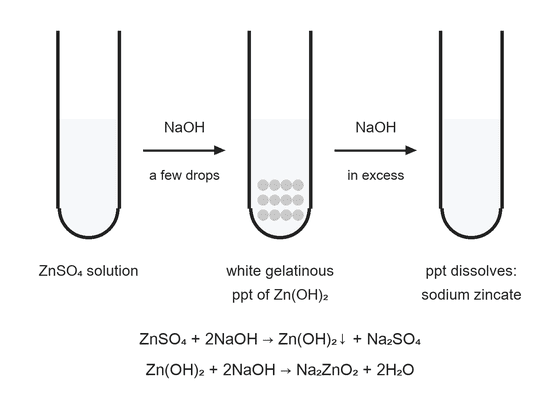
Step 3 — (c) Sodium zincate.
We dissolve zinc hydroxide in excess sodium hydroxide solution; zinc hydroxide is amphoteric:
Step 4 — (d) Iron (II) sulphate.
We add iron to dilute sulphuric acid (displacement), filter and crystallise:
Step 5 — (e) Sodium chloride.
We neutralise sodium hydroxide with dilute hydrochloric acid by titration, then evaporate:
Watch out: Iron with any dilute acid gives the iron (II) salt; the iron (III) chloride needs chlorine.
Therefore, (a) Fe + Cl₂ (heated); (b) NaOH + H₂SO₄ by titration; (c) Zn(OH)₂ + excess NaOH; (d) Fe + dilute H₂SO₄; (e) NaOH + HCl by titration.
- 495 marks
Question 49
For each of the salt A, B, C and D, suggest a suitable method for its preparation.
(a) A is a sodium salt.
(b) B is an insoluble salt.
(c) C is a soluble salt of copper.
(d) D is a soluble salt of zinc.
- 505 marks
Question 50
Choosing only the substances from the list given in the box below, write equations for the reactions which you would use in the laboratory to obtain :
(a) Sodium sulphate,
(b) Copper sulphate,
(c) Iron(II) sulphate,
(d) Zinc carbonate.
Dilute sulphuric acid Copper Copper carbonate Iron Sodium carbonate Sodium Zinc - 515 marks
Question 51
From the formula listed below, choose one in each case corresponding to the salt having the description given ahead : AgCl, , , , NaCl, , , , .
(a) an acid salt.
(b) an insoluble chloride.
(c) on treating with concentrated sulphuric acid, this salt changes from blue to white.
(d) on heating, this salt changes from green to black.
(e) this salt gives nitrogen dioxide on heating.
- 523 marks
Question 52
(a) is an example of a compound called __________ (acid salt / basic salt / normal salt).
(b) Write the balanced equation for the reaction of : A named acid and a named alkali.
- 533 marks
Question 53
State the terms defined by the following sentences :
(a) A soluble base.
(b) The insoluble solid formed when two solutions are mixed together.
(c) An acidic solution in which there is only partial ionization of the solute molecules.
- 545 marks
Question 54
Which of the following methods, A, B, C, D or E is generally used for preparing the chlorides listed below from (i) to (v). Answer by writing down the chloride and the letter pertaining to the corresponding method. Each letter is to be used only once.
A. Action of an acid on a metal,
B. Action of an acid on an oxide or carbonate,
C. Direct combination,
D. Neutralization of an alkali by an acid
E. Precipitation (double decomposition)
(i) Copper (II) chloride
(ii) Iron (II) chloride
(iii) Iron (III) chloride
(iv) Lead (II) chloride
(v) Sodium chloride
- 554 marks
Question 55
From the list given below, which one is :
[, , , CO, MgO, ]
(a) a covalent oxide of a metalloid.
(b) an oxide which when dissolved in water form acid.
(c) a basic oxide.
(d) an amphoteric oxide.
- 561 mark
Question 56
The acid which contains four hydrogen atoms is :
- 571 mark
Question 57
A black coloured solid which on reaction with dilute sulphuric acid forms a blue coloured solution is :
- 581 mark
Question 58
A weak acid is :
- 591 mark
Question 59
A complex salt is :
- 601 mark
Question 60
Which one of the following will not produce acid with water ?
- 611 mark
Question 61
The basicity of acetic acid is :
- 621 mark
Question 62
Lead sulphate can be prepared by the following methods.
P Reacting lead with sulphuric acid.
Q Reacting lead nitrate with sodium sulphate solution.
R Reacting lead oxide with sodium sulphate solution.
- 631 mark
Question 63
The following questions are Assertion-Reason based questions. Choose the answer based on the codes given below.
(1) Both A and R are true and R is the correct explanation of A.
(2) Both A and R are true but R is not the correct explanation of A.
(3) A is true but R is false.
(4) A is false but R is true.
Assertion (A) : All acids form hydronium ions when dissolved in water.
Reason (R) : Every acid has hydrogen as the necessary element.
- 641 mark
Question 64
The following questions are Assertion-Reason based questions. Choose the answer based on the codes given below.
(1) Both A and R are true and R is the correct explanation of A.
(2) Both A and R are true but R is not the correct explanation of A.
(3) A is true but R is false.
(4) A is false but R is true.
Assertion (A) : All bases react with acids to form salt and water only.
Reason (R) : All alkalies are bases but all bases are not alkalies.
- 651 mark
Question 65
The following questions are Assertion-Reason based questions. Choose the answer based on the codes given below.
(1) Both A and R are true and R is the correct explanation of A.
(2) Both A and R are true but R is not the correct explanation of A.
(3) A is true but R is false.
(4) A is false but R is true.
Assertion (A) : Acids which contain carbon are necessarily organic acids.
Reason (R) : All organic acids are derived from plants and animals.
- 661 mark
Question 66
The following questions are Assertion-Reason based questions. Choose the answer based on the codes given below.
(1) Both A and R are true and R is the correct explanation of A.
(2) Both A and R are true but R is not the correct explanation of A.
(3) A is true but R is false.
(4) A is false but R is true.
Assertion (A) : Acids have a pH of more than 7.
Reason (R) : Acids produce hydronium ions as the only positively charged ion in solution.
- 671 mark
Question 67
The following questions are Assertion-Reason based questions. Choose the answer based on the codes given below.
(1) Both A and R are true and R is the correct explanation of A.
(2) Both A and R are true but R is not the correct explanation of A.
(3) A is true but R is false.
(4) A is false but R is true.
Assertion (A) : Iron (III) chloride is stored in a moisture proof container.
Reason (R) : Iron (III) chloride is hygroscopic in nature.
- 681 mark
Question 68
The following questions are Assertion-Reason based questions. Choose the answer based on the codes given below.
(1) Both A and R are true and R is the correct explanation of A.
(2) Both A and R are true but R is not the correct explanation of A.
(3) A is true but R is false.
(4) A is false but R is true.
Assertion (A) : Water is added to acids to dilute it.
Reason (R) : The addition of water to acids is a highly exothermic reaction. Splashes of acid solution may come in contact with skin and container may also break.
- 694 marks
Question 69
(a) A solution has a pH of 7. Explain how you would :
(i) increase its pH; (ii) decrease its pH;
(b) If a solution changes the colour of litmus from red to blue, what can you say about its pH ?
(c) What can you say about the pH of a solution, that liberates carbon dioxide from sodium carbonate ?
- 705 marks
Question 70
Match the following :
Column A Column B (i) Acid salt (A) Ferrous ammonium sulphate (ii) Double salt (B) Contains only ions (iii) Ammonium hydroxide solution (C) Sodium hydrogen sulphate (iv) Dilute hydrochloric acid (D) Contains only molecules (v) Carbon tetrachloride (E) Contains ions and molecules - 715 marks
Question 71
Match the salts given in Column I with their method of preparation given in Column II.
Column I Column II (i) from PbO (a) Simple displacement (ii) from Mg (b) Titration (iii) from Fe (c) Neutralization (iv) from NaOH (d) Precipitation (v) from (e) Combination - 721 mark
Question 72
From the following list,
, , , , MgO, CO, select an oxide which dissolves in water forming an acid.
- 733 marks
Question 73
From the list given below, which one is :
(i) a deliquescent compound
(ii) a compound soluble in hot water but insoluble in cold water
(iii) a compound which in the aqueous solution state, is neutral in nature.
A. Nitroso iron [II] sulphate
B. Iron [III] chloride
C. Chromium sulphate
D. Lead chloride
E. Sodium chloride
- 742 marks
Question 74
From the following list of salts, choose the salt that most appropriately fits the description given ahead : [AgCl, , , , , , ].
(i) a deliquescent salt
(ii) an insoluble chloride
- 755 marks
Question 75
Give a suitable word or phrase for :
(i) A salt formed by incomplete neutralisation of an acid by a base.
(ii) The definite number of water molecules bound to some salts.
(iii) The process in which a substance absorbs moisture from the atmospheric air to become moist, and ultimately dissolves in the absorbed water.
(iv) A salt containing a metal ion surrounded by other ions or molecules.
(v) A base which is soluble in water.
- 765 marks
Question 76
Name the method used for the preparation of the following salts from the list given below :
(i) Sodium nitrate
(ii) Iron (III) chloride
(iii) Lead chloride
(iv) Zinc sulphate
(v) Sodium hydrogen sulphate
List :
A. Simple displacement
B. Neutralisation
C. Decomposition by acid
D. Double decomposition
E. Direct synthesis
- 772 marks
Question 77
Define 'Neutralization'.
- 782 marks
Question 78
State your observation when zinc granules are added to copper sulphate solution.
- 792 marks
Question 79
Salt S is prepared by reacting dilute sulphuric acid with copper oxide. Identify S.
- 805 marks
Question 80
From the substances given in the list below, write the equations for the reactions by which you could obtain the compounds given ahead :
Dilute sulphuric acid sodium carbonate Zinc sodium sulphite Lead calcium carbonate (i) hydrogen, (ii) sulphur dioxide,
(iii) carbon dioxide,
(iv) zinc carbonate (two steps required).
- 815 marks
Question 81
Choosing the substances from the given list :
dil. sulphuric acid, copper, iron, sodium, copper [II] carbonate, sodium carbonate, sodium chloride, zinc nitrate. write balanced equations for the reactions which would be used in the laboratory to obtain the salts given ahead :
(a) sodium sulphate (b) zinc carbonate
(c) copper [II] sulphate (d) iron [II] sulphate
- 824 marks
Question 82
You are given three solutions A, B and C. A is a strong acid, B is a weak acid and C is a strong alkali.
(a) Which solution contains solute molecules in addition to water molecules ?
(b) Which solution gives gelatinous white precipitate with zinc sulphate which disappears in excess solution ?
- 835 marks
Question 83
Write balanced chemical equations for the following:
(a) Reaction of silver nitrate solution and sodium chloride solution.
(b) Lead nitrate solution is added to sodium chloride solution.
(c) State what happens to the crystals of washing soda when they are exposed to air. Name the phenomenon exhibited.
- 845 marks
Question 84
Give a balanced equation for the preparation of the following salts :
(a) Copper [II] sulphate from copper [II] oxide
(b) Iron [III] chloride from the metal iron
(c) Lead sulphate from lead carbonate.
(d) Potassium sulphate from KOH solution
(e) Lead [II] chloride from lead carbonate [give two equations].
(f) Sodium sulphate – using dilute sulphuric aicd.
(g) Copper chloride – using copper carbonate.
- 855 marks
Question 85
Write the balanced equations for the preparation of the following compounds (as the major product) starting from iron and using only one other substance :
(a) Iron (II) chloride (b) Iron (III) chloride
(c) Iron (II) sulphate (d) Iron (II) sulphide.
- 863 marks
Question 86
Draw the structure of the stable positive ion formed when an acid dissolves in water.
- 875 marks
Question 87
Write balanced reactions for the following conversions (A, B, C, D).
- 885 marks
Question 88
Give equations for the following conversions A to E :
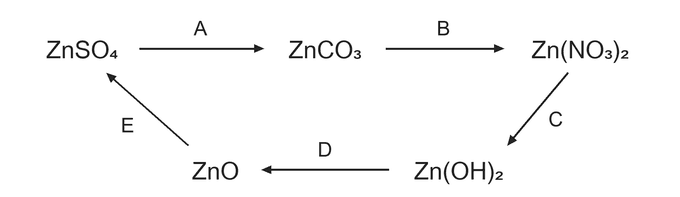
- 895 marks
Question 89
The preparation of lead sulphate from lead carbonate is a two-step process. (lead sulphate cannot be prepared by adding dilute sulphuric acid to lead carbonate.)
(a) What is the first step that is required to prepare lead sulphate from lead carbonate ?
(b) Write the equation for the reaction that will take place when this first step is carried out.
(c) Why is the direct addition of dilute sulphuric acid to lead carbonate an impractical method of preparing lead sulphate ?
- 905 marks
Question 90
The diagram given below is to prepare Iron [III] chloride in the laboratory.
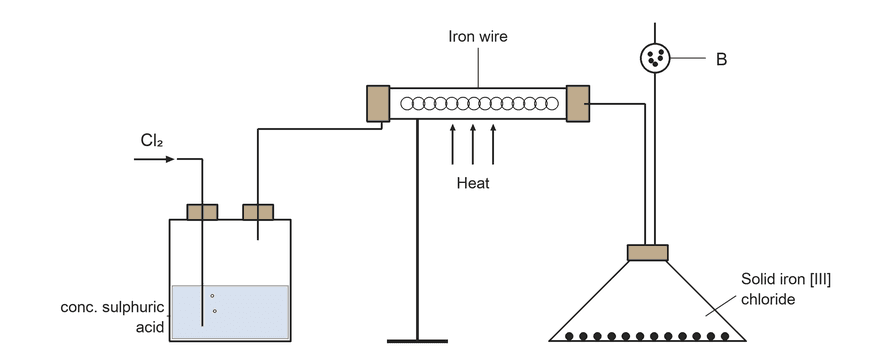
Look at the diagram and answer the questions given below :
(i) What is substance B ?
(ii) What is the purpose of B ?
(iii) Why is iron [III] chloride to be stored in a closed container ?
(iv) Write the equation for the reaction between iron and chlorine.
What Class 10 Chemistry Ch 3 covers
The sections of the chapter, in the order the book takes them. Every question above comes from one of these.
- 01Acids
- 02Bases
- 03pH Scale
- 04Salts and Their Preparations
- 05Properties of Salts
More ways to study this chapter
The same chapter asked three other ways. Practise it, revise it, and see what the board has set on Ch 3 before.
- Competency-Based Questions (CBQ)Case study questions: a situation, and the part of the chapter that answers it.40questionsOpen
- Previous Year QuestionsQuestions that have actually appeared in board papers, each tagged with its year.60questionsOpen
- Practice QuestionsExtra questions per chapter, for when one attempt at a method is not enough.42questionsOpen
Ch 3 in past ICSE papers
The same chapter as the board has actually asked it. These are worded differently from the textbook exercise, which is the point of reading them.
- 11 mark
Board paper question 1
Fill in the blanks with the choices given in brackets.
Higher the pH value of a solution, the more ...............(acidic/alkaline) it is.
Solve with AIWritten solution
Solution:
Concept: The pH scale runs from 0 to 14. A solution of pH 7 is neutral, a pH below 7 is acidic and a pH above 7 is alkaline. The farther the pH is from 7, the stronger the acidity or the alkalinity.
Step 1 — Recall what the pH number tells us.
The pH falls as the concentration of hydronium ions rises. So a high pH means very few ions and many ions in the solution.
Step 2 — Decide which way the scale goes.
Above 7 the solution is alkaline, and it becomes more alkaline as the pH rises from 8 towards 14. Below 7 it is acidic, and it becomes more acidic as the pH falls towards 0.

Watch out: Do not read the pH as 'the amount of acid'; a HIGHER pH means LESS acid and more alkali.
Therefore, the higher the pH value of a solution, the more alkaline it is.
- 21 mark
Board paper question 2
Write balanced chemical equations for each of the following:
Action of Hydrochloric acid on sodium bicarbonate.
Solve with AIWritten solution
Solution:
Concept: A dilute acid decomposes a carbonate or a hydrogen carbonate (bicarbonate) to give a salt, water and carbon dioxide.
Step 1 — Name the reactants and the products.
Sodium bicarbonate is sodium hydrogen carbonate, . With hydrochloric acid it gives the salt sodium chloride, water and carbon dioxide.
Step 2 — Write and balance the equation.
One ion takes up one hydrogen ion from the acid, so the two react one to one:
Each side has 1 Na, 1 C, 3 O, 2 H and 1 Cl, so the equation is balanced.
Step 3 — Note what is seen.
Carbon dioxide comes off with brisk effervescence, and it turns lime water milky.

Watch out: A bicarbonate needs only ONE HCl; writing 2HCl (as for a carbonate such as Na₂CO₃) leaves the equation unbalanced.
Therefore, NaHCO₃ + HCl → NaCl + H₂O + CO₂↑.
- 35 marks
Board paper question 3
Match the salts given in Column I with their method of preparation given in Column II:
Column I Column II (i) from PbO (A) Simple displacement (ii) from Mg (B) Titration (iii) from Fe (C) Neutralization (iv) from NaOH (D) Precipitation (v) from (E) Combination Solve with AIWritten solution
Solution:
Concept: The method of preparing a salt depends on its solubility and on the starting material: an insoluble salt is made by precipitation; a soluble salt from an active metal by simple displacement of hydrogen from a dilute acid; a soluble salt from an insoluble base or carbonate by neutralisation with a dilute acid; a salt from two soluble reactants (an alkali and an acid) by titration; and anhydrous iron (III) chloride by direct combination of the metal with chlorine.
Step 1 — Lead nitrate from PbO: (C) Neutralization.
Lead (II) oxide is an insoluble base. It is warmed with dilute nitric acid, and the excess oxide is filtered off before the solution is crystallised.
Step 2 — Magnesium chloride from Mg: (A) Simple displacement.
Magnesium is above hydrogen in the activity series, so it displaces hydrogen from dilute hydrochloric acid.
Step 3 — Iron (III) chloride from Fe: (E) Combination.
Iron with dilute hydrochloric acid gives only iron (II) chloride, so iron (III) chloride is made by heating iron in dry chlorine, a direct combination of the two elements.
Step 4 — Sodium nitrate from NaOH: (B) Titration.
Sodium hydroxide and nitric acid are both soluble, so an excess of either could not be filtered off. The exact volumes that neutralise each other are found by titration and then mixed without the indicator.
Step 5 — Zinc carbonate from ZnSO₄: (D) Precipitation.
Zinc carbonate is insoluble in water, so it is precipitated by mixing zinc sulphate solution with sodium carbonate solution; it is then filtered, washed and dried.
Step 6 — Put the matches together.
Each salt in Column I has now been given one method from Column II:
Column I Column II (i) from PbO (C) Neutralization (ii) from Mg (A) Simple displacement (iii) from Fe (E) Combination (iv) from NaOH (B) Titration (v) from (D) Precipitation 
Watch out: Iron with dilute HCl does NOT give FeCl₃; it gives FeCl₂. FeCl₃ needs chlorine.
Therefore, (i) – (C), (ii) – (A), (iii) – (E), (iv) – (B), (v) – (D).
- 41 mark
Board paper question 4
Fill in the blanks from the choices given in brackets:
When a metallic oxide is dissolved in water, the solution formed has a high concentration of .............. ions. (, , )
Solve with AIWritten solution
Solution:
Concept: A metallic oxide is a basic oxide. The oxide of an active metal such as sodium dissolves in water to form an alkali, and an alkali is a base that dissolves in water and gives hydroxyl ions () as the only negatively charged ions.
Step 1 — See what the oxide forms in water.
Sodium oxide is a typical soluble metallic oxide. It reacts with water to form sodium hydroxide:
Step 2 — See which ions the solution holds.
Sodium hydroxide dissociates in water and gives hydroxyl ions:
So the solution has a high concentration of ions. and ions come from acids, not from metallic oxides.

Therefore, when a metallic oxide is dissolved in water, the solution formed has a high concentration of OH⁻ ions.
- 51 mark
Board paper question 5
To increase the pH value of a neutral solution, we should add:
Solve with AIAnswer
(A) an acid
(B) an acid salt
- Correct
(C) an alkali
(D) a salt
Answer: (C) an alkali
Concept: The pH scale runs from 0 to 14. A solution of pH 7 is neutral, a pH below 7 is acidic and a pH above 7 is alkaline. The farther the pH is from 7, the stronger the acidity or the alkalinity.
Step 1 — Say what 'increase the pH' needs.
A neutral solution has pH 7. To raise its pH above 7 we must make it alkaline, that is, add ions.
Step 2 — Pick the substance that gives OH⁻ ions.
An alkali such as sodium hydroxide gives hydroxyl ions in water, so adding it raises the pH above 7.
Watch out: Raising the pH means making the solution LESS acidic; anything that gives H₃O⁺ ions lowers the pH.
Why the other options are wrong:
- (A) an acid: an acid gives ions, which make the solution acidic and LOWER the pH below 7.
- (B) an acid salt: an acid salt such as still has a replaceable hydrogen; it gives ions in water and so lowers the pH.
- (D) a salt: a normal salt of a strong acid and a strong alkali, such as sodium chloride, is neutral and leaves the pH at 7.
Therefore, to increase the pH of a neutral solution we should add an alkali, option (C).
- 61 mark
Board paper question 6
Anhydrous iron (III) chloride is prepared by:
Solve with AIAnswer
- Correct
(A) direct combination
(B) simple displacement
(C) decomposition
(D) neutralization
Answer: (A) direct combination
Concept: Iron forms two chlorides. With dilute hydrochloric acid it gives only the lower chloride, iron (II) chloride, because the hydrogen set free is not an oxidising agent. Heated in dry chlorine, a strong oxidising agent, it gives the higher chloride, iron (III) chloride, by direct combination.
Step 1 — Combine iron with chlorine.
Iron is heated in a stream of dry chlorine. Chlorine is a strong oxidising agent, so the two elements combine directly to give iron (III) chloride:
Step 2 — Keep it anhydrous.
Iron (III) chloride is deliquescent (it absorbs moisture from the air), so the apparatus is kept dry and the product is collected in a dry receiver. This gives the anhydrous salt.
Watch out: Anhydrous FeCl₃ cannot be got by heating the hydrated salt; heat breaks it down instead.
Why the other options are wrong:
- (B) simple displacement: iron with dilute hydrochloric acid gives iron (II) chloride, , not iron (III) chloride.
- (C) decomposition: decomposition breaks a compound into simpler substances; heating hydrated iron (III) chloride does not leave the anhydrous salt but breaks it down to iron (III) oxide, water and hydrogen chloride.
- (D) neutralization: neutralising iron (III) hydroxide with hydrochloric acid gives iron (III) chloride only in solution; it crystallises as the hydrated salt, which cannot be dried by heating for the same reason.
Therefore, anhydrous iron (III) chloride is prepared by direct combination, option (A).
All 60 board paper questions for this chapter, solved the same way.
Class 10 Chemistry Ch 3 questions students ask
How many questions are there in Class 10 Chemistry Ch 3?
90 questions. Every one is solved step by step on this page.
Are these Class 10 Chemistry solutions free?
Yes. Every question and its full working is free to read, with no account needed.
Can I download the Class 10 Chemistry Ch 3 solutions as a PDF?
There is no PDF to download. Every solution is on this page instead, which means it is searchable, always the current syllabus, and readable on a phone. Use your browser's print option if you want it on paper.