
Opening your dashboard
Class 10 Chemistry Chapter 3 Acids, Bases and Salts: Competency-Based Questions (CBQ)
40 questions on Chapter 3, each worked through on its own page with the AI tutor. Class 10 Chemistry, ICSE 2026-27.
40 questions
1–5 marks · Mixed difficulty
- 11 mark
Question 1
Cognitive domain: Application · CISCE Competency-Focused Practice Questions 2024, Q22
The pH of the soil is tested, and for the better growth of crops, slightly alkaline soil is required. Which ion in the fertiliser will increase the alkalinity of the soil?
- 21 mark
Question 2
Cognitive domain: Application · CISCE Competency-Focused Practice Questions 2024, Q27
Which of the following observations correctly shows the action of indicator on sodium hydroxide solution?
Indicator methyl orange phenolphthalein P orange to yellow remains colourless Q orange to pink remains colourless R orange to yellow colourless to pink S remains orange remains pink - 35 marks
Question 3
Cognitive domain: Understanding & Application · CISCE Competency-Focused Practice Questions 2024, Q51
Match the reactants in column A to their methods of preparation in column B.
Column A Column B (a) Zinc Oxide + Sulphuric acid (i) Synthesis (b) Iron + Chlorine (ii) Precipitation (c) Barium chloride + Sodium sulphate (iii) Neutralization (d) Magnesium + Hydrochloric acid (iv) Neutralization by titration (e) Potassium hydroxide + Nitric acid (v) Displacement - 45 marks
Question 4
Cognitive domain: Analysis · CISCE Competency-Focused Practice Questions 2024, Q52
Match the terms in column A with their descriptions in column B.
Column A Column B (a) Acidic oxide (i) Metallic oxides that react with both acids and bases (b) Basic oxide (ii) Non-metallic oxides (c) Amphoteric oxide (iii) Non-metallic oxides that react with neither acids nor bases (d) Neutral oxide (iv) Amphoteric oxide (e) Aluminium oxide (v) Metallic oxide - 51 mark
Question 5
Cognitive domain: Understanding · CISCE Competency-Focused Practice Questions 2024, Q59
Name a positive non-metallic radical which is basic in nature.
- 62 marks
Question 6
Cognitive domain: Analysis · CISCE Competency-Focused Practice Questions 2024, Q91
Some general rules for the solubility of salts in water are listed.
- Carbonates are insoluble (except ammonium carbonate, potassium carbonate and sodium carbonate).
- Chlorides are soluble (except lead(II) chloride and silver chloride).
- Nitrates are soluble.
- Sulphates are soluble (except barium sulphate, calcium sulphate and lead(II) sulphate).
Which substances produce an insoluble salt when aqueous solutions of them are mixed? Justify your answer.
(a) Copper nitrate and magnesium chloride
(b) Zinc chloride and ammonium nitrate
(c) Silver nitrate and zinc chloride
(d) Potassium carbonate and sodium sulphate
- 73 marks
Question 7
Cognitive domain: Understanding & Application · CISCE Competency-Focused Practice Questions 2024, Q110
Give balanced equations for the conversions A, B and C.
- 83 marks
Question 8
Cognitive domain: Understanding & Application · CISCE Competency-Focused Practice Questions 2024, Q113
An element X combines with oxygen to form an oxide . This oxide is a good conductor of electricity in the molten state and can be reduced to its metal only by electrolysis.
(a) Write the equation for the reaction formed when the oxide () combines with hydrochloric acid.
(b) How many valence electrons are present in the outermost shell of X?
(c) Will element X undergo oxidation or reduction?
- 91 mark
Question 9
Cognitive domain: Application
A lab assistant finds three bottles of dilute acid, X, Y and Z, whose labels have peeled off. The stock register shows that they are hydrochloric acid, sulphuric acid and phosphoric acid, and that all three were made up to contain the same number of acid molecules per litre. She takes 10 mL of each and finds the volume of the same sodium hydroxide solution needed to neutralise it completely.
Acid X Y Z Volume of sodium hydroxide solution needed (mL) 20 10 30 Which option identifies the three acids correctly?
- 101 mark
Question 10
Cognitive domain: Analysis
Sana puts 10 mL of dilute hydrochloric acid in a conical flask with a few drops of universal indicator. She then runs in sodium hydroxide solution from a burette, swirls the flask, and notes the colour of the mixture.
Total volume of sodium hydroxide solution added (mL) 0 4 8 10 11 14 Colour of the mixture red orange yellow green blue violet Which statement about the mixture in the flask after 14 mL has been added is correct?
- 111 mark
Question 11
Cognitive domain: Understanding
Assertion (A): Pure water does not change the colour of either red litmus or blue litmus.
Reason (R): Pure water contains no hydrogen ions and no hydroxyl ions.
- 121 mark
Question 12
Cognitive domain: Understanding
Assertion (A): Blue crystals of copper sulphate turn into a white powder when heated gently, and the white powder turns blue again when a few drops of water are added to it.
Reason (R): Concentrated sulphuric acid can remove the water of crystallisation from blue copper sulphate crystals.
- 131 mark
Question 13
Cognitive domain: Application
A beaker of clear lime water (calcium hydroxide solution) is left uncovered on a laboratory bench over a weekend. On Monday, a thin white crust is found floating on its surface. Name the substance that forms the crust and the gas in the air that caused it.
- 142 marks
Question 14
Cognitive domain: Evaluation
Two bottles stand on a shelf in the school laboratory. One is labelled concentrated acetic acid and the other dilute nitric acid. Arjun tells his partner: "The concentrated one is the stronger acid of the two. That is what concentrated means."
Is Arjun right? Justify your answer.
- 154 marks
Question 15
Cognitive domain: Analysis
While checking the chemistry store of her school, Ms. D'Souza found three jars whose labels had faded. The stock book showed that they were washing soda crystals, anhydrous calcium chloride and potassium nitrate. To find out which was which, she weighed a sample of each on a watch glass, left the three watch glasses uncovered on an open shelf for a week, and then weighed them again. She knew that washing soda crystals, , slowly change in air into the monohydrate, .
Sample Appearance at the start Mass at the start (g) Appearance after a week Mass after a week (g) P clear, glassy crystals 14.3 dull white powder 6.2 Q white lumps 10.0 colourless liquid 16.8 R white crystals 10.0 white crystals 10.0 (a) Identify P, Q and R, and name the property shown by P and the property shown by Q.
(b) Show by calculation that the final mass of P agrees with a complete change to the monohydrate. (H = 1, C = 12, O = 16, Na = 23)
(c) Ms. D'Souza wants to keep the inside of the glass case of a balance dry by leaving a small dish of one of these three substances in it. Which one should she use? Explain why neither of the other two will do.
- 164 marks
Question 16
Cognitive domain: Application
A road tanker carrying concentrated sulphuric acid to a fertiliser factory develops a leak near a highway toll plaza, and about 490 kg of the acid spreads over the road. The fire crew keeps people away and does not hose the acid with water. Instead, the crew first rings the pool with dry sand so that it cannot reach the roadside drain. They then shovel soda ash (anhydrous sodium carbonate) over the acid, a little at a time. The pool froths vigorously. When fresh soda ash produces no more froth, the crew tests the slurry with pH paper, and only then washes the road with water.
(a) Why did the crew not hose the concentrated acid with water straight away?
(b) Explain the frothing with the help of a balanced equation. What should the pH paper show before the road is washed?
(c) Calculate the least mass of soda ash needed to neutralise 490 kg of sulphuric acid. (H = 1, C = 12, O = 16, Na = 23, S = 32) Give one reason why soda ash is a better choice for this job than caustic soda.
- 175 marks
Question 17
Cognitive domain: Creativity
An advertisement for antacid tablets of brand X says: "One tablet of X neutralises twice as much stomach acid as a tablet of any other brand." The acid in the stomach is dilute hydrochloric acid. You are given tablets of three brands and the name of the active ingredient printed on each strip:
Brand X Y Z Active ingredient magnesium hydroxide aluminium hydroxide sodium hydrogen carbonate You also have dilute hydrochloric acid from one stock bottle, methyl orange, a burette, conical flasks, a mortar and pestle, and distilled water.
(a) Plan an experiment to test the claim. Give the main steps and state two things that must be kept the same for all three brands.
(b) What will you measure, and how will your results show whether the claim is true?
(c) One brand will fizz as the acid is added. Which brand is it? Write the balanced equation for its reaction.
(d) Write the balanced equation for the reaction of the active ingredient of brand X with the acid. Why is sodium hydroxide never used as an antacid, although it also neutralises hydrochloric acid?
- 181 mark
Question 18
Cognitive domain: Analysis
A student made dilute hydrochloric acid of pH . She took mL of it, added mL of distilled water and measured the pH of the new solution. She repeated this step again and again, each time taking mL of the latest solution and adding mL of water. (Hypothetical data.)
Number of dilutions 0 1 2 3 4 5 6 7 pH of the solution 1.0 2.0 3.0 4.0 5.0 6.0 6.8 7.0 Which statement about these readings is correct ?
- 191 mark
Question 19
Cognitive domain: Understanding
Assertion (A): Lead(II) sulphate is not prepared in the laboratory by the action of dilute sulphuric acid on lead.
Reason (R): Lead is below hydrogen in the activity series, so it does not react with dilute acids at all.
- 201 mark
Question 20
Cognitive domain: Analysis
Assertion (A): A solution of acetic acid conducts electricity much less than a solution of hydrochloric acid of the same concentration.
Reason (R): An acetic acid molecule, , has four hydrogen atoms, whereas a hydrochloric acid molecule, , has only one.
- 211 mark
Question 21
Cognitive domain: Analysis
A student tested four white or coloured solids, P, Q, R and S, in the following ways. (Hypothetical data.)
Solid Shaken with water Effect on red litmus paper in the water Warmed with dilute hydrochloric acid P dissolves completely turns blue reacts, and the solid disappears Q does not dissolve no change dissolves slowly and gives a coloured solution R dissolves completely no change no change S does not dissolve no change no change Which of the following is the correct conclusion ?
- 221 mark
Question 22
Cognitive domain: Application
Four substances P, Q, R and S were dissolved in water. A chemist lists the ions found in each solution. (Hypothetical data.)
Substance Positive ions Negative ions P only Q only R and S only Which description of the four substances is correct ?
- 231 mark
Question 23
Cognitive domain: Analysis
Rahul put mL of dilute sodium hydroxide solution in a plastic cup and noted its temperature. He then added dilute hydrochloric acid from a burette, mL at a time, stirred, and noted the highest temperature after each addition. The acid was at the same starting temperature as the alkali. (Hypothetical data.)
Volume of acid added (mL) 0 5 10 15 20 25 30 Temperature of the mixture (°C) 28.0 30.6 32.6 34.1 35.3 34.2 33.4 Which conclusion is best supported by the readings ?
- 241 mark
Question 24
Cognitive domain: Application
A farmer spreads slaked lime, , on his acidic field and, on the same day, mixes in the fertiliser ammonium sulphate. Soon a sharp, choking smell is noticed over the damp field. An agriculture officer advises him to leave a gap of a few weeks between liming the field and adding this fertiliser. Which statement best explains the advice ?
- 251 mark
Question 25
Cognitive domain: Evaluation
Nisha wrote four statements in her revision notes. Only one of them is correct. Which one is it ?
- 261 mark
Question 26
Cognitive domain: Analysis
Two flasks hold equal volumes of dilute acids of the same concentration: flask P has hydrochloric acid and flask Q has acetic acid. An excess of identical magnesium ribbon is dropped into each flask, and the volume of hydrogen gas collected is read every minute. (Hypothetical data.)
Time (minutes) 1 2 3 4 5 6 Volume of gas from P (mL) 48 84 108 118 120 120 Volume of gas from Q (mL) 6 11 16 21 25 29 Flask Q went on giving gas more and more slowly, and both flasks finally gave mL of gas, Q only after about minutes. Which conclusion is best supported ?
- 272 marks
Question 27
Cognitive domain: Application
A dye-works in Surat stores Glauber's salt, , which is used in dyeing cloth. A chemist heats g of the clear crystals gently until the mass stops changing. (H = 1, O = 16, Na = 23, S = 32)
(a) Calculate the mass of water driven off.
(b) Name the white solid left and calculate its mass.
- 282 marks
Question 28
Cognitive domain: Evaluation
Priya wants crystals of sodium chloride. She puts mL of sodium hydroxide solution in a flask with a few drops of phenolphthalein, and runs in dilute hydrochloric acid from a burette until the pink colour just disappears. She reads the volume ( mL) and then evaporates this same mixture to get the crystals. Her partner says that the crystals will not be pure.
Is her partner right? Justify your answer, and say what Priya should do instead.
- 292 marks
Question 29
Cognitive domain: Understanding
A student puts a piece of blue litmus paper in a glass of fresh soda water, and the paper turns red. She then boils another sample of the soda water for a few minutes, lets it cool, and finds that blue litmus paper stays blue in it.
Explain both observations.
- 302 marks
Question 30
Cognitive domain: Analysis
The enamel of a tooth, which is calcium phosphate, begins to dissolve when the pH of the film of plaque on it falls below . Bacteria in the plaque turn sugar into acids. The pH of the plaque of a student was measured after she ate a sweet. (Hypothetical data.)
Time after eating the sweet (min) 0 3 6 12 20 30 45 pH of the plaque 6.8 5.6 5.1 5.0 5.6 6.4 6.8 (a) For about how long was the enamel at risk after this one sweet?
(b) No toothpaste or medicine was used, yet the pH of the plaque rose back to . Saliva contains hydrogencarbonate ions. Use this to explain the rise, and say why eating sweets many times a day harms the teeth more than eating the same sweets at one time.
- 312 marks
Question 31
Cognitive domain: Creativity
Three clear colourless liquids, X, Y and Z, are in unlabelled bottles. They are dilute hydrochloric acid, dilute sodium hydroxide solution and distilled water, but not in that order. You have only several strips of red litmus paper and a clean dropper.
Describe how you will identify all three liquids.
- 322 marks
Question 32
Cognitive domain: Understanding
A student suggests two ways to prepare salts by simple displacement, using a metal and dilute hydrochloric acid:
(i) sodium chloride from sodium; (ii) iron(III) chloride from iron.
Explain why neither suggestion is suitable, and name a method that could be used to prepare each of the two salts.
- 333 marks
Question 33
Cognitive domain: Application
Dilute sulphuric acid can be used to prepare magnesium sulphate from each of four magnesium compounds or elements: magnesium metal, magnesium oxide, magnesium hydroxide and magnesium carbonate.
(a) Write a balanced equation for each of the four reactions.
(b) Name the substance other than magnesium sulphate formed in each case.
(c) Which two of the four reactions would show a gas escaping, and how will you test each gas?
- 343 marks
Question 34
Cognitive domain: Evaluation
A television advertisement for a shampoo makes three claims: "Our shampoo has a pH of 5.5. (1) A pH of 5.5 means it is neutral. (2) Ordinary soap has a pH of 10, so it is more acidic and burns the skin. (3) The pH of healthy skin is slightly acidic, and ours is close to it."
Evaluate each of the three claims. Say whether it is correct or not, and give a reason.
- 353 marks
Question 35
Cognitive domain: Analysis
Baking powder is a dry mixture of sodium hydrogencarbonate, an organic acid such as tartaric acid, and a little starch. The mixture can be stored for months in a closed tin, but when it is mixed with a wet cake batter and warmed, bubbles form and the cake rises.
(a) Why does the dry powder not react in the tin?
(b) Name the gas that makes the cake rise, and say how you would test for it.
(c) Why does the packet say, "Keep the lid tightly closed"?
- 363 marks
Question 36
Cognitive domain: Creativity
Meena has some copper turnings, dilute sulphuric acid, a burner and the usual laboratory apparatus. She wants a solution of copper(II) sulphate, but copper does not react with the dilute acid.
(a) Plan a route in two stages that starts with the copper turnings and ends with copper(II) sulphate solution. Give a balanced equation for each stage.
(b) In stage 1 only the surface of each turning is changed, and some shiny copper is left inside. What happens to this copper in stage 2, and how is it removed?
(c) State the colour change seen in each stage.
- 373 marks
Question 37
Cognitive domain: Understanding
In the rainy season, the common salt in many village shops becomes damp and sticky, while the packet of pure salt in a laboratory stays dry and free-flowing. The sticky salt is found to contain small amounts of magnesium chloride and calcium chloride as impurities.
(a) Which property of these chlorides makes the salt damp? Explain the term.
(b) Why does pure sodium chloride not show this?
(c) Suggest one way to keep such salt dry at home.
- 385 marks
Question 38
Cognitive domain: Analysis
After heavy rain, sulphuric acid washed out of the acid soils of the Kuttanad region made the water of a fish pond, of area m², acidic, and the fish stopped feeding. The pond owner added quicklime, , in lots of kg, and a student measured the pH of the water after each lot had dissolved and settled. The graph shows her readings. Fish grow well only if the pH of the water is between and (shaded in green). (Hypothetical data.)
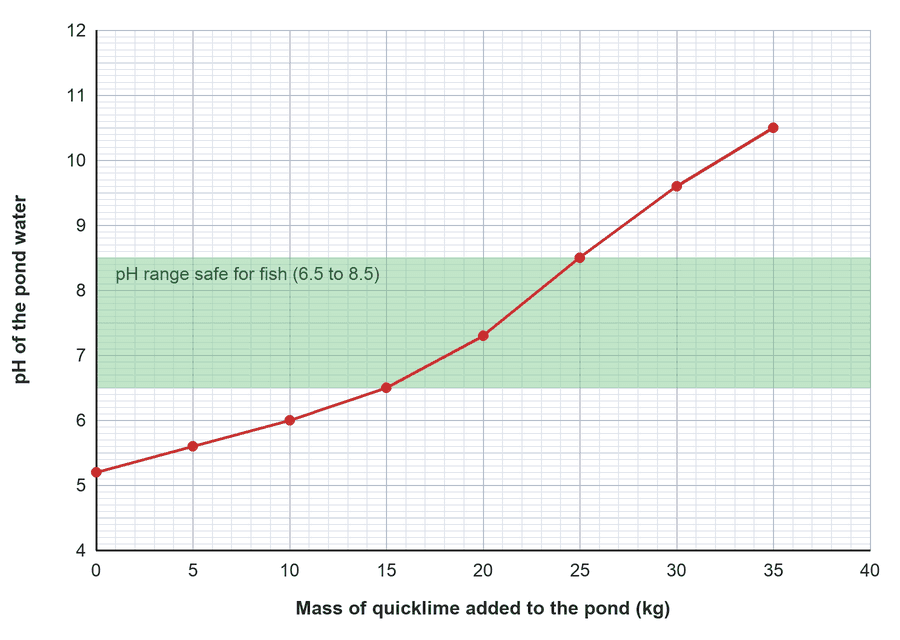
(a) What was the pH of the pond before any quicklime was added, and why was the pond unsuitable for fish?
(b) Write balanced equations to show (i) how quicklime acts on water, and (ii) how the product acts on sulphuric acid in the pond.
(c) From the graph, state the range of the total mass of quicklime that keeps the pH within the safe range, and explain why the owner should not add kg.
- 394 marks
Question 39
Cognitive domain: Application
A small firm makes iron tablets for anaemic patients. A worker adds an excess of iron filings to warm dilute sulphuric acid that contains g of sulphuric acid, . Bubbles come off until all the acid has reacted. The pale green solution is filtered and then evaporated until crystals begin to form on cooling. The green crystals, , are dried between filter papers and weighed. (H = 1, O = 16, S = 32, Fe = 56)
Mass of sulphuric acid taken Mass of green crystals obtained g g (a) Write the balanced equation for the reaction, name the gas, and give a test for it.
(b) Why is the solution filtered before it is evaporated, and why are the crystals dried between filter papers and not by heating them strongly?
(c) Calculate the mass of crystals that g of sulphuric acid should give, and the percentage of this that was actually obtained. Give one reason why it is less.
- 404 marks
Question 40
Cognitive domain: Evaluation
Kavya's grandmother cleans her black, tarnished copper pots by rubbing them with half a lemon dipped in common salt, and then rinses them with water. The pots become bright and reddish-brown. The black layer on the pots is mostly copper(II) oxide. Kavya's neighbour says, "Dilute hydrochloric acid from the school laboratory would be better, because it is a stronger acid than the acid in lemon. And the lemon works only because of the salt."
(a) Which substance in the lemon removes the black layer? Name the type of change that takes place.
(b) Write a balanced equation for the reaction of the black layer with dilute hydrochloric acid, and state the colour of the solution formed.
(c) Evaluate the two statements of the neighbour.