
Question 571 markMCQEasy
A black coloured solid which on reaction with dilute sulphuric acid forms a blue coloured solution is :
Confirming your payment
Sign up now and get 250 free tokens.
Acids, Bases and Salts · Question 57 of 90
A black coloured solid which on reaction with dilute sulphuric acid forms a blue coloured solution is :
(A) Carbon
(B) Manganese [IV] oxide
(C) Lead [II] oxide
(D) Copper [II] oxide
Answer: (D) Copper [II] oxide
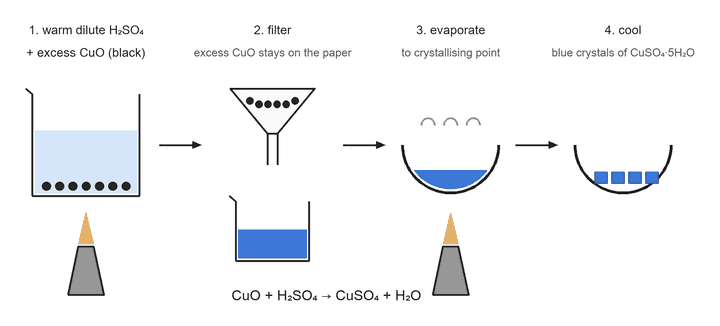
Concept: Copper (II) salts give blue solutions. A black solid that dissolves in a dilute acid to give a blue solution must be a copper (II) compound acting as a base.
Step 1 — Identify the black basic solid.
Black copper (II) oxide is a basic oxide, so dilute sulphuric acid neutralises it:
Step 2 — Check the colour.
The copper sulphate formed dissolves in the water present and gives a blue solution.
Why the other options are wrong:
Therefore, the black solid is copper (II) oxide, option (D).