
Question 65 marksEasy
Name the :
(a) acidic anhydride of the following acids :
(i) sulphurous acid,
(ii) nitric acid,
(iii) phosphoric acid,
(iv) carbonic acid.
(b) acids present in vinegar, grapes and lemon.
Confirming your payment
Sign up now and get 250 free tokens.
Acids, Bases and Salts · Question 6 of 90
Name the :
(a) acidic anhydride of the following acids :
(i) sulphurous acid,
(ii) nitric acid,
(iii) phosphoric acid,
(iv) carbonic acid.
(b) acids present in vinegar, grapes and lemon.
Solution:
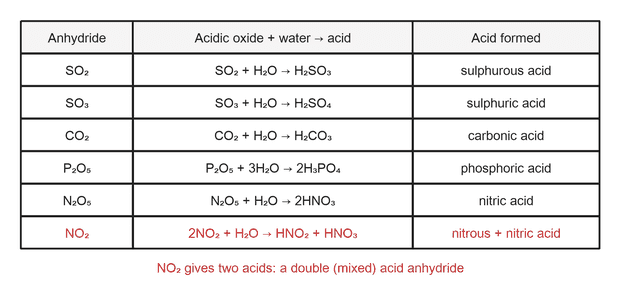
Concept: An acidic anhydride is the non-metallic oxide that dissolves in water to give the acid. To find it, take water away from the acid's formula.
Step 1 — (a)(i) Sulphurous acid.
Removing one water molecule from leaves sulphur dioxide, :
Step 2 — (a)(ii) Nitric acid.
Two molecules of minus one water molecule leave dinitrogen pentoxide, :
Step 3 — (a)(iii) Phosphoric acid.
Two molecules of minus three water molecules leave phosphorus pentoxide, :
Step 4 — (a)(iv) Carbonic acid.
Removing one water molecule from leaves carbon dioxide, :
Step 5 — (b) Acids in vinegar, grapes and lemon.
These are organic acids obtained from plants: vinegar contains acetic acid, grapes contain tartaric acid and lemons contain citric acid.
Watch out: The anhydride of nitric acid is , not (which gives two acids with water).
Therefore, (a) (i) SO₂, (ii) N₂O₅, (iii) P₂O₅, (iv) CO₂; (b) vinegar – acetic acid, grapes – tartaric acid, lemon – citric acid.