Solution:
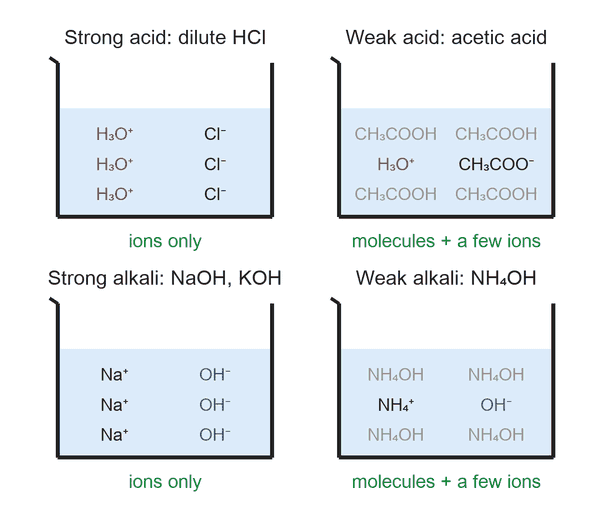
Concept: Strong electrolytes (like dilute HCl) are fully ionised, so they contain only ions; weak ones (like NH4OH) are partly ionised, so they contain ions and molecules; covalent liquids (like CCl4) contain only molecules.
Step 1 — (i) and (ii) The two salts.
NaHSO4 still has one replaceable hydrogen of the dibasic acid, so the acid salt is (C) sodium hydrogen sulphate. Ferrous ammonium sulphate (Mohr's salt) is two normal salts crystallised together, so the double salt is (A) ferrous ammonium sulphate.
Step 2 — (iii) Ammonium hydroxide solution.
Ammonium hydroxide is a weak alkali: only a few molecules ionise, so it (E) contains ions and molecules.
Step 3 — (iv) Dilute hydrochloric acid.
Dilute HCl is a strong acid: practically every molecule is ionised, so it (B) contains only ions (apart from the water).
Step 4 — (v) Carbon tetrachloride.
Carbon tetrachloride is a covalent liquid and does not ionise at all, so it (D) contains only molecules.
Step 5 — Write the matched pairs.
Putting the answers together:
| Column A | Column B |
|---|
| (i) Acid salt | (C) Sodium hydrogen sulphate |
| (ii) Double salt | (A) Ferrous ammonium sulphate |
| (iii) Ammonium hydroxide solution | (E) Contains ions and molecules |
| (iv) Dilute hydrochloric acid | (B) Contains only ions |
| (v) Carbon tetrachloride | (D) Contains only molecules |
Therefore, (i) – (C), (ii) – (A), (iii) – (E), (iv) – (B), (v) – (D).
