
Question 285 marksEasy
Distinguish between :
(a) a common acid base indicator and a universal indicator,
(b) acidity of bases and basicity of acids,
(c) acid and alkali (other than indicators).
Confirming your payment
Sign up now and get 250 free tokens.
Acids, Bases and Salts · Question 28 of 90
Distinguish between :
(a) a common acid base indicator and a universal indicator,
(b) acidity of bases and basicity of acids,
(c) acid and alkali (other than indicators).
Solution:
Concept: To distinguish two things, compare them on the same point, one point at a time.
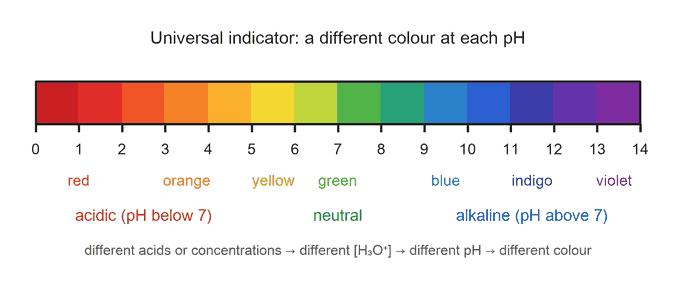
Step 1 — (a) Common indicator and universal indicator.
A common indicator only says acid or base, while a universal indicator also says how strong:
| Common acid–base indicator | Universal indicator |
|---|---|
| A single dye, e.g. litmus, methyl orange. | A mixture of several indicator dyes. |
| Shows only whether a solution is acidic or basic. | Gives a different colour at each pH, so shows how acidic or basic it is. |
Step 2 — (b) Acidity of bases and basicity of acids.
Both count ions from one molecule, but different ions:
| Acidity of a base | Basicity of an acid |
|---|---|
| The number of hydroxyl () ions one molecule of the base can produce, e.g. has acidity 2. | The number of hydronium ions () one molecule of the acid can produce, e.g. has basicity 2. |
Step 3 — (c) Acid and alkali (other than indicators).
We compare the ions, taste and typical reactions:
| Acid | Alkali |
|---|---|
| Gives ions in water; pH less than 7. | Gives ions in water; pH more than 7. |
| Sour in taste. | Bitter in taste and soapy to touch. |
| Reacts with active metals to give hydrogen. | Reacts with ammonium salts on heating to give ammonia. |
Watch out: Never taste a laboratory acid or alkali; taste is listed only as a property described in books.
Therefore, (a) a universal indicator shows the pH, a common indicator only acid or base; (b) acidity counts OH⁻ ions per base molecule, basicity counts H₃O⁺ ions per acid molecule; (c) acids give H₃O⁺ (pH < 7), alkalis give OH⁻ (pH > 7).