Solution:
Concept: These are the typical reactions of dilute acids. In each, the hydrogen of the acid is replaced by a metal to give a salt; what else forms depends on what the acid reacts with.
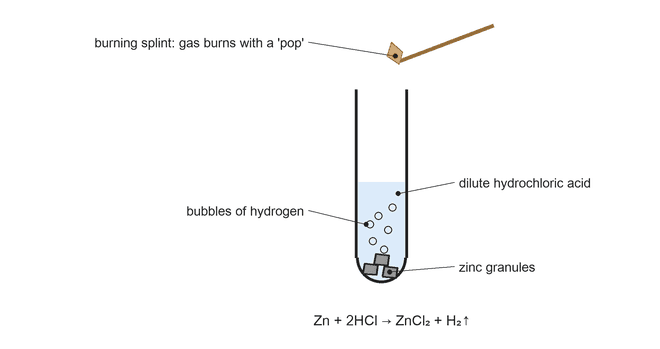
Step 1 — (a) Acid + active metal → salt + hydrogen.
Zinc, an active metal, displaces hydrogen from dilute hydrochloric acid; the gas burns with a 'pop' sound:
Zn+2HCl→ZnCl2+H2↑
Step 2 — (b) Acid + base → salt + water.
Sodium hydroxide is neutralised by hydrochloric acid:
NaOH+HCl→NaCl+H2O
Step 3 — (c) Acid + carbonate or bicarbonate → salt + water + carbon dioxide.
A carbonate and a bicarbonate each give carbon dioxide, which turns lime water milky:
CaCO3+2HCl→CaCl2+H2O+CO2↑
NaHCO3+HCl→NaCl+H2O+CO2↑
Step 4 — (d) Acid + sulphite or bisulphite → salt + water + sulphur dioxide.
A sulphite and a bisulphite each give sulphur dioxide, which has the suffocating smell of burning sulphur:
Na2SO3+2HCl→2NaCl+H2O+SO2↑
NaHSO3+HCl→NaCl+H2O+SO2↑
Step 5 — (e) Acid + sulphide → salt + hydrogen sulphide.
Iron (II) sulphide with dilute sulphuric acid gives hydrogen sulphide, which smells of rotten eggs:
FeS+H2SO4→FeSO4+H2S↑
Watch out: A carbonate needs 2HCl but a bicarbonate needs only HCl; check the balance of each equation.
Therefore, the five equations are Zn + 2HCl → ZnCl₂ + H₂; NaOH + HCl → NaCl + H₂O; CaCO₃ + 2HCl → CaCl₂ + H₂O + CO₂; Na₂SO₃ + 2HCl → 2NaCl + H₂O + SO₂; FeS + H₂SO₄ → FeSO₄ + H₂S.
