Solution:
Concept: The method chosen for preparing a salt depends on whether the salt is soluble or insoluble in water and on the metal in it: sodium, potassium and ammonium salts by titration; salts of active metals (Mg, Zn, Fe) by displacement; salts of unreactive metals (Cu, Pb) from an insoluble base; insoluble salts by precipitation; anhydrous chlorides by direct combination.
Step 1 — (a) What a salt is.
A salt is a compound formed by the partial or total replacement of the ionisable hydrogen atoms of an acid by a metallic ion or an ammonium ion.
Step 2 — (b) Salts made by precipitation.
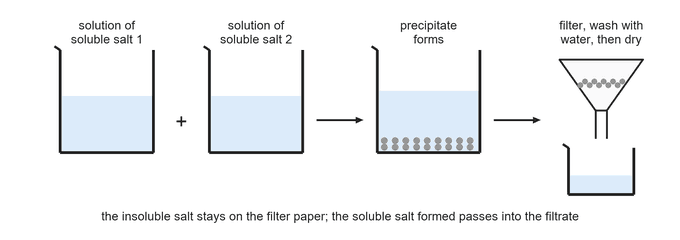
Insoluble salts (e.g. BaSO4, PbCl2, AgCl, CaCO3) are prepared by precipitation — mixing solutions of two soluble salts, then filtering, washing and drying:
BaCl2+Na2SO4→BaSO4↓+2NaCl
Step 3 — (c) A salt made by direct combination.
Iron (III) chloride is made by heating iron in a stream of dry chlorine:
2Fe+3Cl2→2FeCl3
Step 4 — (d) Preparing a sodium salt.
Sodium sulphate is made by titration — neutralising an alkali (sodium hydroxide) with the dilute acid (sulphuric acid). Both are soluble, so the exact volumes are first found using an indicator.
Therefore, (a) a salt is formed when the ionisable H of an acid is replaced by a metal or ammonium ion; (b) insoluble salts; (c) FeCl₃: 2Fe + 3Cl₂ → 2FeCl₃; (d) titration (neutralisation of an alkali).
