
Question 772 marksEasy
Define 'Neutralization'.
Confirming your payment
Sign up now and get 250 free tokens.
Acids, Bases and Salts · Question 77 of 90
Define 'Neutralization'.
Solution:
Concept: In neutralisation an acid and a base cancel each other's properties: the ions of the acid and the ions of the base join to form water.
Step 1 — Define neutralisation.
Neutralisation is the process in which the () ions of an acid react completely with the ions of a base to give salt and water only.
Step 2 — Give an example.
Sodium hydroxide and hydrochloric acid neutralise each other:
Step 3 — Show the ionic change.
The and ions are unchanged; the actual reaction is between the hydronium and hydroxide ions:
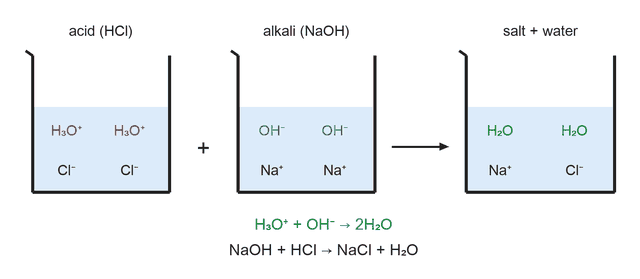
Therefore, neutralisation is the reaction of the H₃O⁺ ions of an acid with the OH⁻ ions of a base to give salt and water only.