Solution:
Concept: Pick a reaction of exactly the stated type for each part.
Step 1 — (a) A soluble sulphate from an insoluble base.
Black copper (II) oxide dissolves in warm dilute sulphuric acid to give blue copper sulphate solution:
CuO+H2SO4→CuSO4+H2O
Step 2 — (b) An insoluble salt from an acid and another salt.
Dilute sulphuric acid with barium chloride solution gives a white precipitate of barium sulphate:
BaCl2+H2SO4→BaSO4↓+2HCl
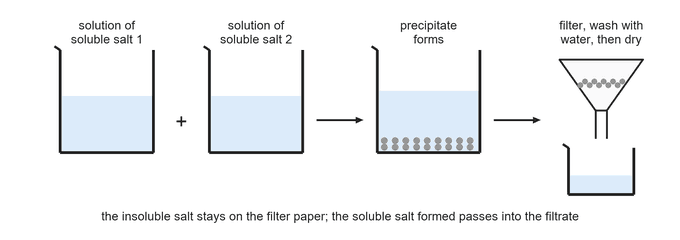
Step 3 — (c) An insoluble base from a soluble base and a soluble salt.
Sodium hydroxide with copper sulphate solution gives a pale blue precipitate of copper (II) hydroxide:
CuSO4+2NaOH→Cu(OH)2↓+Na2SO4
Step 4 — (d) A soluble sulphate from an acid and a metal.
Zinc displaces hydrogen from dilute sulphuric acid:
Zn+H2SO4→ZnSO4+H2↑
Therefore, (a) CuO + H₂SO₄ → CuSO₄ + H₂O; (b) BaCl₂ + H₂SO₄ → BaSO₄ + 2HCl; (c) CuSO₄ + 2NaOH → Cu(OH)₂ + Na₂SO₄; (d) Zn + H₂SO₄ → ZnSO₄ + H₂.
