Solution:
Concept: Recall the solubility of common chlorides and sulphates, and the kinds of salts (normal, acid, basic, mixed, complex, double).
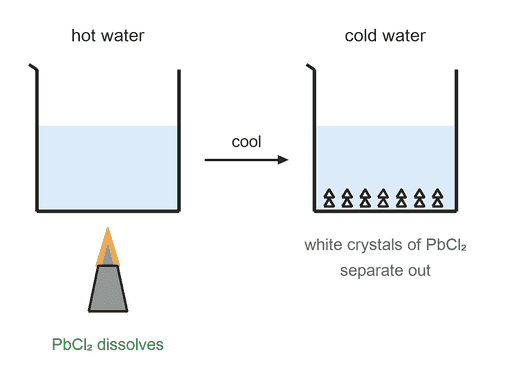
Step 1 — (a) A chloride insoluble in cold water but soluble in hot water.
Lead chloride, PbCl2, dissolves in hot water and crystallises out again on cooling.
Step 2 — (b) An insoluble chloride.
Silver chloride, AgCl, is insoluble in hot and cold water.
Step 3 — (c) Two insoluble sulphates.
Barium sulphate, BaSO4, and lead sulphate, PbSO4.
Step 4 — (d) A basic salt.
Basic lead chloride, Pb(OH)Cl — it still has an OH group.
Step 5 — (e) An acid salt.
Sodium hydrogen sulphate, NaHSO4 — it still has a replaceable H.
Step 6 — (f) A mixed salt.
A mixed salt has two different metal ions or two different acid radicals: sodium potassium carbonate, NaKCO3 (or bleaching powder, CaOCl2).
Step 7 — (g) A complex salt.
A complex salt gives a complex ion in solution: tetrammine copper (II) sulphate, [Cu(NH3)4]SO4.
Step 8 — (h) A double salt.
A double salt is two normal salts crystallised together: potash alum, K2SO4⋅Al2(SO4)3⋅24H2O.
Watch out: A double salt gives only simple ions in solution, while a complex salt keeps its complex ion.
Therefore, (a) PbCl₂, (b) AgCl, (c) BaSO₄ and PbSO₄, (d) Pb(OH)Cl, (e) NaHSO₄, (f) NaKCO₃, (g) [Cu(NH₃)₄]SO₄, (h) potash alum.
