Answer: (B) (2)
Concept: In an assertion–reason item, judge the Assertion (A) and the Reason (R) separately as true or false; only when both are true do we ask whether R correctly explains A. The Assertion is the definition of a base; the Reason is about solubility in water.
Step 1 — Judge the Assertion.
The Assertion is true: by definition a base reacts with an acid to give salt and water only, for example:
CuO+2HCl→CuCl2+H2O
Step 2 — Judge the Reason.
The Reason is true: alkalis are the bases that dissolve in water, and many bases (like CuO) do not.
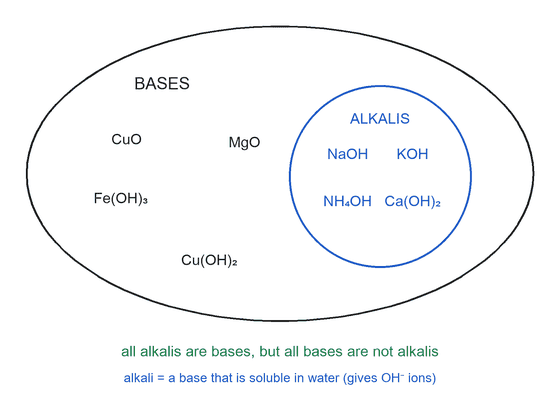
Step 3 — Decide whether R explains A.
Whether a base dissolves in water has nothing to do with its giving salt and water with an acid, so the Reason does not explain the Assertion.
Why the other options are wrong:
- (A) (1): this code says R explains A, but solubility is not the reason bases give salt and water.
- (C) (3): this code needs a false Reason, but “all alkalis are bases but all bases are not alkalis” is true.
- (D) (4): this code needs a false Assertion, but the Assertion is the definition of a base.
Therefore, both statements are true but R does not explain A, option (B).
