
Question 15 marksMedium
(a) What do you understand by the term acid ?
(b) Name the positive ion formed when an acid is dissolved in water.
(c) Draw the structure of this ion.
Confirming your payment
Sign up now and get 250 free tokens.
Acids, Bases and Salts · Question 1 of 90
(a) What do you understand by the term acid ?
(b) Name the positive ion formed when an acid is dissolved in water.
(c) Draw the structure of this ion.
Solution:
Concept: An acid gives hydrogen ions in water, but a bare ion (a proton) never stays free: it at once joins a water molecule and forms the hydronium ion, .
Step 1 — (a) What an acid is.
We define an acid by the ions it gives when it dissolves in water. An acid is a compound which, when dissolved in water, gives hydronium ions () as the only positively charged ions.
For example, hydrogen chloride gives hydronium ions and chloride ions in water:
The only positive ion in the solution is ; the negative ion, , is the acid radical.

Step 2 — (b) Name the positive ion.
The positive ion is the hydronium ion, . It forms because the ion released by the acid combines with a water molecule:
Step 3 — (c) Draw the structure of the hydronium ion.
The oxygen atom of a water molecule has two lone pairs of electrons, while the ion has no electrons at all. Oxygen donates one of its lone pairs to the ion, so the shared pair comes from oxygen alone: this is a coordinate bond.
So the hydronium ion has three O–H bonds (two ordinary covalent bonds and one coordinate bond), one lone pair left on oxygen, and an overall charge of +1, shown outside the brackets.
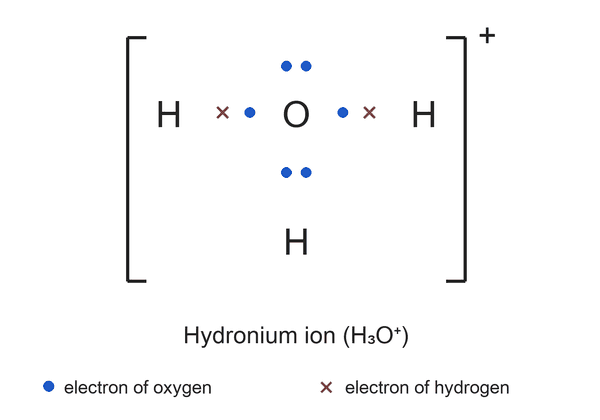
Watch out: The ion in an acid solution is written , not a free ; and in the structure, the bond to the third hydrogen uses a pair of electrons that both came from oxygen.
Therefore, (a) an acid gives as the only positive ions in water; (b) the positive ion is the hydronium ion, ; (c) it has three O–H bonds (one of them coordinate), one lone pair on oxygen and a charge of +1.