Solution:
Concept: Sodium reacts violently with acid and copper does not react with dilute acid, so their carbonates are used. Zinc carbonate is insoluble, so it needs two steps.
Step 1 — (a) Sodium sulphate.
Sodium carbonate reacts with dilute sulphuric acid:
Na2CO3+H2SO4→Na2SO4+H2O+CO2↑
Step 2 — (b) Copper sulphate.
Copper carbonate reacts with dilute sulphuric acid:
CuCO3+H2SO4→CuSO4+H2O+CO2↑
Step 3 — (c) Iron (II) sulphate.
Iron displaces hydrogen from dilute sulphuric acid:
Fe+H2SO4→FeSO4+H2↑
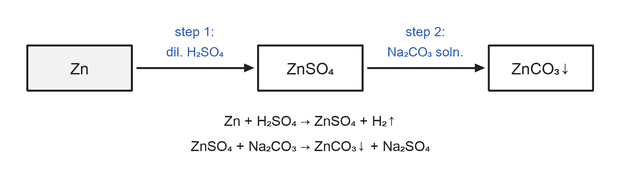
Step 4 — (d) Zinc carbonate.
We first make soluble zinc sulphate, then precipitate the carbonate with sodium carbonate solution:
Zn+H2SO4→ZnSO4+H2↑
ZnSO4+Na2CO3→ZnCO3↓+Na2SO4
Watch out: Use only the substances in the box: there is no sodium hydroxide, so sodium sulphate comes from sodium carbonate.
Therefore, (a) Na₂CO₃ + H₂SO₄; (b) CuCO₃ + H₂SO₄; (c) Fe + H₂SO₄; (d) Zn + H₂SO₄, then ZnSO₄ + Na₂CO₃.
