Solution:
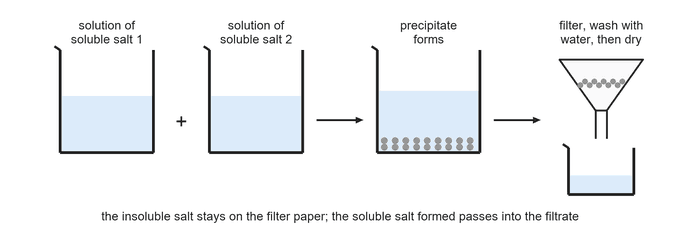
Concept: Parts (a) and (b) are precipitation reactions in which an insoluble chloride forms. Washing soda crystals lose water to the air (efflorescence).
Step 1 — (a) Silver nitrate and sodium chloride.
A white precipitate of silver chloride forms:
AgNO3+NaCl→AgCl↓+NaNO3
Step 2 — (b) Lead nitrate and sodium chloride.
A white precipitate of lead chloride forms, as it is insoluble in cold water:
Pb(NO3)2+2NaCl→PbCl2↓+2NaNO3
Step 3 — (c) Washing soda crystals in air.
The transparent crystals lose nine molecules of water of crystallisation to the air and crumble into a white powder (sodium carbonate monohydrate):
Na2CO3⋅10H2O→Na2CO3⋅H2O+9H2O

Watch out: Efflorescence is losing water to the air; deliquescence is gaining it.
Therefore, (a) AgNO₃ + NaCl → AgCl + NaNO₃; (b) Pb(NO₃)₂ + 2NaCl → PbCl₂ + 2NaNO₃; (c) washing soda loses water and becomes a white powder — efflorescence.
