Solution:
Concept: Choose the method from the starting material: an insoluble base needs an acid, iron (III) chloride needs chlorine, KOH needs titration, and insoluble lead salts are made from lead carbonate in two steps through soluble lead nitrate (a direct reaction would stop at once behind an insoluble coating).
Step 1 — (a) Copper [II] sulphate from copper [II] oxide.
The insoluble base is neutralised by dilute sulphuric acid:
CuO+H2SO4→CuSO4+H2O
Step 2 — (b) Iron [III] chloride from iron.
Iron combines directly with dry chlorine:
2Fe+3Cl2→2FeCl3
Step 3 — (c) Lead sulphate from lead carbonate.
Lead carbonate is first dissolved in dilute nitric acid, then lead sulphate is precipitated:
PbCO3+2HNO3→Pb(NO3)2+H2O+CO2↑
Pb(NO3)2+H2SO4→PbSO4↓+2HNO3

Step 4 — (d) Potassium sulphate from KOH solution.
The alkali is neutralised by dilute sulphuric acid (titration):
2KOH+H2SO4→K2SO4+2H2O
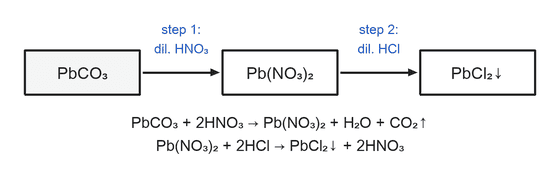
Step 5 — (e) Lead [II] chloride from lead carbonate.
Again lead nitrate is made first, then lead chloride is precipitated:
PbCO3+2HNO3→Pb(NO3)2+H2O+CO2↑
Pb(NO3)2+2HCl→PbCl2↓+2HNO3
Step 6 — (f) Sodium sulphate using dilute sulphuric acid.
Sodium hydroxide is neutralised by the dilute acid (titration):
2NaOH+H2SO4→Na2SO4+2H2O
Step 7 — (g) Copper chloride using copper carbonate.
Copper carbonate reacts with dilute hydrochloric acid:
CuCO3+2HCl→CuCl2+H2O+CO2↑
Watch out: Lead carbonate is never treated directly with dilute H₂SO₄ or HCl, as the insoluble product coats it.
Therefore, the equations are as above: (a) CuO + H₂SO₄; (b) 2Fe + 3Cl₂; (c) and (e) PbCO₃ → Pb(NO₃)₂ → PbSO₄ or PbCl₂; (d) 2KOH + H₂SO₄; (f) 2NaOH + H₂SO₄; (g) CuCO₃ + 2HCl.
