Solution:
Concept: A weak acid is only partly ionised, so un-ionised molecules remain. Zinc hydroxide is amphoteric: an alkali precipitates it and then dissolves it when added in excess.
Step 1 — (a) Solute molecules besides water.
The weak acid B is only partly ionised, so its solution contains solute molecules as well as ions. The strong acid A and the strong alkali C are almost fully ionised.
Step 2 — (b) The white precipitate with zinc sulphate.
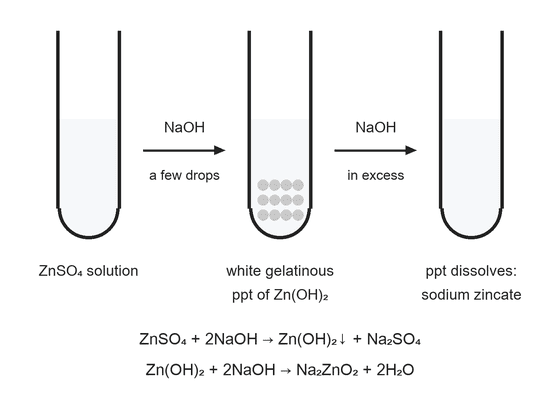
The strong alkali C (e.g. NaOH) first gives a white gelatinous precipitate of zinc hydroxide:
ZnSO4+2NaOH→Zn(OH)2↓+Na2SO4
Step 3 — (b) Why the precipitate disappears.
In excess alkali the amphoteric zinc hydroxide dissolves, forming soluble sodium zincate:
Zn(OH)2+2NaOH→Na2ZnO2+2H2O
Therefore, (a) B, the weak acid; (b) C, the strong alkali.
