Solution:
Concept: Choose a reaction in which the unwanted solids can be filtered off, and avoid reactions that form an insoluble coating.
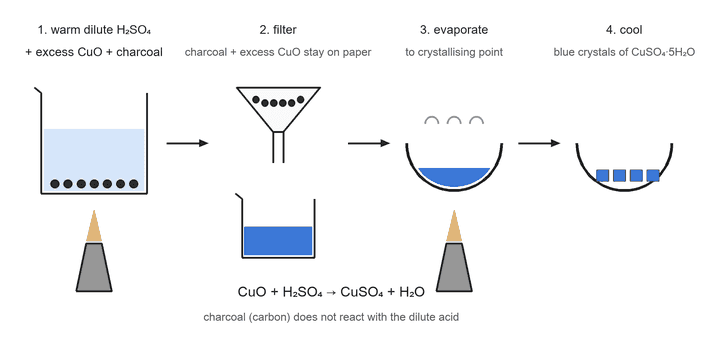
Step 1 — (a) Copper sulphate crystals from charcoal and copper oxide.
We warm the mixture with dilute sulphuric acid. Copper oxide (a base) reacts; charcoal (carbon) does not:
CuO+H2SO4→CuSO4+H2O
We filter off the charcoal (and any unreacted copper oxide), concentrate the blue filtrate by heating and cool it to get blue crystals of CuSO4⋅5H2O.
Step 2 — (b) Zinc sulphate crystals from zinc dust.
We add the zinc dust a little at a time to warm dilute sulphuric acid until no more dissolves. Both zinc and zinc oxide give zinc sulphate:
Zn+H2SO4→ZnSO4+H2↑
ZnO+H2SO4→ZnSO4+H2O
We filter off the excess solid, then concentrate and cool the filtrate to get white crystals of ZnSO4⋅7H2O.
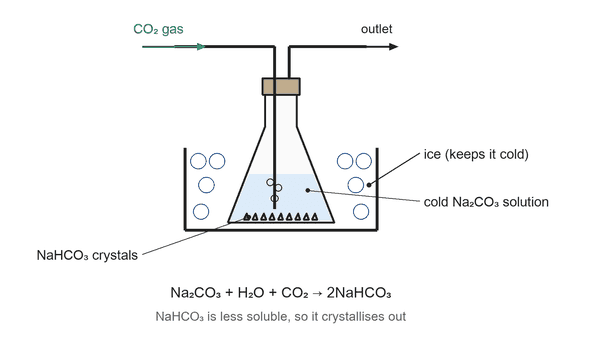
Step 3 — (c) Sodium hydrogen carbonate crystals.
We pass carbon dioxide through a cold, concentrated solution of sodium carbonate kept in ice. Sodium hydrogen carbonate is less soluble, so it crystallises out; we filter and dry the crystals:
Na2CO3+H2O+CO2→2NaHCO3
Step 4 — (d) Calcium sulphate from calcium carbonate: first dissolve the carbonate.
Dilute sulphuric acid cannot be used directly, because calcium sulphate is only sparingly soluble and would coat the carbonate and stop the reaction. So we first dissolve the calcium carbonate in dilute hydrochloric acid to get soluble calcium chloride:
CaCO3+2HCl→CaCl2+H2O+CO2↑
Step 5 — (d) Then precipitate calcium sulphate.
We add sodium sulphate solution; calcium sulphate precipitates and is filtered, washed and dried:
CaCl2+Na2SO4→CaSO4↓+2NaCl

Watch out: In (d), adding dilute H2SO4 straight to CaCO3 gives almost no product, because the reaction stops behind the calcium sulphate layer.
Therefore, (a) warm with dilute H₂SO₄, filter off charcoal, crystallise CuSO₄·5H₂O; (b) dissolve in dilute H₂SO₄, filter, crystallise ZnSO₄·7H₂O; (c) pass CO₂ into cold Na₂CO₃ solution; (d) CaCO₃ → CaCl₂ (dil. HCl) → CaSO₄ (Na₂SO₄ solution).
