
Opening your dashboard
Class 10 Chemistry Chapter 3 Acids, Bases and Salts: Previous Year Questions
60 questions on Chapter 3, each solved step by step. Class 10 Chemistry, ICSE 2026-27.
60 questions with solutions
1–5 marks · Mixed difficulty
- 11 mark
Question 1
Fill in the blanks with the choices given in brackets.
Higher the pH value of a solution, the more ...............(acidic/alkaline) it is.
Solve with AIWritten solution
Solution:
Concept: The pH scale runs from 0 to 14. A solution of pH 7 is neutral, a pH below 7 is acidic and a pH above 7 is alkaline. The farther the pH is from 7, the stronger the acidity or the alkalinity.
Step 1 — Recall what the pH number tells us.
The pH falls as the concentration of hydronium ions rises. So a high pH means very few ions and many ions in the solution.
Step 2 — Decide which way the scale goes.
Above 7 the solution is alkaline, and it becomes more alkaline as the pH rises from 8 towards 14. Below 7 it is acidic, and it becomes more acidic as the pH falls towards 0.

Watch out: Do not read the pH as 'the amount of acid'; a HIGHER pH means LESS acid and more alkali.
Therefore, the higher the pH value of a solution, the more alkaline it is.
- 21 mark
Question 2
Write balanced chemical equations for each of the following:
Action of Hydrochloric acid on sodium bicarbonate.
Solve with AIWritten solution
Solution:
Concept: A dilute acid decomposes a carbonate or a hydrogen carbonate (bicarbonate) to give a salt, water and carbon dioxide.
Step 1 — Name the reactants and the products.
Sodium bicarbonate is sodium hydrogen carbonate, . With hydrochloric acid it gives the salt sodium chloride, water and carbon dioxide.
Step 2 — Write and balance the equation.
One ion takes up one hydrogen ion from the acid, so the two react one to one:
Each side has 1 Na, 1 C, 3 O, 2 H and 1 Cl, so the equation is balanced.
Step 3 — Note what is seen.
Carbon dioxide comes off with brisk effervescence, and it turns lime water milky.

Watch out: A bicarbonate needs only ONE HCl; writing 2HCl (as for a carbonate such as Na₂CO₃) leaves the equation unbalanced.
Therefore, NaHCO₃ + HCl → NaCl + H₂O + CO₂↑.
- 35 marks
Question 3
Match the salts given in Column I with their method of preparation given in Column II:
Column I Column II (i) from PbO (A) Simple displacement (ii) from Mg (B) Titration (iii) from Fe (C) Neutralization (iv) from NaOH (D) Precipitation (v) from (E) Combination Solve with AIWritten solution
Solution:
Concept: The method of preparing a salt depends on its solubility and on the starting material: an insoluble salt is made by precipitation; a soluble salt from an active metal by simple displacement of hydrogen from a dilute acid; a soluble salt from an insoluble base or carbonate by neutralisation with a dilute acid; a salt from two soluble reactants (an alkali and an acid) by titration; and anhydrous iron (III) chloride by direct combination of the metal with chlorine.
Step 1 — Lead nitrate from PbO: (C) Neutralization.
Lead (II) oxide is an insoluble base. It is warmed with dilute nitric acid, and the excess oxide is filtered off before the solution is crystallised.
Step 2 — Magnesium chloride from Mg: (A) Simple displacement.
Magnesium is above hydrogen in the activity series, so it displaces hydrogen from dilute hydrochloric acid.
Step 3 — Iron (III) chloride from Fe: (E) Combination.
Iron with dilute hydrochloric acid gives only iron (II) chloride, so iron (III) chloride is made by heating iron in dry chlorine, a direct combination of the two elements.
Step 4 — Sodium nitrate from NaOH: (B) Titration.
Sodium hydroxide and nitric acid are both soluble, so an excess of either could not be filtered off. The exact volumes that neutralise each other are found by titration and then mixed without the indicator.
Step 5 — Zinc carbonate from ZnSO₄: (D) Precipitation.
Zinc carbonate is insoluble in water, so it is precipitated by mixing zinc sulphate solution with sodium carbonate solution; it is then filtered, washed and dried.
Step 6 — Put the matches together.
Each salt in Column I has now been given one method from Column II:
Column I Column II (i) from PbO (C) Neutralization (ii) from Mg (A) Simple displacement (iii) from Fe (E) Combination (iv) from NaOH (B) Titration (v) from (D) Precipitation 
Watch out: Iron with dilute HCl does NOT give FeCl₃; it gives FeCl₂. FeCl₃ needs chlorine.
Therefore, (i) – (C), (ii) – (A), (iii) – (E), (iv) – (B), (v) – (D).
- 41 mark
Question 4
Fill in the blanks from the choices given in brackets:
When a metallic oxide is dissolved in water, the solution formed has a high concentration of .............. ions. (, , )
Solve with AIWritten solution
Solution:
Concept: A metallic oxide is a basic oxide. The oxide of an active metal such as sodium dissolves in water to form an alkali, and an alkali is a base that dissolves in water and gives hydroxyl ions () as the only negatively charged ions.
Step 1 — See what the oxide forms in water.
Sodium oxide is a typical soluble metallic oxide. It reacts with water to form sodium hydroxide:
Step 2 — See which ions the solution holds.
Sodium hydroxide dissociates in water and gives hydroxyl ions:
So the solution has a high concentration of ions. and ions come from acids, not from metallic oxides.

Therefore, when a metallic oxide is dissolved in water, the solution formed has a high concentration of OH⁻ ions.
- 51 mark
Question 5
To increase the pH value of a neutral solution, we should add:
Solve with AIAnswer
(A) an acid
(B) an acid salt
- Correct
(C) an alkali
(D) a salt
Answer: (C) an alkali
Concept: The pH scale runs from 0 to 14. A solution of pH 7 is neutral, a pH below 7 is acidic and a pH above 7 is alkaline. The farther the pH is from 7, the stronger the acidity or the alkalinity.
Step 1 — Say what 'increase the pH' needs.
A neutral solution has pH 7. To raise its pH above 7 we must make it alkaline, that is, add ions.
Step 2 — Pick the substance that gives OH⁻ ions.
An alkali such as sodium hydroxide gives hydroxyl ions in water, so adding it raises the pH above 7.
Watch out: Raising the pH means making the solution LESS acidic; anything that gives H₃O⁺ ions lowers the pH.
Why the other options are wrong:
- (A) an acid: an acid gives ions, which make the solution acidic and LOWER the pH below 7.
- (B) an acid salt: an acid salt such as still has a replaceable hydrogen; it gives ions in water and so lowers the pH.
- (D) a salt: a normal salt of a strong acid and a strong alkali, such as sodium chloride, is neutral and leaves the pH at 7.
Therefore, to increase the pH of a neutral solution we should add an alkali, option (C).
- 61 mark
Question 6
Anhydrous iron (III) chloride is prepared by:
Solve with AIAnswer
- Correct
(A) direct combination
(B) simple displacement
(C) decomposition
(D) neutralization
Answer: (A) direct combination
Concept: Iron forms two chlorides. With dilute hydrochloric acid it gives only the lower chloride, iron (II) chloride, because the hydrogen set free is not an oxidising agent. Heated in dry chlorine, a strong oxidising agent, it gives the higher chloride, iron (III) chloride, by direct combination.
Step 1 — Combine iron with chlorine.
Iron is heated in a stream of dry chlorine. Chlorine is a strong oxidising agent, so the two elements combine directly to give iron (III) chloride:
Step 2 — Keep it anhydrous.
Iron (III) chloride is deliquescent (it absorbs moisture from the air), so the apparatus is kept dry and the product is collected in a dry receiver. This gives the anhydrous salt.
Watch out: Anhydrous FeCl₃ cannot be got by heating the hydrated salt; heat breaks it down instead.
Why the other options are wrong:
- (B) simple displacement: iron with dilute hydrochloric acid gives iron (II) chloride, , not iron (III) chloride.
- (C) decomposition: decomposition breaks a compound into simpler substances; heating hydrated iron (III) chloride does not leave the anhydrous salt but breaks it down to iron (III) oxide, water and hydrogen chloride.
- (D) neutralization: neutralising iron (III) hydroxide with hydrochloric acid gives iron (III) chloride only in solution; it crystallises as the hydrated salt, which cannot be dried by heating for the same reason.
Therefore, anhydrous iron (III) chloride is prepared by direct combination, option (A).
- 72 marks
Question 7
Write a balanced chemical equation for the preparation of each of the following salts:
(i) Copper carbonate
(ii) Ammonium sulphate crystals
Solve with AIWritten solution
Solution:
Concept: The method of preparing a salt depends on its solubility and on the starting material: an insoluble salt is made by precipitation; a soluble salt from an active metal by simple displacement of hydrogen from a dilute acid; a soluble salt from an insoluble base or carbonate by neutralisation with a dilute acid; a salt from two soluble reactants (an alkali and an acid) by titration; and anhydrous iron (III) chloride by direct combination of the metal with chlorine.
Step 1 — Copper carbonate: precipitation.
Copper carbonate is insoluble in water, so it is made by mixing solutions of two soluble salts, copper sulphate and sodium carbonate. The precipitate is filtered, washed and dried.
Each side has 1 Cu, 1 S, 2 Na, 1 C and 7 O, so the equation is balanced.
Step 2 — Ammonium sulphate crystals: titration.
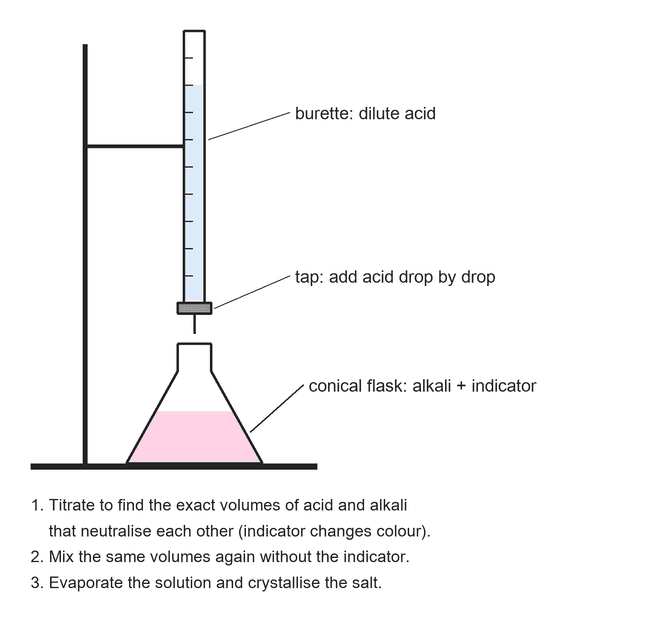
Ammonium sulphate is soluble and both reactants (ammonium hydroxide and dilute sulphuric acid) are soluble, so the exact volumes that neutralise each other are found by titration. The same volumes are mixed without the indicator, and the solution is evaporated and crystallised.
Sulphuric acid is dibasic, so one molecule of it needs two molecules of ammonium hydroxide.
Watch out: The precipitate from copper sulphate and sodium carbonate is really a basic copper carbonate (CuCO₃·Cu(OH)₂); the ICSE equation writes it simply as CuCO₃.
Therefore, (i) CuSO₄ + Na₂CO₃ → CuCO₃↓ + Na₂SO₄; (ii) 2NH₄OH + H₂SO₄ → (NH₄)₂SO₄ + 2H₂O.
- 81 mark
Question 8
Write a balanced chemical equation for each of the following:
Action of dilute hydrochloric acid on magnesium sulphite.
Solve with AIWritten solution
Solution:
Concept: A dilute acid decomposes a sulphite to give a salt, water and sulphur dioxide.
Step 1 — Name the products.
Magnesium sulphite, , with dilute hydrochloric acid gives magnesium chloride, water and sulphur dioxide.
Step 2 — Write and balance the equation.
Magnesium is divalent, so one needs two molecules of HCl:
Each side has 1 Mg, 1 S, 3 O, 2 H and 2 Cl, so the equation is balanced. Sulphur dioxide is a colourless gas with a suffocating smell.
Watch out: The gas from a sulphite is SO₂, not SO₃ or H₂S.
Therefore, MgSO₃ + 2HCl → MgCl₂ + H₂O + SO₂↑.
- 91 mark
Question 9
Fill up the blanks with the correct choice given in brackets.
The salt prepared by the method of direct combination is ............... (iron (II) chloride / iron (III) chloride)
Solve with AIWritten solution
Solution:
Concept: Iron forms two chlorides. With dilute hydrochloric acid it gives only the lower chloride, iron (II) chloride, because the hydrogen set free is not an oxidising agent. Heated in dry chlorine, a strong oxidising agent, it gives the higher chloride, iron (III) chloride, by direct combination.
Step 1 — Say what direct combination means.
Direct combination means heating the metal with the non-metal itself, here iron with dry chlorine.
Step 2 — Find the chloride it gives.
Chlorine oxidises iron to its higher valency, so the product is iron (III) chloride:
Step 3 — Rule out the other choice.
Iron (II) chloride is made by simple displacement, from iron and dilute hydrochloric acid:
Therefore, the salt prepared by the method of direct combination is iron (III) chloride.
- 102 marks
Question 10
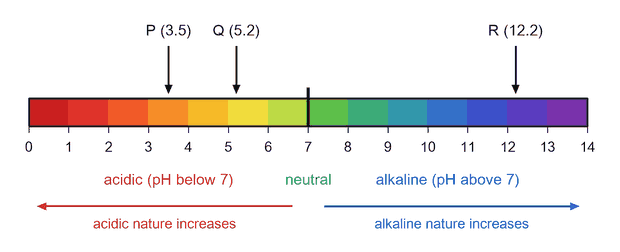
Three solutions P, Q and R have pH value of 3.5, 5.2 and 12.2 respectively.
Which one of these is a:
(i) Weak acid?
(ii) Strong alkali?
Solve with AIWritten solution
Solution:
Concept: The pH scale runs from 0 to 14. A solution of pH 7 is neutral, a pH below 7 is acidic and a pH above 7 is alkaline. The farther the pH is from 7, the stronger the acidity or the alkalinity.
Step 1 — Sort the solutions.
P (pH 3.5) and Q (pH 5.2) are below 7, so both are acidic. R (pH 12.2) is above 7, so it is alkaline.
Step 2 — (i) Find the weak acid.
Q is closer to 7 than P, so it has the lower concentration of ions. Q is therefore the weak acid, and P is the more strongly acidic one.
Step 3 — (ii) Find the strong alkali.
R is far above 7, so it has a high concentration of ions. R is the strong alkali.
Watch out: The pH also depends on how concentrated a solution is. At this level a pH close to 7 is read as a weak acid or alkali, and a pH far from 7 as a strong one.
Therefore, (i) Q (pH 5.2) is the weak acid; (ii) R (pH 12.2) is the strong alkali.
- 112 marks
Question 11
Write a balanced equation for the preparation of each of the following salts:
(i) Copper sulphate from Copper carbonate.
(ii) Zinc carbonate from Zinc sulphate.
Solve with AIWritten solution
Solution:
Concept: The method of preparing a salt depends on its solubility and on the starting material: an insoluble salt is made by precipitation; a soluble salt from an active metal by simple displacement of hydrogen from a dilute acid; a soluble salt from an insoluble base or carbonate by neutralisation with a dilute acid; a salt from two soluble reactants (an alkali and an acid) by titration; and anhydrous iron (III) chloride by direct combination of the metal with chlorine.
Step 1 — (i) Copper sulphate from copper carbonate.
Copper carbonate is insoluble, so it is added a little at a time to warm dilute sulphuric acid until no more dissolves (no more effervescence). The excess carbonate is filtered off and the filtrate is crystallised.
Step 2 — (ii) Zinc carbonate from zinc sulphate.
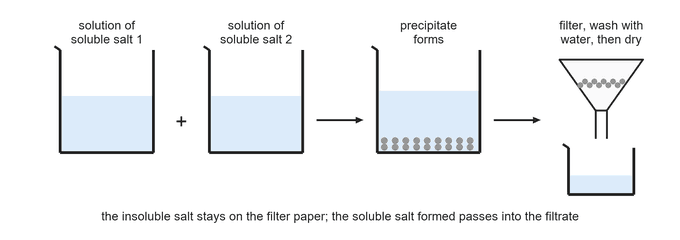
Zinc carbonate is insoluble, so it is precipitated by mixing zinc sulphate solution with sodium carbonate solution. The precipitate is filtered, washed and dried.
Watch out: An excess of the INSOLUBLE reactant is used in (i), so that no free acid is left in the salt solution.
Therefore, (i) CuCO₃ + H₂SO₄ → CuSO₄ + H₂O + CO₂↑; (ii) ZnSO₄ + Na₂CO₃ → ZnCO₃↓ + Na₂SO₄.
- 121 mark
Question 12
Write a balanced chemical equation for each of the following reactions:
Action of dilute sulphuric acid on sodium hydroxide.
Solve with AIWritten solution
Solution:
Concept: An acid neutralises an alkali to give a salt and water only.
Step 1 — Count the hydrogen ions to be replaced.
Sulphuric acid is dibasic: one molecule has two replaceable hydrogen ions. So one molecule of it neutralises two molecules of sodium hydroxide.
Step 2 — Write and balance the equation.
The normal salt formed is sodium sulphate:
Each side has 2 Na, 6 O, 4 H and 1 S, so the equation is balanced. In the laboratory this is done by titration, since both reactants are soluble.
Watch out: With too little NaOH only one hydrogen is replaced and the acid salt NaHSO₄ forms; the balanced equation for the normal salt needs 2NaOH.
Therefore, 2NaOH + H₂SO₄ → Na₂SO₄ + 2H₂O.
- 131 mark
Question 13
State one observation for each of the following:
A small piece of zinc is added to dilute hydrochloric acid.
Solve with AIWritten solution
Solution:
Concept: A metal displaces hydrogen from dilute hydrochloric or sulphuric acid only if it is above hydrogen in the activity series (K, Na, Ca, Mg, Al, Zn, Fe, Pb, H, Cu, Hg, Ag, Au).
Step 1 — Decide whether zinc reacts.
Zinc is above hydrogen in the activity series, so it displaces hydrogen from dilute hydrochloric acid:
Step 2 — Describe what is seen.
Bubbles of a colourless, odourless gas come off briskly (effervescence), and the zinc slowly dissolves. A burning splint held at the mouth of the tube makes the gas burn with a 'pop', which shows it is hydrogen.

Watch out: The observation is what you SEE (effervescence of a colourless gas), not just the name of the gas.
Therefore, brisk effervescence is seen: a colourless gas (hydrogen) is given off, which burns with a 'pop' sound, and the zinc slowly dissolves.
- 141 mark
Question 14
Give the appropriate term defined by the statements given below:
The substance that releases hydronium ion as the only positive ion when dissolved in water.
Solve with AIWritten solution
Solution:
Concept: Acids and alkalis are defined by the ions they give in water.
Step 1 — Match the statement to a definition.
The statement describes a substance that gives hydronium ions as the ONLY positive ions in water. That is the definition of an acid.
Step 2 — Show it with an example.
Hydrogen chloride ionises in water and gives as its only positive ion:
Therefore, the term is acid.
- 153 marks
Question 15
The pH values of three solutions A, B and C are given in the table. Answer the following questions:
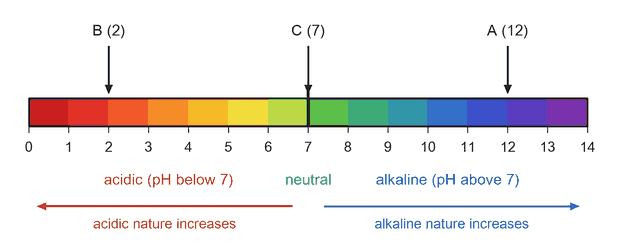
Solution pH value A 12 B 2 C 7 (i) Which solution will have no effect on litmus solution?
(ii) Which solution will liberate when reacted with sodium carbonate?
(iii) Which solution will turn red litmus solution blue?
Solve with AIWritten solution
Solution:
Concept: The pH scale runs from 0 to 14. A solution of pH 7 is neutral, a pH below 7 is acidic and a pH above 7 is alkaline. The farther the pH is from 7, the stronger the acidity or the alkalinity.
Step 1 — Sort the solutions.
A (pH 12) is above 7, so it is alkaline. B (pH 2) is below 7, so it is acidic. C (pH 7) is neutral.
Step 2 — (i) No effect on litmus.
A neutral solution changes neither red nor blue litmus, so the answer is C.
Step 3 — (ii) Liberates carbon dioxide with sodium carbonate.
Acids decompose carbonates and set free carbon dioxide, so the answer is B. If B were, say, dilute hydrochloric acid:
Step 4 — (iii) Turns red litmus blue.
Alkalis turn red litmus blue, so the answer is A.
Therefore, (i) C; (ii) B; (iii) A.
- 164 marks
Question 16
Choose the method of preparation of the following salts, from the methods given in the list:
[List: A. Neutralization B. Precipitation C. Direct combination D. Substitution]
(i) Lead chloride
(ii) Iron (II) sulphate
(iii) Sodium nitrate
(iv) Iron (III) chloride
Solve with AIWritten solution
Solution:
Concept: The method of preparing a salt depends on its solubility and on the starting material: an insoluble salt is made by precipitation; a soluble salt from an active metal by simple displacement of hydrogen from a dilute acid; a soluble salt from an insoluble base or carbonate by neutralisation with a dilute acid; a salt from two soluble reactants (an alkali and an acid) by titration; and anhydrous iron (III) chloride by direct combination of the metal with chlorine.
Step 1 — (i) Lead chloride: B. Precipitation.
Lead chloride is insoluble in cold water, so it is precipitated from lead nitrate solution with a soluble chloride:
Step 2 — (ii) Iron (II) sulphate: D. Substitution.
Iron is above hydrogen, so it displaces (substitutes) hydrogen from dilute sulphuric acid:
Step 3 — (iii) Sodium nitrate: A. Neutralization.
Sodium hydroxide is neutralised by dilute nitric acid, the volumes being fixed by titration:
Step 4 — (iv) Iron (III) chloride: C. Direct combination.
Iron is heated in dry chlorine:
Therefore, (i) B. Precipitation; (ii) D. Substitution; (iii) A. Neutralization; (iv) C. Direct combination.
- 171 mark
Question 17
State one relevant reason for each of the following:
(iii) Hydrated copper sulphate crystals turn white on heating.
Solve with AIWritten solution
Solution:
Concept: The blue colour of copper sulphate crystals is due to their water of crystallisation; anhydrous copper sulphate is white.
Step 1 — Say what heat does to the crystals.
On heating, hydrated copper sulphate, , loses its water of crystallisation:
Step 2 — Explain the colour change.
Without the water of crystallisation the crystal structure breaks down to a white powder, anhydrous copper sulphate. The water driven off collects as droplets near the cooler mouth of the test tube.
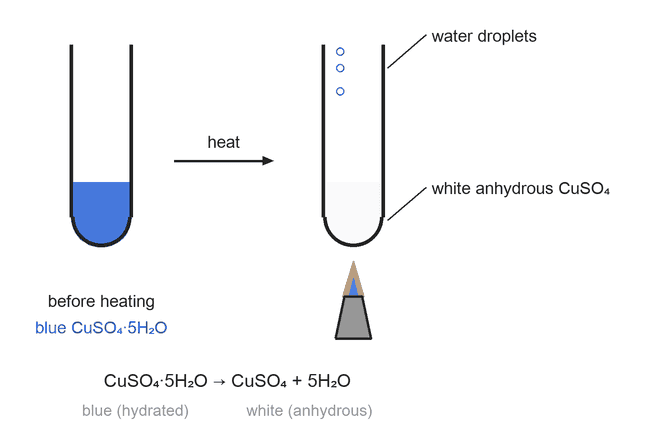
Watch out: The white solid is still copper sulphate (anhydrous); it is not copper oxide.
Therefore, the crystals turn white because on heating they lose their water of crystallisation and become white anhydrous copper sulphate.
- 181 mark
Question 18
Fill in the blanks from the choices given in brackets:
(ii) A salt prepared by displacement reaction is ...............
(ferric chloride, ferrous chloride, silver chloride)
Solve with AIWritten solution
Solution:
Concept: A metal displaces hydrogen from dilute hydrochloric or sulphuric acid only if it is above hydrogen in the activity series (K, Na, Ca, Mg, Al, Zn, Fe, Pb, H, Cu, Hg, Ag, Au). Iron does this, but it forms the lower chloride.
Step 1 — Use iron and dilute hydrochloric acid.
Iron displaces hydrogen from dilute hydrochloric acid and forms iron (II) chloride, that is, ferrous chloride:
Step 2 — Rule out the other two.
Ferric chloride is made by direct combination of iron with chlorine. Silver is below hydrogen and does not react with dilute hydrochloric acid, so silver chloride is made by precipitation.
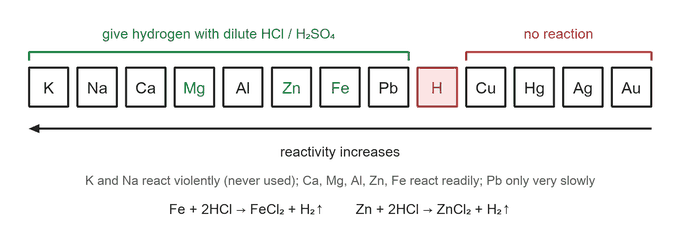
Therefore, a salt prepared by displacement reaction is ferrous chloride.
- 191 mark
Question 19
Fill in the blanks from the choices given in brackets:
(iv) An alkali which completely dissociates into ions is ...............
(ammonium hydroxide, calcium hydroxide, lithium hydroxide)
Solve with AIWritten solution
Solution:
Concept: A strong alkali is almost completely dissociated into ions in water; a weak alkali is only partly dissociated.
Step 1 — Pick the alkali-metal hydroxide.
Lithium hydroxide is the hydroxide of an alkali metal, like sodium hydroxide and potassium hydroxide. Like them it dissociates completely in water:
Step 2 — Rule out the other two.
Ammonium hydroxide is only feebly dissociated, so its solution holds many molecules and few ions. Calcium hydroxide is listed as a weak alkali in the book because so little of it dissolves that lime water has only a low concentration.

Watch out: Strictly, the little calcium hydroxide that does dissolve is almost fully dissociated; it is 'weak' in the book's sense because it is only slightly soluble. Ammonium hydroxide is the true weak (feebly ionised) alkali.
Therefore, an alkali which completely dissociates into ions is lithium hydroxide.
- 201 mark
Question 20
Differentiate between the following pairs based on the information given in the brackets.
(iii) Acid and Alkali (formation of type of ions)
Solve with AIWritten solution
Solution:
Concept: Acids and alkalis are told apart by the ions each forms in water.
Step 1 — The ions an acid forms.
An acid dissolves in water to give hydronium ions () as the ONLY positive ions:
Step 2 — The ions an alkali forms.
An alkali dissolves in water to give hydroxyl ions () as the ONLY negative ions:
Therefore, an acid forms H₃O⁺ ions as the only positive ions in water, while an alkali forms OH⁻ ions as the only negative ions.
- 213 marks
Question 21
Write balanced chemical equations, for the preparation of the given salts.
(i) to (iii) by using the methods A to C respectively:
A: Neutralization B: Precipitation C: Titration
(i) Copper sulphate
(ii) Zinc carbonate
(iii) Ammonium sulphate
Solve with AIWritten solution
Solution:
Concept: The method of preparing a salt depends on its solubility and on the starting material: an insoluble salt is made by precipitation; a soluble salt from an active metal by simple displacement of hydrogen from a dilute acid; a soluble salt from an insoluble base or carbonate by neutralisation with a dilute acid; a salt from two soluble reactants (an alkali and an acid) by titration; and anhydrous iron (III) chloride by direct combination of the metal with chlorine.
Step 1 — (i) Copper sulphate by A: Neutralization.
Copper is below hydrogen and does not react with dilute sulphuric acid, so the insoluble base copper (II) oxide is used. It is warmed with dilute sulphuric acid, the excess oxide is filtered off and the solution is crystallised.
Step 2 — (ii) Zinc carbonate by B: Precipitation.
Zinc carbonate is insoluble, so it is precipitated by mixing zinc sulphate solution with sodium carbonate solution:
Step 3 — (iii) Ammonium sulphate by C: Titration.
Ammonium hydroxide and dilute sulphuric acid are both soluble, so the exact volumes are found by titration:
Watch out: Copper metal itself cannot be used for (i), because it does not displace hydrogen from dilute sulphuric acid.
Therefore, (i) CuO + H₂SO₄ → CuSO₄ + H₂O; (ii) ZnSO₄ + Na₂CO₃ → ZnCO₃↓ + Na₂SO₄; (iii) 2NH₄OH + H₂SO₄ → (NH₄)₂SO₄ + 2H₂O.
- 221 mark
Question 22
The metallic oxide which when reacts with HCl forms salt and water:
Solve with AIAnswer
(A) Carbon monoxide
(B) Nitrous oxide
(C) Ammonium hydroxide
- Correct
(D) Sodium oxide
Answer: (D) Sodium oxide
Concept: A basic (metallic) oxide reacts with an acid to give a salt and water only.
Step 1 — Find the metallic oxide.
Of the four, only sodium oxide is the oxide of a metal, so it is a basic oxide.
Step 2 — Check its reaction with HCl.
Sodium oxide neutralises hydrochloric acid and gives the salt sodium chloride and water:
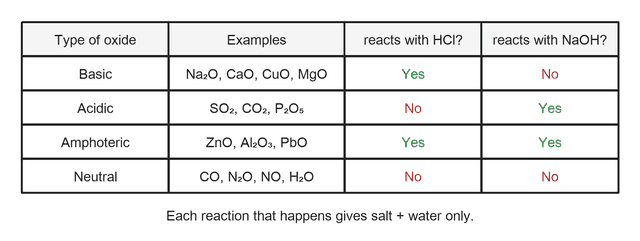
Watch out: Ammonium hydroxide also gives a salt and water with HCl, but the question asks for a metallic OXIDE.
Why the other options are wrong:
- (A) Carbon monoxide: carbon monoxide is the oxide of a non-metal and a neutral oxide; it does not react with acids.
- (B) Nitrous oxide: nitrous oxide is also a non-metallic, neutral oxide; it does not react with acids.
- (C) Ammonium hydroxide: ammonium hydroxide does give a salt and water with HCl, but it is a hydroxide (a weak alkali), not a metallic oxide.
Therefore, the metallic oxide that reacts with HCl to form salt and water is sodium oxide, option (D).
- 233 marks
Question 23
Write balanced equation for the following conversions:
(a) Carbon from cane sugar and concentrated sulphuric acid.
(b) Ferric nitrate from ferric hydroxide and nitric acid.
(c) Ammonium sulphate from ammonium hydroxide and sulphuric acid.
Solve with AIWritten solution
Solution:
Concept: Concentrated sulphuric acid is a strong dehydrating agent: it removes the elements of water (hydrogen and oxygen in the ratio 2 : 1) from compounds such as sugar. A salt is made by neutralising a base with the matching acid.
Step 1 — (a) Carbon from cane sugar.
Cane sugar, , holds 22 H and 11 O, exactly 11 molecules of water. Concentrated sulphuric acid removes them, leaving a black, spongy mass of carbon:
Step 2 — (b) Ferric nitrate from ferric hydroxide.
Ferric hydroxide is an insoluble tri-acidic base, so one formula unit needs three molecules of nitric acid:
Step 3 — (c) Ammonium sulphate from ammonium hydroxide.
Sulphuric acid is dibasic, so one molecule neutralises two molecules of ammonium hydroxide:
Watch out: In (a) the acid is not used up in the equation; it only takes away the water, so it is written over the arrow.
Therefore, (a) C₁₂H₂₂O₁₁ → 12C + 11H₂O (conc. H₂SO₄); (b) Fe(OH)₃ + 3HNO₃ → Fe(NO₃)₃ + 3H₂O; (c) 2NH₄OH + H₂SO₄ → (NH₄)₂SO₄ + 2H₂O.
- 241 mark
Question 24
The acid which does not form acid salt by a basic radical:
Solve with AIAnswer
(A)
(B)
(C)
- Correct
(D)
Answer: (D)
Concept: The basicity of an acid is the number of hydronium ions one molecule gives in water, that is, the number of replaceable hydrogen ions. Only an acid with two or more replaceable hydrogen ions can have them partly replaced, so only a polybasic acid can form an acid salt.
Step 1 — Find the basicity of acetic acid.
Acetic acid, , has four hydrogen atoms, but only the one in the –COOH group is replaceable. So it is monobasic.
Step 2 — See why no acid salt forms.
With only one replaceable hydrogen, the replacement is either complete (the normal salt ) or does not happen at all. No acid salt is possible.

Watch out: Count only the REPLACEABLE hydrogens; the three hydrogens of CH₃– are never replaced by a metal.
Why the other options are wrong:
- (A) : is dibasic; it forms the acid salt sodium hydrogen carbonate, .
- (B) : is tribasic; it forms two acid salts, and .
- (C) : is dibasic; it forms the acid salt sodium hydrogen sulphate, .
Therefore, the acid that does not form an acid salt is CH₃COOH, option (D).
- 251 mark
Question 25
The indicator which changes to pink colour in an alkaline solution is:
Solve with AIAnswer
(A) Blue Litmus
(B) Methyl Orange
(C) Red Litmus
- Correct
(D) Phenolphthalein
Answer: (D) Phenolphthalein
Concept: Each indicator shows one colour in acids and another in alkalis. Phenolphthalein is colourless in acids and pink in alkalis.
Step 1 — Test each indicator in an alkali.
In an alkaline solution litmus is blue, methyl orange is yellow and phenolphthalein is pink.
Step 2 — Pick the one that turns pink.
Only phenolphthalein turns pink, for example when a few drops are added to sodium hydroxide solution.

Watch out: Methyl orange is pink in ACIDS; in alkalis it is yellow.
Why the other options are wrong:
- (A) Blue Litmus: blue litmus stays blue in an alkaline solution; it turns red only in an acid.
- (B) Methyl Orange: methyl orange turns yellow in an alkaline solution; it is pink in an acid.
- (C) Red Litmus: red litmus turns blue in an alkaline solution, not pink.
Therefore, the indicator which turns pink in an alkaline solution is phenolphthalein, option (D).
- 261 mark
Question 26
Fill in the blanks with the choices given in the brackets:
(c) Higher the pH value of a solution, the more is ............... [acidic / alkaline] it is.
Solve with AIWritten solution
Solution:
Concept: The pH scale runs from 0 to 14. A solution of pH 7 is neutral, a pH below 7 is acidic and a pH above 7 is alkaline. The farther the pH is from 7, the stronger the acidity or the alkalinity.
Step 1 — Relate pH to the ions present.
A higher pH means a lower concentration of hydronium ions and a higher concentration of hydroxyl ions.
Step 2 — Fill the blank.
So, as the pH rises above 7 towards 14, the solution becomes more and more alkaline.
Note: The paper prints an extra word ("the more is … it is"); the sentence is read as "the more alkaline it is".
Therefore, the higher the pH value of a solution, the more alkaline it is.
- 271 mark
Question 27
State the terms/process for the following:
(d) A type of salt formed by partial replacement of hydroxyl radicals with an acid radical.
Solve with AIWritten solution
Solution:
Concept: A normal salt forms when all the replaceable hydrogen of an acid is replaced by a metallic or ammonium ion. An acid salt forms when only part of it is replaced, and a basic salt forms when only part of the hydroxyl groups of a di- or tri-acidic base is replaced by an acid radical.
Step 1 — Match the description.
The statement speaks of partly replacing the HYDROXYL groups of a base by an acid radical. That gives a basic salt (partly replacing the hydrogen of an acid would give an acid salt).
Step 2 — Show it with an example.
Lead hydroxide is a di-acidic base (two OH groups). If only one of them is replaced by chloride, basic lead chloride forms:
A basic salt therefore holds a metal ion, a hydroxyl ion of the base and an anion of the acid.

Therefore, the term is basic salt.
- 281 mark
Question 28
Choose the substances given in the box below to answer the following questions:
Iron Magnesium sulphite Zinc Sodium sulphide Lead Ferric chloride Copper Ferrous sulphate (a) The metal that will not produce hydrogen gas when reacted with dilute acids.
Solve with AIWritten solution
Solution:
Concept: A metal displaces hydrogen from dilute hydrochloric or sulphuric acid only if it is above hydrogen in the activity series (K, Na, Ca, Mg, Al, Zn, Fe, Pb, H, Cu, Hg, Ag, Au).
Step 1 — Pick out the metals in the box.
The metals in the box are iron, zinc, lead and copper; the other four are compounds.
Step 2 — Find the one below hydrogen.
Iron and zinc are above hydrogen and give hydrogen readily, for example:
Lead is just above hydrogen; it reacts only very slowly, because a coating of an insoluble lead salt soon stops the reaction. Copper is below hydrogen, so it cannot displace hydrogen from a dilute acid at all.
Therefore, the metal that will not produce hydrogen gas with dilute acids is copper.
- 291 mark
Question 29
Convert the following reactions into a balanced chemical equation:
(b) Sodium hydroxide to sodium sulphate using sulphuric acid.
Solve with AIWritten solution
Solution:
Concept: An acid neutralises an alkali to give a salt and water only.
Step 1 — Count the hydrogen ions to be replaced.
Sulphuric acid is dibasic, so one molecule of it needs two molecules of sodium hydroxide to give the normal salt, sodium sulphate.
Step 2 — Write and balance the equation.
Two NaOH supply the two Na needed in and form two molecules of water:
Therefore, 2NaOH + H₂SO₄ → Na₂SO₄ + 2H₂O.
- 301 mark
Question 30
Match the Column A with Column B:
Column A: (e) Weak acid
Column B:
-
Lithium
-
Iodine
-
Covalent compound
-
Acetic acid
-
Ionic compound
-
Sulphuric acid
Solve with AIWritten solution
Solution:
Concept: A weak acid ionises only partly in water, so its solution contains molecules as well as ions. Organic acids such as acetic acid are weak acids.
Step 1 — Pick the acids from Column B.
Column B lists two acids: acetic acid (4) and sulphuric acid (6). The rest are a metal (lithium), a non-metal (iodine) and two kinds of compound.
Step 2 — Decide which acid is weak.
Acetic acid ionises only partly:
Sulphuric acid is a strong mineral acid that ionises almost completely, so it is not the answer.
Therefore, (e) weak acid – 4. Acetic acid.
-
- 311 mark
Question 31
Complete the following sentences by choosing the correct answer from the brackets:
(a) The salt that can be prepared by Direct Combination is ............... . [ / ]
Solve with AIWritten solution
Solution:
Concept: Iron forms two chlorides. With dilute hydrochloric acid it gives only the lower chloride, iron (II) chloride, because the hydrogen set free is not an oxidising agent. Heated in dry chlorine, a strong oxidising agent, it gives the higher chloride, iron (III) chloride, by direct combination.
Step 1 — Say what direct combination means.
Direct combination means heating the metal with the non-metal itself, here iron with dry chlorine.
Step 2 — Find the chloride it gives.
Chlorine is a strong oxidising agent, so iron is taken to its higher valency, 3:
Step 3 — Rule out the other choice.
is prepared by simple displacement, from iron and dilute hydrochloric acid.
Therefore, the salt that can be prepared by Direct Combination is FeCl₃.
- 323 marks
Question 32
Mohan has three solutions P, Q and R having a pH of 13, 5 and 2 respectively. Which of the above solutions P, Q or R:
(a) will react with Magnesium to liberate hydrogen gas?
(b) will liberate ammonia gas when it reacts with ammonium chloride?
(c) will contain molecules as well as ions?
Solve with AIWritten solution
Solution:
Concept: The pH scale runs from 0 to 14. A solution of pH 7 is neutral, a pH below 7 is acidic and a pH above 7 is alkaline. The farther the pH is from 7, the stronger the acidity or the alkalinity. A weak acid is only partly ionised, so its solution holds molecules as well as ions.
Step 1 — Sort the solutions.
P (pH 13) is far above 7, so it is a strong alkali. Q (pH 5) is a little below 7, so it is a weak acid. R (pH 2) is far below 7, so it is a strong acid.
Step 2 — (a) Liberates hydrogen with magnesium.
Acids react with active metals such as magnesium to give a salt and hydrogen, so the answer is R, the strong acid. If R were, say, dilute hydrochloric acid:
Q is also acidic and would give hydrogen too, but only slowly; R is the expected answer.
Step 3 — (b) Liberates ammonia with ammonium chloride.
An alkali warmed with an ammonium salt drives off ammonia, so the answer is P. If P were, say, sodium hydroxide:
Step 4 — (c) Contains molecules as well as ions.
A weak acid is only partly ionised, so its solution holds un-ionised molecules as well as ions. The answer is Q. If Q were, say, acetic acid:
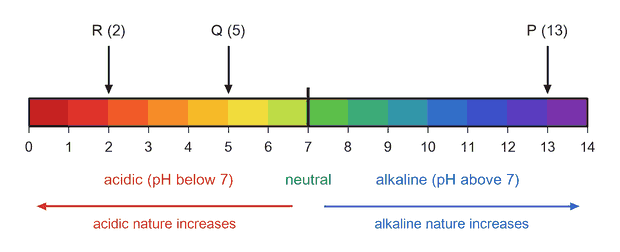
Watch out: A STRONG acid or alkali is almost fully ionised (ions only), so P and R do not fit (c).
Therefore, (a) R; (b) P; (c) Q.
- 331 mark
Question 33
Define the following terms:
(b) Normal salt
Solve with AIWritten solution
Solution:
Concept: A normal salt forms when all the replaceable hydrogen of an acid is replaced by a metallic or ammonium ion. An acid salt forms when only part of it is replaced, and a basic salt forms when only part of the hydroxyl groups of a di- or tri-acidic base is replaced by an acid radical.
Step 1 — State the definition.
A normal salt is a salt formed by the complete replacement of the ionisable (replaceable) hydrogen ions of an acid by a metallic ion or an ammonium ion. It has no replaceable hydrogen left.
Step 2 — Give examples.
Sodium chloride () and sodium sulphate () are normal salts. In sodium sulphate both hydrogen ions of sulphuric acid have been replaced:
Watch out: NaHSO₄ is NOT a normal salt; one replaceable hydrogen is still left in it, so it is an acid salt.
Therefore, a normal salt is a salt formed by the complete replacement of the replaceable hydrogen ions of an acid by a metallic or ammonium ion, e.g. NaCl, Na₂SO₄.
- 343 marks
Question 34
Match the salts underlined in Column A with the most suitable method of preparation given in Column B.
Column A Column B (a) from Zn 1. Precipitation (b) from KOH 2. Direct combination (c) from 3. Displacement reaction 4. Neutralization Solve with AIWritten solution
Solution:
Concept: The method of preparing a salt depends on its solubility and on the starting material: an insoluble salt is made by precipitation; a soluble salt from an active metal by simple displacement of hydrogen from a dilute acid; a soluble salt from an insoluble base or carbonate by neutralisation with a dilute acid; a salt from two soluble reactants (an alkali and an acid) by titration; and anhydrous iron (III) chloride by direct combination of the metal with chlorine.
Step 1 — (a) ZnCl₂ from Zn: 3. Displacement reaction.
Zinc is above hydrogen, so it displaces hydrogen from dilute hydrochloric acid:
Step 2 — (b) KNO₃ from KOH: 4. Neutralization.
Potassium hydroxide is an alkali, so it is neutralised by dilute nitric acid, the volumes being fixed by titration:
Step 3 — (c) CaCO₃ from CaCl₂: 1. Precipitation.
Calcium carbonate is insoluble, so it precipitates when sodium carbonate solution is added to calcium chloride solution:
Method 2 (direct combination) is not needed for any of the three salts.
Therefore, (a) – 3. Displacement reaction; (b) – 4. Neutralization; (c) – 1. Precipitation.
- 351 mark
Question 35
Which pair of reactants can be best used to produce lead (II) sulphate?
Solve with AIAnswer
(A) Sulphuric acid + Lead
(B) Sulphuric acid + Lead hydroxide
- Correct
(C) Sodium sulphate + Lead nitrate
(D) Potassium sulphate + Lead oxide
Answer: (C) Sodium sulphate + Lead nitrate
Concept: Lead (II) sulphate is insoluble in water, so it is best made by precipitation: mixing solutions of two soluble salts, one supplying ions and the other ions.
Step 1 — Mix the two soluble salts.
Lead nitrate and sodium sulphate are both soluble. When their solutions are mixed, white lead sulphate precipitates:
Step 2 — Collect the salt.
The precipitate is filtered, washed with distilled water and dried; the sodium nitrate stays in the filtrate.
Watch out: An insoluble salt is not made from an insoluble starting material and an acid; the insoluble product coats the solid and stops the reaction.
Why the other options are wrong:
- (A) Sulphuric acid + Lead: insoluble lead sulphate forms a coating on the lead and stops any further reaction.
- (B) Sulphuric acid + Lead hydroxide: lead hydroxide is insoluble; a crust of insoluble lead sulphate forms on it and stops the reaction, so this is not a practical method.
- (D) Potassium sulphate + Lead oxide: lead oxide is insoluble and is a base, not a salt in solution, so it cannot exchange radicals with potassium sulphate.
Therefore, the best pair is sodium sulphate + lead nitrate, option (C).
- 361 mark
Question 36
State the terms for the following:
A salt formed by the partial replacement of the hydroxyl group of a di-acidic or a tri-acidic base by an acid radical.
Solve with AIWritten solution
Solution:
Concept: A normal salt forms when all the replaceable hydrogen of an acid is replaced by a metallic or ammonium ion. An acid salt forms when only part of it is replaced, and a basic salt forms when only part of the hydroxyl groups of a di- or tri-acidic base is replaced by an acid radical.
Step 1 — Match the description.
The statement speaks of partly replacing the HYDROXYL groups of a base (not the hydrogen of an acid) by an acid radical. That gives a basic salt.
Step 2 — Show it with an example.
Lead hydroxide is a di-acidic base. Replacing one of its two OH groups by chloride gives basic lead chloride:
Therefore, the term is basic salt.
- 371 mark
Question 37
Give balanced equations for the following:
Action of dilute hydrochloric acid on ammonium carbonate.
Solve with AIWritten solution
Solution:
Concept: A dilute acid decomposes a carbonate or a hydrogen carbonate (bicarbonate) to give a salt, water and carbon dioxide.
Step 1 — Name the products.
Ammonium carbonate, , with dilute hydrochloric acid gives ammonium chloride, water and carbon dioxide.
Step 2 — Write and balance the equation.
The carbonate ion takes up two hydrogen ions, so two molecules of HCl are needed:
Each side has 2 N, 10 H, 1 C, 3 O and 2 Cl, so the equation is balanced. The carbon dioxide comes off with brisk effervescence.
Therefore, (NH₄)₂CO₃ + 2HCl → 2NH₄Cl + H₂O + CO₂↑.
- 383 marks
Question 38
Given below is a diagram showing the placement of five different oxides. With respect to the given diagram answer the following questions:
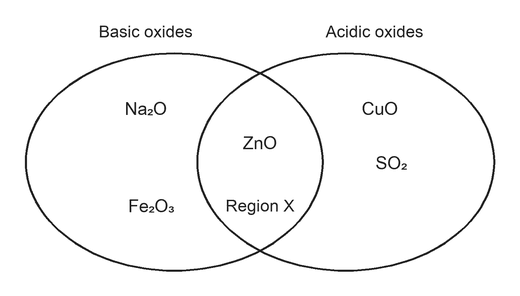
(a) Name the type of oxide represented in region X in the diagram.
(b) Identify the oxide which has been incorrectly placed in the above diagram.
(c) Name the oxide from the above diagram which will form an alkali when dissolved in water.
Solve with AIWritten solution
Solution:
Concept: Oxides are grouped by what they react with: a basic oxide (a metallic oxide) reacts with acids, an acidic oxide (usually a non-metallic oxide) reacts with alkalis, an amphoteric oxide reacts with both, and a neutral oxide reacts with neither. Each reaction gives a salt and water.
Step 1 — (a) Name the oxides of region X.
Region X is the part common to both circles, so an oxide placed there behaves as a basic oxide AND as an acidic oxide. Such oxides are amphoteric. Zinc oxide, placed in X, reacts with an acid and with an alkali:
Step 2 — (b) Find the oxide in the wrong place.
CuO (copper (II) oxide) is in the acidic-oxide circle. But it is a metallic oxide that reacts with acids to give a salt and water, and it does not react with alkalis, so it is a basic oxide:
It should be in the basic-oxide circle. The other oxides are placed correctly: and are basic and is acidic.
Step 3 — (c) Find the oxide that gives an alkali.
Sodium oxide dissolves in water to form sodium hydroxide, an alkali:
is also basic, but it is insoluble in water, so it does not form an alkali.

Watch out: An oxide of a METAL can still be wrongly placed; check how it reacts, not just its name.
Therefore, (a) amphoteric oxides; (b) CuO; (c) Na₂O.
- 393 marks
Question 39
P, Q, R and S are the different methods of preparation of salts.
P – Simple displacement Q – Neutralisation by titration R – Precipitation S – Direct combination
Choose the most appropriate method to prepare the following salts:
(a)
(b)
(c)
Solve with AIWritten solution
Solution:
Concept: The method of preparing a salt depends on its solubility and on the starting material: an insoluble salt is made by precipitation; a soluble salt from an active metal by simple displacement of hydrogen from a dilute acid; a soluble salt from an insoluble base or carbonate by neutralisation with a dilute acid; a salt from two soluble reactants (an alkali and an acid) by titration; and anhydrous iron (III) chloride by direct combination of the metal with chlorine.
Step 1 — (a) PbCl₂: R (Precipitation).
Lead chloride is insoluble in cold water, so it is precipitated from lead nitrate solution with a soluble chloride:
Step 2 — (b) FeCl₃: S (Direct combination).
Iron is heated in dry chlorine, which takes it to iron (III) chloride:
Step 3 — (c) Na₂SO₄: Q (Neutralisation by titration).
Sodium hydroxide and dilute sulphuric acid are both soluble, so the exact volumes are found by titration:
Watch out: Simple displacement (P) cannot give FeCl₃: iron with dilute HCl gives FeCl₂.
Therefore, (a) R; (b) S; (c) Q.
- 401 mark
Question 40
Sodium hydroxide can react with ............... acid to form an acid salt.
Solve with AIAnswer
(A) Nitric acid
(B) Hydrochloric acid
(C) Acetic acid
- Correct
(D) Sulphuric acid
Answer: (D) Sulphuric acid
Concept: The basicity of an acid is the number of hydronium ions one molecule gives in water, that is, the number of replaceable hydrogen ions. Only an acid with two or more replaceable hydrogen ions can have them partly replaced, so only a polybasic acid can form an acid salt.
Step 1 — Find the polybasic acid.
Sulphuric acid is dibasic (two replaceable hydrogen ions per molecule). Nitric, hydrochloric and acetic acids are all monobasic.
Step 2 — Replace only one hydrogen.
When the amount of sodium hydroxide is only enough to replace one of the two hydrogens, the acid salt sodium hydrogen sulphate forms:
Why the other options are wrong:
- (A) Nitric acid: nitric acid is monobasic; it gives only the normal salt .
- (B) Hydrochloric acid: hydrochloric acid is monobasic; it gives only the normal salt .
- (C) Acetic acid: acetic acid is monobasic (one replaceable hydrogen); it gives only the normal salt .
Therefore, sodium hydroxide forms an acid salt with sulphuric acid, option (D).
- 411 mark
Question 41
The oxide which reacts with both dilute hydrochloric acid and sodium hydroxide solution to form salt and water is:
Solve with AIAnswer
(A) Basic oxide
- Correct
(B) Amphoteric oxide
(C) Acidic oxide
(D) Neutral oxide
Answer: (B) Amphoteric oxide
Concept: Oxides are grouped by what they react with: a basic oxide (a metallic oxide) reacts with acids, an acidic oxide (usually a non-metallic oxide) reacts with alkalis, an amphoteric oxide reacts with both, and a neutral oxide reacts with neither. Each reaction gives a salt and water.
Step 1 — React the oxide with the acid.
Zinc oxide, an amphoteric oxide, reacts with dilute hydrochloric acid to give a salt and water:
Step 2 — React the same oxide with the alkali.
It also reacts with sodium hydroxide solution to give a salt (sodium zincate) and water:
An oxide that reacts with both is amphoteric.
Why the other options are wrong:
- (A) Basic oxide: a basic oxide reacts with acids but not with alkalis.
- (C) Acidic oxide: an acidic oxide reacts with alkalis but not with acids.
- (D) Neutral oxide: a neutral oxide reacts with neither acids nor alkalis.
Therefore, an oxide that reacts with both dilute HCl and NaOH solution is an amphoteric oxide, option (B).
- 421 mark
Question 42
State the terms for the following:
A substance which when dissolved in water forms hydronium ion as the only positive ion.
Solve with AIWritten solution
Solution:
Concept: Acids and alkalis are defined by the ions they give in water.
Step 1 — Match the statement to a definition.
A substance that gives hydronium ions as the ONLY positive ions in water fits the definition of an acid.
Step 2 — Show it with an example.
Hydrogen chloride ionises in water like this:
Therefore, the term is acid.
- 433 marks
Question 43
You are provided with some compounds in the box.
[, , , , , , , ]
Choose the compound from the above box that fits the descriptions from (a) to (c).
(a) An acid present in vinegar.
(b) An oxide which dissolves in water forming an acid.
(c) A salt formed by the incomplete neutralization of an acid by a base.
Solve with AIWritten solution
Solution:
Concept: Sort the box first. and are acids; is an acidic oxide, PbO is amphoteric and CO is neutral; and KCl are normal salts; is an acid salt.
Step 1 — (a) The acid in vinegar.
Vinegar is a dilute solution of acetic acid, .
Step 2 — (b) The oxide that forms an acid in water.
Sulphur dioxide is an acidic oxide. It dissolves in water to form sulphurous acid:
CO is neutral and PbO is amphoteric and insoluble, so neither forms an acid in water.
Step 3 — (c) The salt from incomplete neutralisation.
An acid salt forms when only part of the replaceable hydrogen of an acid is neutralised. In only one of the two hydrogens of sulphuric acid has been replaced:
Watch out: K₂SO₄ and KCl are salts too, but they are NORMAL salts (complete neutralisation).
Therefore, (a) CH₃COOH; (b) SO₂; (c) NaHSO₄.
- 441 mark
Question 44
Write the balanced equations for the following reactions:
Potassium bicarbonate reacts with dilute .
Solve with AIWritten solution
Solution:
Concept: A dilute acid decomposes a carbonate or a hydrogen carbonate (bicarbonate) to give a salt, water and carbon dioxide.
Step 1 — Name the products.
Potassium bicarbonate is potassium hydrogen carbonate, . With dilute hydrochloric acid it gives potassium chloride, water and carbon dioxide.
Step 2 — Write and balance the equation.
One ion takes up one hydrogen ion, so the reactants combine one to one:
Each side has 1 K, 2 H, 1 C, 3 O and 1 Cl, so the equation is balanced. Carbon dioxide comes off with brisk effervescence.
Watch out: A bicarbonate needs only ONE HCl.
Therefore, KHCO₃ + HCl → KCl + H₂O + CO₂↑.
- 453 marks
Question 45
Name the most appropriate method of preparation of the following salts:
(a) Copper carbonate
(b) Sodium sulphate
(c) Ferric chloride
Solve with AIWritten solution
Solution:
Concept: The method of preparing a salt depends on its solubility and on the starting material: an insoluble salt is made by precipitation; a soluble salt from an active metal by simple displacement of hydrogen from a dilute acid; a soluble salt from an insoluble base or carbonate by neutralisation with a dilute acid; a salt from two soluble reactants (an alkali and an acid) by titration; and anhydrous iron (III) chloride by direct combination of the metal with chlorine.
Step 1 — (a) Copper carbonate: Precipitation.
Copper carbonate is insoluble, so it is precipitated from copper sulphate solution with sodium carbonate solution:
Step 2 — (b) Sodium sulphate: Neutralisation by titration.
Sodium hydroxide and dilute sulphuric acid are both soluble, so the exact volumes are found by titration:
Step 3 — (c) Ferric chloride: Direct combination (synthesis).
Iron is heated in dry chlorine, which gives iron (III) chloride directly:
Therefore, (a) precipitation; (b) neutralisation by titration; (c) direct combination.
- 461 mark
Question 46
The electronic configuration of an element is 2,8,2. The hydroxide of this element can produce ............... hydroxyl ions per molecule.
Solve with AIAnswer
(A) 3
- Correct
(B) 2
(C) 1
(D) 0
Answer: (B) 2
Concept: The number of ions one molecule of a base gives equals the valency of its metal (its acidity).
Step 1 — Identify the element.
The configuration 2, 8, 2 holds 12 electrons, so the atomic number is 12: magnesium. It has 2 valence electrons, which it loses to form .
Step 2 — Count the hydroxyl ions.
Its hydroxide is , a di-acidic base, which gives two hydroxyl ions per molecule:
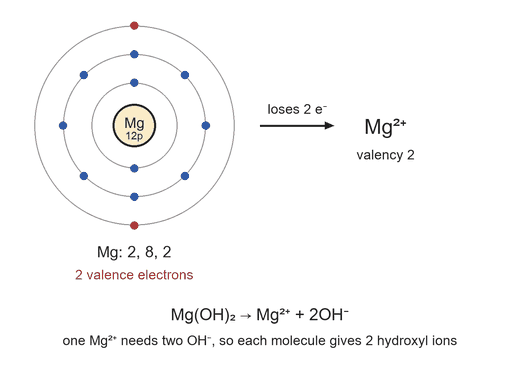
Watch out: The number of OH⁻ ions comes from the VALENCY (2), not from the number of shells (3).
Why the other options are wrong:
- (A) 3: 3 would fit a metal of valency 3, such as aluminium (2, 8, 3) in .
- (C) 1: 1 would fit a metal of valency 1, such as sodium (2, 8, 1) in NaOH.
- (D) 0: 0 is wrong because magnesium hydroxide is a base; it does give hydroxyl ions.
Therefore, the hydroxide of this element can produce 2 hydroxyl ions per molecule, option (B).
- 471 mark
Question 47
Rita added dilute hydrochloric acid to four metals. She recorded her observations in the table given below. While noting her observations she made some errors.
Metals Observations 1 copper a gas was given off 2 iron a gas was given off 3 magnesium no gas was given off 4 zinc a gas was given off Which observation(s) made by Rita is/are correct?
Solve with AIAnswer
(A) 1 only
(B) 3 only
(C) Both 1 and 4
- Correct
(D) Both 2 and 4
Answer: (D) Both 2 and 4
Concept: A metal displaces hydrogen from dilute hydrochloric or sulphuric acid only if it is above hydrogen in the activity series (K, Na, Ca, Mg, Al, Zn, Fe, Pb, H, Cu, Hg, Ag, Au).
Step 1 — Observation 1 (copper, gas given off).
Copper is below hydrogen and does not react with dilute hydrochloric acid, so no gas comes off. This observation is incorrect.
Step 2 — Observation 2 (iron, gas given off).
Iron is above hydrogen, so it gives hydrogen. This observation is correct:
Step 3 — Observation 3 (magnesium, no gas).
Magnesium is well above hydrogen and reacts briskly, giving hydrogen. This observation is incorrect.
Step 4 — Observation 4 (zinc, gas given off).
Zinc is above hydrogen, so it gives hydrogen. This observation is correct:
Watch out: The question asks for the CORRECT observations, not the errors.
Why the other options are wrong:
- (A) 1 only: observation 1 is wrong: copper gives no gas with dilute HCl.
- (B) 3 only: observation 3 is wrong: magnesium does give hydrogen.
- (C) Both 1 and 4: observation 4 is correct, but observation 1 is wrong.
Therefore, the correct observations are 2 and 4, option (D).
- 481 mark
Question 48
Salts can be prepared by the action of dilute acid on:
-
bases
-
carbonates
-
metals
-
sulphites
The method which cannot be used for the preparation of copper salts is:
Solve with AIAnswer
(A) 1
(B) 2
- Correct
(C) 3
(D) 4
Answer: (C) 3
Concept: A metal displaces hydrogen from dilute hydrochloric or sulphuric acid only if it is above hydrogen in the activity series (K, Na, Ca, Mg, Al, Zn, Fe, Pb, H, Cu, Hg, Ag, Au). Copper is below hydrogen.
Step 1 — Test method 3 (dilute acid on the metal).
Copper does not displace hydrogen from dilute hydrochloric or sulphuric acid, so this method cannot give a copper salt.
Step 2 — Test the other three methods.
Copper oxide (a base), copper carbonate and copper sulphite all react with a dilute acid to give a copper salt:
Note: Dilute nitric acid does attack copper, but as an oxidising agent (it gives nitric oxide, not hydrogen). The method meant here is a metal displacing hydrogen from a dilute acid, which copper cannot do, so the key (C) stands.
Why the other options are wrong:
- (A) 1: a base such as copper (II) oxide reacts with a dilute acid to give a copper salt and water.
- (B) 2: copper carbonate reacts with a dilute acid to give a copper salt, water and carbon dioxide.
- (D) 4: copper sulphite reacts with a dilute acid to give a copper salt, water and sulphur dioxide.
Therefore, the method which cannot be used for copper salts is method 3, option (C).
-
- 491 mark
Question 49
Differentiate between the following pairs based on the criteria given in the bracket:
Acetic acid and Sulphuric acid (number of replaceable hydrogen ion per molecule)
Solve with AIWritten solution
Solution:
Concept: The basicity of an acid is the number of hydronium ions one molecule gives in water, that is, the number of replaceable hydrogen ions. Only an acid with two or more replaceable hydrogen ions can have them partly replaced, so only a polybasic acid can form an acid salt.
Step 1 — Acetic acid.
Acetic acid, , has four hydrogen atoms, but only the one in the –COOH group is replaceable. It gives one hydronium ion per molecule, so it is monobasic:
Step 2 — Sulphuric acid.
Sulphuric acid has two replaceable hydrogen ions per molecule, so it is dibasic:
Watch out: Basicity counts REPLACEABLE hydrogen ions, not all the hydrogen atoms (acetic acid has four, but its basicity is 1).
Therefore, acetic acid has one replaceable hydrogen ion per molecule (monobasic), while sulphuric acid has two (dibasic).
- 503 marks
Question 50
Given below are some chemicals.
Lead nitrate, Copper, Hydrochloric acid, Lead oxide, Iron, Sodium carbonate, Copper carbonate, Chlorine Using suitable chemicals from the box given above, write balanced chemical equations for the preparation of the following salts.
(Note: The chemicals may be used more than once, if needed.)
(a) Lead (II) carbonate
(b) Copper (II) chloride
(c) Iron (II) chloride
Solve with AIWritten solution
Solution:
Concept: The method of preparing a salt depends on its solubility and on the starting material: an insoluble salt is made by precipitation; a soluble salt from an active metal by simple displacement of hydrogen from a dilute acid; a soluble salt from an insoluble base or carbonate by neutralisation with a dilute acid; a salt from two soluble reactants (an alkali and an acid) by titration; and anhydrous iron (III) chloride by direct combination of the metal with chlorine.
Step 1 — (a) Lead (II) carbonate by precipitation.
Lead carbonate is insoluble, so it is precipitated by mixing lead nitrate solution with sodium carbonate solution:
Step 2 — (b) Copper (II) chloride from copper carbonate.
Copper does not react with dilute hydrochloric acid, so the copper carbonate in the box is used. It reacts with dilute hydrochloric acid:
Copper and chlorine from the box can also be combined directly:
Step 3 — (c) Iron (II) chloride by simple displacement.
Iron is above hydrogen, so it displaces hydrogen from dilute hydrochloric acid and forms the lower chloride:
Watch out: Iron with CHLORINE gives FeCl₃, not FeCl₂, so chlorine is not used in (c).
Therefore, (a) Pb(NO₃)₂ + Na₂CO₃ → PbCO₃↓ + 2NaNO₃; (b) CuCO₃ + 2HCl → CuCl₂ + H₂O + CO₂↑; (c) Fe + 2HCl → FeCl₂ + H₂↑.
- 511 mark
Question 51
Give reasons why:
Hydrochloric acid cannot form an acid salt.
Solve with AIWritten solution
Solution:
Concept: The basicity of an acid is the number of hydronium ions one molecule gives in water, that is, the number of replaceable hydrogen ions. Only an acid with two or more replaceable hydrogen ions can have them partly replaced, so only a polybasic acid can form an acid salt.
Step 1 — Find the basicity of hydrochloric acid.
Hydrochloric acid is monobasic: each molecule has only one replaceable hydrogen ion.
Step 2 — See why partial replacement is impossible.
That single hydrogen is either replaced completely, giving the normal salt, or not at all. There is nothing to replace 'partly':
A dibasic acid such as sulphuric acid can form the acid salt .
Therefore, hydrochloric acid cannot form an acid salt because it is monobasic: its one replaceable hydrogen ion cannot be partly replaced.
- 521 mark
Question 52
State whether the following statements are True or False:
A salt is a compound formed by partial or complete replacement of the hydrogen ion of an acid by a metal or electropositive ion.
Solve with AIWritten solution
Solution:
Concept: A salt is a compound formed by the partial or complete replacement of the replaceable hydrogen ions of an acid by a metallic ion or an ammonium ion.
Step 1 — Compare the statement with the definition.
The statement says the same thing: partial or complete replacement of the hydrogen ion of an acid by a metal or an electropositive ion (such as the ammonium ion). So it is true.
Step 2 — Check both parts with examples.
Complete replacement gives a normal salt, and partial replacement gives an acid salt:
Therefore, the statement is True.
- 531 mark
Question 53
Acid + Metal oxide on reaction gives:
Solve with AIAnswer
(A) base + water
- Correct
(B) salt + water
(C) base + salt
(D) metal + salt
Answer: (B) salt + water
Concept: A metal oxide is a base. An acid and a base neutralise each other to give a salt and water only.
Step 1 — Take an example.
Copper (II) oxide reacts with dilute sulphuric acid:
Step 2 — Name the products.
The products are copper sulphate, a salt, and water.
Why the other options are wrong:
- (A) base + water: the base (the metal oxide) is used up in the reaction; no base is formed.
- (C) base + salt: no base is formed; the base reacts and is used up.
- (D) metal + salt: the metal stays combined in the salt; no free metal is set free by the acid.
Therefore, acid + metal oxide gives salt + water, option (B).
- 541 mark
Question 54
Name the following:
A salt which is soluble in hot water, but insoluble in cold water.
Solve with AIWritten solution
Solution:
Concept: Most chlorides are soluble in water. Lead (II) chloride is an exception: it is insoluble in cold water but dissolves in hot water.
Step 1 — Name the salt.
Lead (II) chloride, , dissolves in hot water, and white crystals separate out again when the solution cools.
Step 2 — Show how it is made.
Because it is insoluble in cold water, it is prepared by precipitation:

Therefore, the salt is lead (II) chloride, PbCl₂.
- 551 mark
Question 55
Complete the following sentences by choosing the correct word(s) from the brackets.
A black solid, ............... (manganese dioxide / copper oxide) reacts with dilute sulphuric acid to form a blue-coloured solution.
Solve with AIWritten solution
Solution:
Concept: A basic oxide reacts with a dilute acid to give a salt and water. Solutions of copper (II) salts are blue.
Step 1 — React copper oxide with the acid.
Black copper (II) oxide is a basic oxide; it dissolves in warm dilute sulphuric acid to give copper sulphate and water:
The blue colour is due to the copper sulphate (the hydrated ion).
Step 2 — Rule out manganese dioxide.
Manganese dioxide is also black, but it does not give a blue solution with dilute sulphuric acid.
Therefore, a black solid, copper oxide, reacts with dilute sulphuric acid to form a blue-coloured solution.
- 561 mark
Question 56
Complete the following sentences by choosing the correct word(s) from the brackets.
The salt formed when iron reacts with dilute is ............... ( / )
Solve with AIWritten solution
Solution:
Concept: Iron forms two chlorides. With dilute hydrochloric acid it gives only the lower chloride, iron (II) chloride, because the hydrogen set free is not an oxidising agent. Heated in dry chlorine, a strong oxidising agent, it gives the higher chloride, iron (III) chloride, by direct combination.
Step 1 — React iron with dilute HCl.
Iron displaces hydrogen from dilute hydrochloric acid and forms the lower chloride:
Step 2 — Rule out the other choice.
is made by heating iron in chlorine (direct combination).
Therefore, the salt formed when iron reacts with dilute HCl is FeCl₂.
- 572 marks
Question 57
The reactions of four different oxides W, X, Y and Z are given below:
-
W reacts with hydrochloric acid, but not with sodium hydroxide.
-
X reacts with both hydrochloric acid and sodium hydroxide.
-
Y does not react with either hydrochloric acid or sodium hydroxide.
-
Z reacts with sodium hydroxide, but not with hydrochloric acid.
From the information provided above, identify the oxide which is:
(a) amphoteric
(b) acidic
Solve with AIWritten solution
Solution:
Concept: Oxides are grouped by what they react with: a basic oxide (a metallic oxide) reacts with acids, an acidic oxide (usually a non-metallic oxide) reacts with alkalis, an amphoteric oxide reacts with both, and a neutral oxide reacts with neither. Each reaction gives a salt and water.
Step 1 — Classify each oxide.
W reacts with the acid only, so it is basic. X reacts with both, so it is amphoteric. Y reacts with neither, so it is neutral. Z reacts with the alkali only, so it is acidic.
Step 2 — (a) The amphoteric oxide.
X is the amphoteric oxide, because it reacts with both hydrochloric acid and sodium hydroxide.
Step 3 — (b) The acidic oxide.
Z is the acidic oxide, because it reacts with sodium hydroxide (an alkali) but not with hydrochloric acid.
Therefore, (a) X is amphoteric; (b) Z is acidic.
-
- 581 mark
Question 58
Choose the answer from the list of compounds given below:
sodium bisulphite, ferric oxide, iron (II) chloride, sodium sulphate, aluminium oxide
An acid salt.
Solve with AIWritten solution
Solution:
Concept: A normal salt forms when all the replaceable hydrogen of an acid is replaced by a metallic or ammonium ion. An acid salt forms when only part of it is replaced, and a basic salt forms when only part of the hydroxyl groups of a di- or tri-acidic base is replaced by an acid radical.
Step 1 — Classify each compound.
Ferric oxide is a basic oxide and aluminium oxide an amphoteric oxide, so neither is a salt. Iron (II) chloride and sodium sulphate are normal salts (no replaceable hydrogen left).
Step 2 — Find the acid salt.
Sodium bisulphite, , still holds one replaceable hydrogen of sulphurous acid, so it is an acid salt:
Watch out: The prefix 'bi-' in bisulphite (bicarbonate, bisulphate) means 'hydrogen': these are acid salts.
Therefore, the acid salt is sodium bisulphite (NaHSO₃).
- 593 marks
Question 59
What would you say about the pH of a solution-
(a) in which the concentration of ions is equal to concentration of ions?
(b) which evolves hydrogen sulphide when added to ferrous sulphide?
(c) which produces a pungent smelling gas when heated with an ammonium salt?
Solve with AIWritten solution
Solution:
Concept: The pH scale runs from 0 to 14. A solution of pH 7 is neutral, a pH below 7 is acidic and a pH above 7 is alkaline. The farther the pH is from 7, the stronger the acidity or the alkalinity. Acids set free hydrogen sulphide from sulphides; alkalis set free ammonia from ammonium salts.
Step 1 — (a) Equal H⁺ and OH⁻.
When the two ion concentrations are equal, the solution is neither acidic nor alkaline: it is neutral, so its pH is 7.
Step 2 — (b) Gives hydrogen sulphide with ferrous sulphide.
An acid decomposes a sulphide, so the solution is acidic and its pH is less than 7. For example:
Step 3 — (c) Gives a pungent gas with an ammonium salt.
The pungent gas is ammonia, which an alkali drives off from an ammonium salt, so the solution is alkaline and its pH is more than 7. For example:
Therefore, (a) pH = 7 (neutral); (b) pH less than 7 (acidic); (c) pH more than 7 (alkaline).
- 603 marks
Question 60
From the list given, choose the method which is most suitable for the preparation of the following salts?
-
E - Neutralization by titration
-
F - Precipitation
-
G - Simple displacement
-
H - Direct combination
(a) Zinc sulphate
(b) Silver chloride
(c) Ammonium nitrate
Solve with AIWritten solution
Solution:
Concept: The method of preparing a salt depends on its solubility and on the starting material: an insoluble salt is made by precipitation; a soluble salt from an active metal by simple displacement of hydrogen from a dilute acid; a soluble salt from an insoluble base or carbonate by neutralisation with a dilute acid; a salt from two soluble reactants (an alkali and an acid) by titration; and anhydrous iron (III) chloride by direct combination of the metal with chlorine.
Step 1 — (a) Zinc sulphate: G (Simple displacement).
Zinc is above hydrogen, so it displaces hydrogen from dilute sulphuric acid:
Step 2 — (b) Silver chloride: F (Precipitation).
Silver chloride is insoluble, so it is precipitated from silver nitrate solution with a soluble chloride:
Step 3 — (c) Ammonium nitrate: E (Neutralization by titration).
Ammonium hydroxide and dilute nitric acid are both soluble, so the exact volumes are found by titration:
Method H (direct combination) is not needed here.
Therefore, (a) G; (b) F; (c) E.
-