
Question 411 markMCQAsked 2025Easy
The oxide which reacts with both dilute hydrochloric acid and sodium hydroxide solution to form salt and water is:
Confirming your payment
Sign up now and get 250 free tokens.
Previous Year Questions · Question 41 of 60
The oxide which reacts with both dilute hydrochloric acid and sodium hydroxide solution to form salt and water is:
(A) Basic oxide
(B) Amphoteric oxide
(C) Acidic oxide
(D) Neutral oxide
Answer: (B) Amphoteric oxide
Concept: Oxides are grouped by what they react with: a basic oxide (a metallic oxide) reacts with acids, an acidic oxide (usually a non-metallic oxide) reacts with alkalis, an amphoteric oxide reacts with both, and a neutral oxide reacts with neither. Each reaction gives a salt and water.
Step 1 — React the oxide with the acid.
Zinc oxide, an amphoteric oxide, reacts with dilute hydrochloric acid to give a salt and water:
Step 2 — React the same oxide with the alkali.
It also reacts with sodium hydroxide solution to give a salt (sodium zincate) and water:
An oxide that reacts with both is amphoteric.
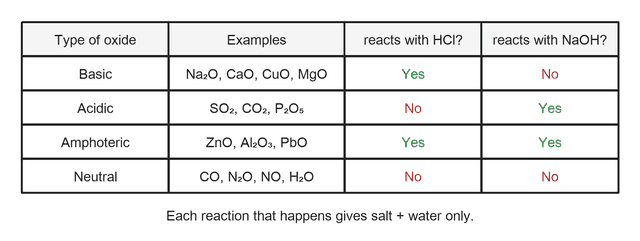
Why the other options are wrong:
Therefore, an oxide that reacts with both dilute HCl and NaOH solution is an amphoteric oxide, option (B).