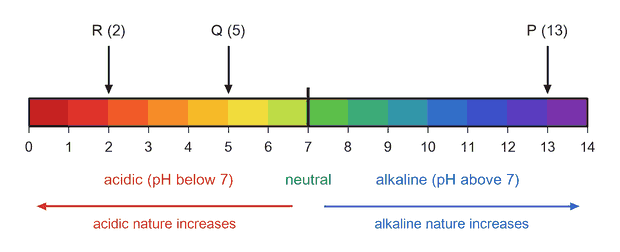
Mohan has three solutions P, Q and R having a pH of 13, 5 and 2 respectively. Which of the above solutions P, Q or R
Question 323 marksAsked 2024Easy
Mohan has three solutions P, Q and R having a pH of 13, 5 and 2 respectively. Which of the above solutions P, Q or R:
(a) will react with Magnesium to liberate hydrogen gas?
(b) will liberate ammonia gas when it reacts with ammonium chloride?
(c) will contain molecules as well as ions?
Solution:
Concept: The pH scale runs from 0 to 14. A solution of pH 7 is neutral, a pH below 7 is acidic and a pH above 7 is alkaline. The farther the pH is from 7, the stronger the acidity or the alkalinity. A weak acid is only partly ionised, so its solution holds molecules as well as ions.
Step 1 — Sort the solutions.
P (pH 13) is far above 7, so it is a strong alkali. Q (pH 5) is a little below 7, so it is a weak acid. R (pH 2) is far below 7, so it is a strong acid.
Step 2 — (a) Liberates hydrogen with magnesium.
Acids react with active metals such as magnesium to give a salt and hydrogen, so the answer is R, the strong acid. If R were, say, dilute hydrochloric acid:
Mg+2HCl→MgCl2+H2↑
Q is also acidic and would give hydrogen too, but only slowly; R is the expected answer.
Step 3 — (b) Liberates ammonia with ammonium chloride.
An alkali warmed with an ammonium salt drives off ammonia, so the answer is P. If P were, say, sodium hydroxide:
NH4Cl+NaOHΔNaCl+H2O+NH3↑
Step 4 — (c) Contains molecules as well as ions.
A weak acid is only partly ionised, so its solution holds un-ionised molecules as well as ions. The answer is Q. If Q were, say, acetic acid:
CH3COOH+H2O⇌H3O++CH3COO−
Watch out: A STRONG acid or alkali is almost fully ionised (ions only), so P and R do not fit (c).