
Question 351 markMCQAsked 2025Easy
Which pair of reactants can be best used to produce lead (II) sulphate?
Confirming your payment
Sign up now and get 250 free tokens.
Previous Year Questions · Question 35 of 60
Which pair of reactants can be best used to produce lead (II) sulphate?
(A) Sulphuric acid + Lead
(B) Sulphuric acid + Lead hydroxide
(C) Sodium sulphate + Lead nitrate
(D) Potassium sulphate + Lead oxide
Answer: (C) Sodium sulphate + Lead nitrate
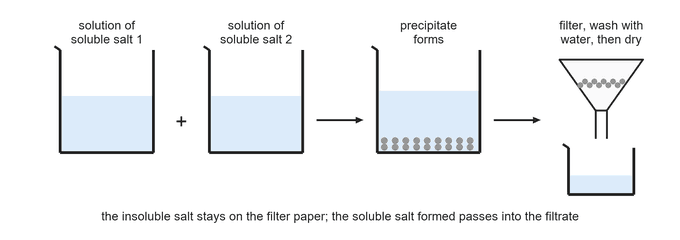
Concept: Lead (II) sulphate is insoluble in water, so it is best made by precipitation: mixing solutions of two soluble salts, one supplying ions and the other ions.
Step 1 — Mix the two soluble salts.
Lead nitrate and sodium sulphate are both soluble. When their solutions are mixed, white lead sulphate precipitates:
Step 2 — Collect the salt.
The precipitate is filtered, washed with distilled water and dried; the sodium nitrate stays in the filtrate.
Watch out: An insoluble salt is not made from an insoluble starting material and an acid; the insoluble product coats the solid and stops the reaction.
Why the other options are wrong:
Therefore, the best pair is sodium sulphate + lead nitrate, option (C).