Answer: (D) Both 2 and 4
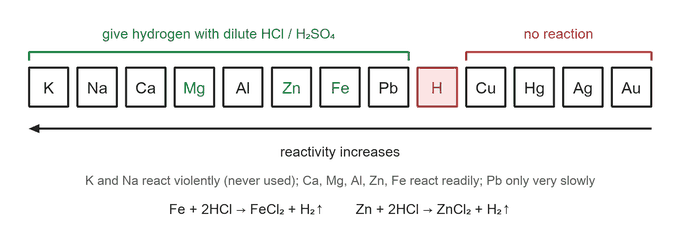
Concept: A metal displaces hydrogen from dilute hydrochloric or sulphuric acid only if it is above hydrogen in the activity series (K, Na, Ca, Mg, Al, Zn, Fe, Pb, H, Cu, Hg, Ag, Au).
Step 1 — Observation 1 (copper, gas given off).
Copper is below hydrogen and does not react with dilute hydrochloric acid, so no gas comes off. This observation is incorrect.
Step 2 — Observation 2 (iron, gas given off).
Iron is above hydrogen, so it gives hydrogen. This observation is correct:
Fe+2HCl→FeCl2+H2↑
Step 3 — Observation 3 (magnesium, no gas).
Magnesium is well above hydrogen and reacts briskly, giving hydrogen. This observation is incorrect.
Step 4 — Observation 4 (zinc, gas given off).
Zinc is above hydrogen, so it gives hydrogen. This observation is correct:
Zn+2HCl→ZnCl2+H2↑
Watch out: The question asks for the CORRECT observations, not the errors.
Why the other options are wrong:
- (A) 1 only: observation 1 is wrong: copper gives no gas with dilute HCl.
- (B) 3 only: observation 3 is wrong: magnesium does give hydrogen.
- (C) Both 1 and 4: observation 4 is correct, but observation 1 is wrong.
Therefore, the correct observations are 2 and 4, option (D).
