
Question 481 markMCQAsked 2026Easy
Salts can be prepared by the action of dilute acid on:
-
bases
-
carbonates
-
metals
-
sulphites
The method which cannot be used for the preparation of copper salts is:
Confirming your payment
Sign up now and get 250 free tokens.
Previous Year Questions · Question 48 of 60
Salts can be prepared by the action of dilute acid on:
bases
carbonates
metals
sulphites
The method which cannot be used for the preparation of copper salts is:
(A) 1
(B) 2
(C) 3
(D) 4
Answer: (C) 3
Concept: A metal displaces hydrogen from dilute hydrochloric or sulphuric acid only if it is above hydrogen in the activity series (K, Na, Ca, Mg, Al, Zn, Fe, Pb, H, Cu, Hg, Ag, Au). Copper is below hydrogen.
Step 1 — Test method 3 (dilute acid on the metal).
Copper does not displace hydrogen from dilute hydrochloric or sulphuric acid, so this method cannot give a copper salt.
Step 2 — Test the other three methods.
Copper oxide (a base), copper carbonate and copper sulphite all react with a dilute acid to give a copper salt:
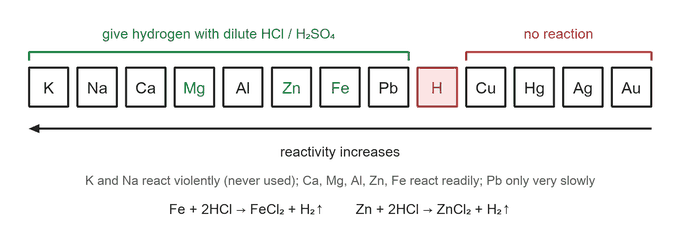
Note: Dilute nitric acid does attack copper, but as an oxidising agent (it gives nitric oxide, not hydrogen). The method meant here is a metal displacing hydrogen from a dilute acid, which copper cannot do, so the key (C) stands.
Why the other options are wrong:
Therefore, the method which cannot be used for copper salts is method 3, option (C).