
Question 461 markMCQAsked 2026Easy
The electronic configuration of an element is 2,8,2. The hydroxide of this element can produce ............... hydroxyl ions per molecule.
Confirming your payment
Sign up now and get 250 free tokens.
Previous Year Questions · Question 46 of 60
The electronic configuration of an element is 2,8,2. The hydroxide of this element can produce ............... hydroxyl ions per molecule.
(A) 3
(B) 2
(C) 1
(D) 0
Answer: (B) 2
Concept: The number of ions one molecule of a base gives equals the valency of its metal (its acidity).
Step 1 — Identify the element.
The configuration 2, 8, 2 holds 12 electrons, so the atomic number is 12: magnesium. It has 2 valence electrons, which it loses to form .
Step 2 — Count the hydroxyl ions.
Its hydroxide is , a di-acidic base, which gives two hydroxyl ions per molecule:
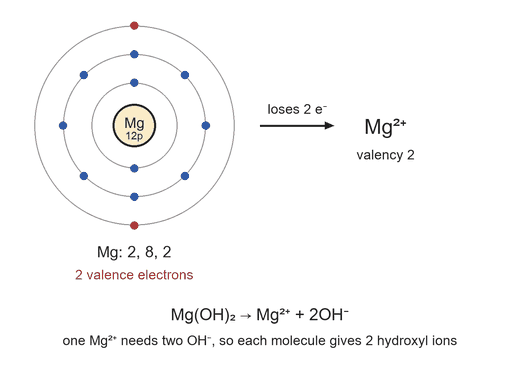
Watch out: The number of OH⁻ ions comes from the VALENCY (2), not from the number of shells (3).
Why the other options are wrong:
Therefore, the hydroxide of this element can produce 2 hydroxyl ions per molecule, option (B).