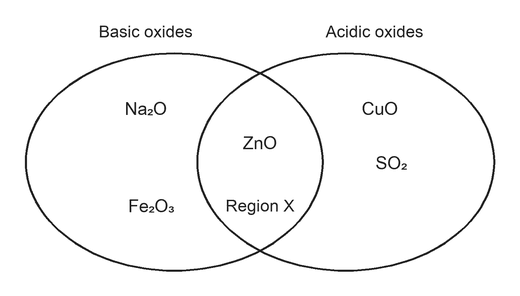
Solution:
Concept: Oxides are grouped by what they react with: a basic oxide (a metallic oxide) reacts with acids, an acidic oxide (usually a non-metallic oxide) reacts with alkalis, an amphoteric oxide reacts with both, and a neutral oxide reacts with neither. Each reaction gives a salt and water.
Step 1 — (a) Name the oxides of region X.
Region X is the part common to both circles, so an oxide placed there behaves as a basic oxide AND as an acidic oxide. Such oxides are amphoteric. Zinc oxide, placed in X, reacts with an acid and with an alkali:
ZnO+2HCl→ZnCl2+H2O
ZnO+2NaOH→Na2ZnO2+H2O
Step 2 — (b) Find the oxide in the wrong place.
CuO (copper (II) oxide) is in the acidic-oxide circle. But it is a metallic oxide that reacts with acids to give a salt and water, and it does not react with alkalis, so it is a basic oxide:
CuO+H2SO4→CuSO4+H2O
It should be in the basic-oxide circle. The other oxides are placed correctly: Na2O and Fe2O3 are basic and SO2 is acidic.
Step 3 — (c) Find the oxide that gives an alkali.
Sodium oxide dissolves in water to form sodium hydroxide, an alkali:
Na2O+H2O→2NaOH
Fe2O3 is also basic, but it is insoluble in water, so it does not form an alkali.

Watch out: An oxide of a METAL can still be wrongly placed; check how it reacts, not just its name.
Therefore, (a) amphoteric oxides; (b) CuO; (c) Na₂O.