
Question 125 marksEasy
Give equations to show how the following are made from their corresponding anhydrides.
(a) sulphurous acid,
(b) phosphoric acid,
(c) carbonic acid,
(d) sulphuric acid.
Confirming your payment
Sign up now and get 250 free tokens.
Acids, Bases and Salts · Question 12 of 90
Give equations to show how the following are made from their corresponding anhydrides.
(a) sulphurous acid,
(b) phosphoric acid,
(c) carbonic acid,
(d) sulphuric acid.
Solution:
Concept: An acidic anhydride (a non-metallic oxide) dissolves in water to give its acid, so each equation is “anhydride + water → acid”. Only oxy-acids can be made this way.
Step 1 — (a) Sulphurous acid from sulphur dioxide.
Sulphur dioxide dissolves in water to give sulphurous acid:
Step 2 — (b) Phosphoric acid from phosphorus pentoxide.
Phosphorus pentoxide reacts with three molecules of water to give two molecules of phosphoric acid:
Step 3 — (c) Carbonic acid from carbon dioxide.
Carbon dioxide dissolves in water to give carbonic acid:
Step 4 — (d) Sulphuric acid from sulphur trioxide.
Sulphur trioxide combines with water to give sulphuric acid:
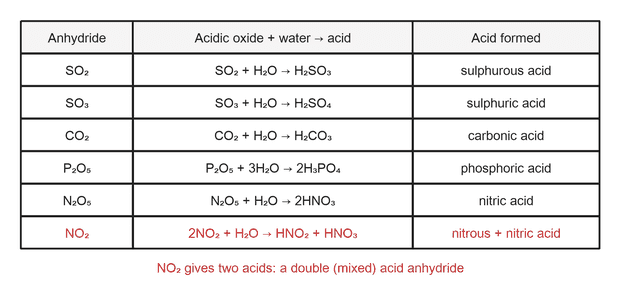
Watch out: Sulphurous acid comes from but sulphuric acid from .
Therefore, (a) SO₂ + H₂O → H₂SO₃; (b) P₂O₅ + 3H₂O → 2H₃PO₄; (c) CO₂ + H₂O → H₂CO₃; (d) SO₃ + H₂O → H₂SO₄.