
Question 32 marksEasy
Water is never added to acid in order to dilute it. Why ?
Confirming your payment
Sign up now and get 250 free tokens.
Acids, Bases and Salts · Question 3 of 90
Water is never added to acid in order to dilute it. Why ?
Solution:
Concept: Dissolving a concentrated acid in water is a highly exothermic process: a large amount of heat is given out.
Step 1 — What happens if water is added to the acid.
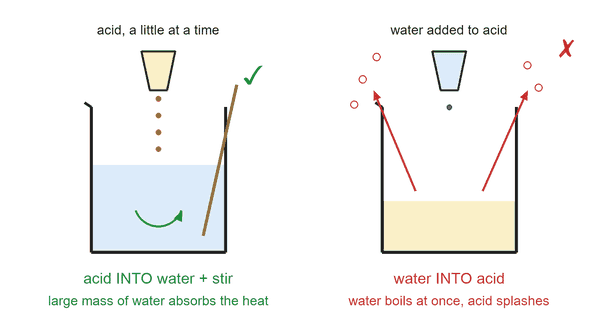
When a little water is poured into a lot of concentrated acid, the first small amount of water meets a large amount of acid. All the heat produced goes into this little water, so the water boils at once.
Step 2 — Why this is dangerous.
The boiling water throws the acid solution out of the container in splashes, which can cause severe burns to the skin and eyes. The sudden local heating can also crack the glass container.
Step 3 — The safe way.
So the acid is added to water slowly, a little at a time, with constant stirring. Now each small amount of acid always meets a large mass of water, which absorbs the heat and spreads it out safely.
Watch out: Remember the order “acid into water”, never “water into acid”.
Therefore, water is never added to acid because the heat given out boils the small amount of water at once, making the acid splash and the vessel crack; the acid is always added slowly to water with stirring.