
Question 42 marksEasy
Define the term 'basicity' of an acid. Give the basicity of : nitric acid, sulphuric acid and phosphoric acid.
Confirming your payment
Sign up now and get 250 free tokens.
Acids, Bases and Salts · Question 4 of 90
Define the term 'basicity' of an acid. Give the basicity of : nitric acid, sulphuric acid and phosphoric acid.
Solution:
Concept: Basicity counts only the ionisable (replaceable) hydrogen atoms of one molecule of an acid, not all the hydrogen atoms it contains.
Step 1 — Define basicity.
We define basicity by the number of hydronium ions one molecule can give. The basicity of an acid is the number of hydronium ions () that can be produced by the ionisation of one molecule of that acid in aqueous solution.
Step 2 — Count the ionisable hydrogens of each acid.
Each acid ionises once for every ionisable hydrogen it has, so we count those hydrogens:
| Acid | Formula | Basicity |
|---|---|---|
| Nitric acid | 1 (monobasic) | |
| Sulphuric acid | 2 (dibasic) | |
| Phosphoric acid | 3 (tribasic) |
Step 3 — Check with the ionisation equations.
Nitric acid ionises in a single step and gives one per molecule:
Sulphuric acid ionises in two steps and phosphoric acid in three steps, each step giving one :
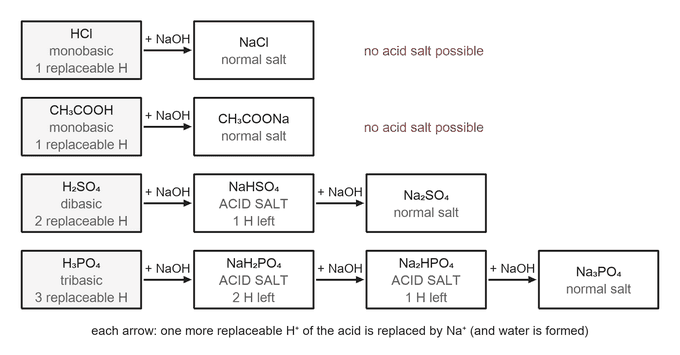
Therefore, basicity is the number of ions one molecule of the acid gives in water: nitric acid 1, sulphuric acid 2 and phosphoric acid 3.