Solution:
Concept: The further the pH is from 7, the stronger the acid or alkali. A strong acid gives hydrogen with active metals; zinc, being amphoteric, also gives hydrogen with a strong alkali.
Step 1 — Classify the five solutions.
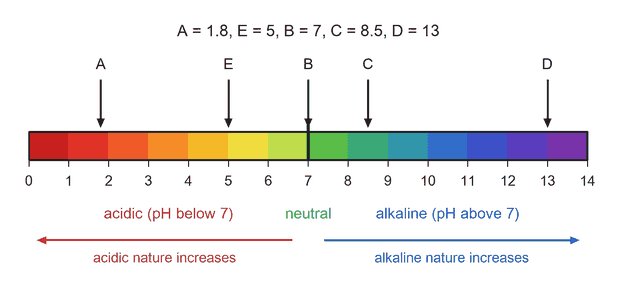
We compare each pH with 7:
| Solution | pH | Nature |
|---|
| A | 1·8 | strongly acidic |
| B | 7 | neutral |
| C | 8·5 | slightly alkaline |
| D | 13 | strongly alkaline |
| E | 5 | slightly acidic |
Step 2 — (a) Magnesium powder.
Magnesium is an active metal and displaces hydrogen most readily from the strong acid, solution A. Taking A as dilute hydrochloric acid:
magnesium + hydrochloric acid → magnesium chloride + hydrogen
Step 3 — (b) Powdered zinc.
Unlike magnesium, zinc also liberates hydrogen from a strong alkali, so the solution that suits zinc in particular is solution D. Taking D as sodium hydroxide solution:
zinc + sodium hydroxide → sodium zincate + hydrogen
Zn+2NaOH→Na2ZnO2+H2↑
Watch out: Zinc also gives hydrogen with the strong acid A (zinc + hydrochloric acid → zinc chloride + hydrogen); D is the answer that shows zinc's special (amphoteric) behaviour.
Therefore, A is strongly acidic, B neutral, C slightly alkaline, D strongly alkaline and E slightly acidic; (a) magnesium – solution A; (b) zinc – solution D.
