
Question 312 marksEasy
When you use universal indicator, you see that solutions of different acids produce different colours. Indeed, solutions of the same acid with different concentrations will also give different colours. Why ?
Confirming your payment
Sign up now and get 250 free tokens.
Acids, Bases and Salts · Question 31 of 90
When you use universal indicator, you see that solutions of different acids produce different colours. Indeed, solutions of the same acid with different concentrations will also give different colours. Why ?
Solution:
Concept: Universal indicator responds to the hydronium ion concentration (pH) of the solution, not to the name of the acid.
Step 1 — What universal indicator is.
Universal indicator is a mixture of dyes that shows a different colour at each pH.
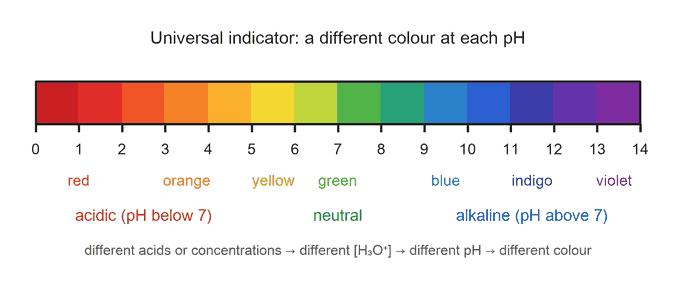
Step 2 — Different acids.
Different acids ionise to different extents (strong acids almost fully, weak acids only slightly), so at the same concentration they give different amounts of .
Step 3 — The same acid at different concentrations.
A more concentrated solution of the same acid gives more ions per litre than a dilute one.
Step 4 — Link to the colour.
In both cases the concentration of ions, and so the pH, is different, so the indicator shows a different colour.
Therefore, the colours differ because different acids, or different concentrations of one acid, give different H₃O⁺ concentrations, that is, different pH values.