
Question 333 marksEasy
Solution P has a pH of 13, solution Q has a pH of 6 and solution R has a pH of 2. Which solution :
(a) will liberate ammonia from ammonium sulphate on heating ?
(b) is a strong acid ?
(c) contains molecules as well as ions ?
Confirming your payment
Sign up now and get 250 free tokens.
Acids, Bases and Salts · Question 33 of 90
Solution P has a pH of 13, solution Q has a pH of 6 and solution R has a pH of 2. Which solution :
(a) will liberate ammonia from ammonium sulphate on heating ?
(b) is a strong acid ?
(c) contains molecules as well as ions ?
Solution:
Concept: PH 13 is a strong alkali, pH 6 a weak (slightly) acidic solution and pH 2 a strong acid.
Step 1 — Place the three solutions on the pH scale.
P (pH 13) is far above 7, Q (pH 6) is just below 7 and R (pH 2) is far below 7.
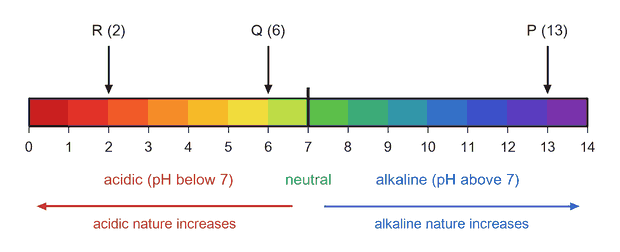
Step 2 — (a) Ammonia from ammonium sulphate.
An alkali heated with an ammonium salt liberates ammonia, so the answer is the alkali P:
Step 3 — (b) The strong acid.
R (pH 2) is far below 7, so it is the strong acid.
Step 4 — (c) Molecules as well as ions.
Q (pH 6) is a weak acid; a weak acid is only partly ionised, so its solution contains un-ionised molecules as well as ions.
Therefore, (a) P, (b) R, (c) Q.