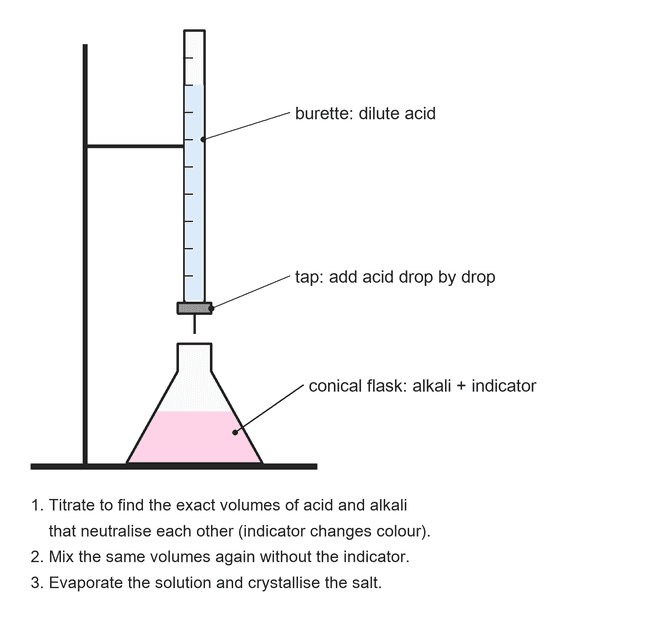
(a) it is necessary to find out the ratio of reactants required in the preparation of sodium sulphate,
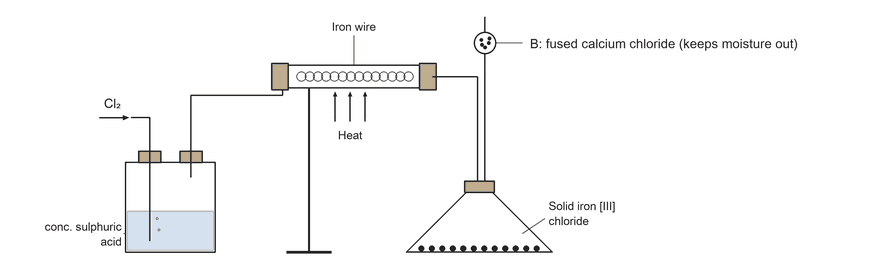
(b) fused calcium chloride is used in the preparation of FeCl3 ?
(c) Anhydrous FeCl3 cannot be prepared by heating hydrated Iron (III) chloride.
Solution:
Concept: Soluble reactants cannot be separated from the product by filtration; iron (III) chloride is deliquescent and its hydrate decomposes on heating.
Step 1 — (a) The ratio of reactants for sodium sulphate.
Sodium hydroxide and sulphuric acid are both soluble. If either is in excess, it cannot be removed by filtration and stays in the salt as an impurity. So the exact ratio needed for complete neutralisation is first found on a small scale by titration, and the same ratio is then used to make the salt:
2NaOH+H2SO4→Na2SO4+2H2O
Step 2 — (b) Fused calcium chloride in the preparation of FeCl₃.
Iron (III) chloride is highly deliquescent: it absorbs moisture from the air and dissolves in it. Fused calcium chloride is a drying agent; placed in the guard tube, it stops moisture from the air entering the receiver, so the iron (III) chloride stays dry (anhydrous).
Step 3 — (c) Heating hydrated iron (III) chloride.
On heating, hydrated iron (III) chloride does not simply lose its water. It decomposes into iron (III) oxide, water and hydrogen chloride, so no anhydrous iron (III) chloride is left:
2FeCl3⋅6H2OΔFe2O3+9H2O+6HCl
Therefore, (a) any excess of a soluble reactant cannot be filtered off, so the exact ratio is found by titration; (b) fused CaCl₂ keeps moisture away from the deliquescent FeCl₃; (c) the hydrate decomposes to Fe₂O₃ and HCl instead of losing only water.