
Question 154 marksEasy
What do you understand by an alkali ? Give two examples of :
(a) strong alkalis,
(b) weak alkalis.
Confirming your payment
Sign up now and get 250 free tokens.
Acids, Bases and Salts · Question 15 of 90
What do you understand by an alkali ? Give two examples of :
(a) strong alkalis,
(b) weak alkalis.
Solution:
Concept: An alkali is a base that dissolves in water. How strong it is depends on how completely it dissociates into ions, which decides the concentration of ions in its solution.
Step 1 — Define an alkali.
We define an alkali by the ions it gives in water. An alkali is a basic hydroxide which, when dissolved in water, produces hydroxyl () ions as the only negatively charged ions. In short, an alkali is a base soluble in water:
Step 2 — (a) Strong alkalis.
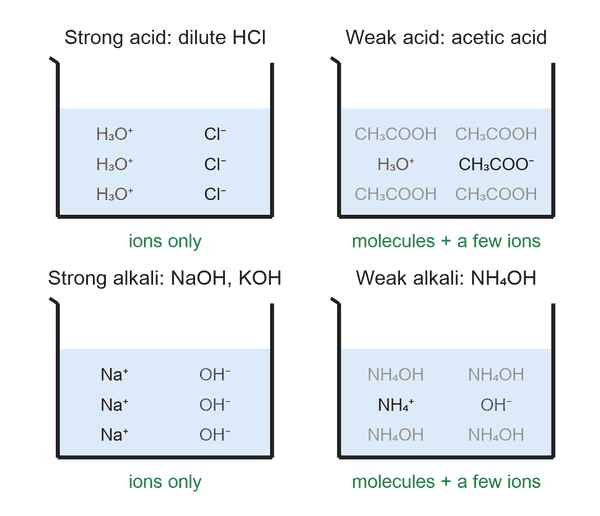
Sodium hydroxide () and potassium hydroxide () are almost completely dissociated in water, so their solutions have a high concentration of ions.
Step 3 — (b) Weak alkalis.
Ammonium hydroxide () is only feebly dissociated, so its solution contains many molecules and only a few ions. Calcium hydroxide () is also listed as a weak alkali in the book, because it is only slightly soluble and lime water therefore has a low concentration.
Watch out: Strictly, the small amount of calcium hydroxide that does dissolve is almost fully dissociated; its solution is weakly alkaline because so little dissolves. Ammonium hydroxide is the true example of a weak (feebly ionised) alkali.
Therefore, an alkali is a base soluble in water that gives OH⁻ as the only negative ions; (a) strong alkalis: NaOH, KOH; (b) weak alkalis: NH₄OH, Ca(OH)₂.