
Question 164 marksEasy
What is the difference between :
(a) an alkali and a base,
(b) the chemical nature of an aqueous solution of HCl and an aqueous solution of .
Confirming your payment
Sign up now and get 250 free tokens.
Acids, Bases and Salts · Question 16 of 90
What is the difference between :
(a) an alkali and a base,
(b) the chemical nature of an aqueous solution of HCl and an aqueous solution of .
Solution:
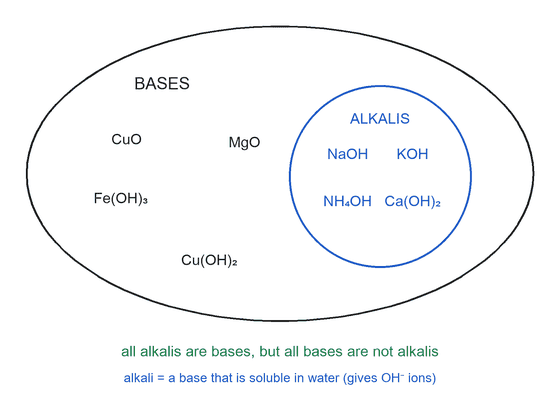
Concept: Every alkali is a base, but only the water-soluble bases are alkalis. Whether a solution is acidic or basic depends on the ions it gives in water.
Step 1 — (a) Compare a base and an alkali.
We compare the two on what they are and on solubility in water:
| Base | Alkali |
|---|---|
| A metallic oxide or hydroxide (or ammonium hydroxide) that reacts with an acid to give salt and water only. | A base which is soluble in water and gives ions as the only negative ions. |
| May or may not dissolve in water, e.g. , (insoluble). | Always soluble, e.g. , . |
Step 2 — (b) Aqueous HCl.
Hydrogen chloride ionises in water and gives ions, so its solution is acidic: it turns blue litmus red and has a pH below 7.
Step 3 — (b) Aqueous ammonia.
Ammonia dissolves in water to form ammonium hydroxide, which produces ions, so its solution is basic (alkaline): it turns red litmus blue and has a pH above 7.
Aqueous ammonia is a weak alkali (only partly ionised), while aqueous HCl is a strong acid (almost fully ionised).
Therefore, (a) all alkalis are bases, but only bases soluble in water are alkalis; (b) aqueous HCl is acidic (gives H₃O⁺ ions), while aqueous NH₃ is basic (gives OH⁻ ions).