Solution:
Concept: Lead sulphate is insoluble, so it is made by precipitation. Lead carbonate is also insoluble, so it must first be turned into a soluble lead salt — lead nitrate, since nearly all nitrates are soluble.
Step 1 — (a) The first step.
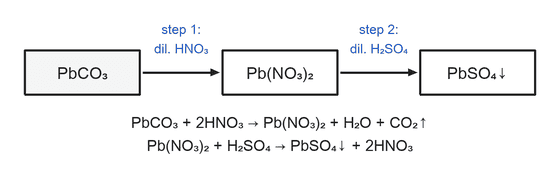
We dissolve the lead carbonate in dilute nitric acid to form soluble lead nitrate. (In the second step, dilute sulphuric acid or sodium sulphate solution is added to precipitate lead sulphate.)
Step 2 — (b) The equation for the first step.
Lead carbonate reacts with dilute nitric acid, giving off carbon dioxide:
PbCO3+2HNO3→Pb(NO3)2+H2O+CO2↑
The second step then completes the preparation:
Pb(NO3)2+H2SO4→PbSO4↓+2HNO3
Step 3 — (c) Why direct addition of dilute sulphuric acid fails.
The lead sulphate formed is insoluble. It forms a coating on the lead carbonate, which prevents further contact with the acid, so the reaction stops almost at once and very little lead sulphate is obtained.

Therefore, (a) dissolve lead carbonate in dilute nitric acid; (b) PbCO₃ + 2HNO₃ → Pb(NO₃)₂ + H₂O + CO₂; (c) an insoluble PbSO₄ coating stops the direct reaction.
