Solution:
Concept: Lead and calcium carbonate form insoluble sulphates with sulphuric acid, which coat them and stop the reaction. So we use zinc, sodium sulphite and sodium carbonate, which react fully.
Step 1 — (i) Hydrogen.
Zinc, an active metal, displaces hydrogen from dilute sulphuric acid:
Zn+H2SO4→ZnSO4+H2↑
Step 2 — (ii) Sulphur dioxide.
A sulphite with a dilute acid gives sulphur dioxide:
Na2SO3+H2SO4→Na2SO4+H2O+SO2↑
Step 3 — (iii) Carbon dioxide.
Sodium carbonate with the dilute acid gives carbon dioxide (calcium carbonate would be coated by calcium sulphate):
Na2CO3+H2SO4→Na2SO4+H2O+CO2↑
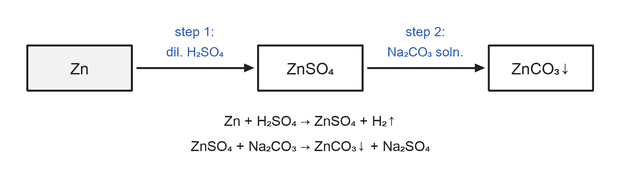
Step 4 — (iv) Zinc carbonate in two steps.
We first make soluble zinc sulphate, then precipitate insoluble zinc carbonate with sodium carbonate solution:
Zn+H2SO4→ZnSO4+H2↑
ZnSO4+Na2CO3→ZnCO3↓+Na2SO4
Watch out: Lead is in the list but is not used: lead sulphate would coat the lead and stop the reaction.
Therefore, (i) Zn + H₂SO₄; (ii) Na₂SO₃ + H₂SO₄; (iii) Na₂CO₃ + H₂SO₄; (iv) Zn + H₂SO₄, then ZnSO₄ + Na₂CO₃.
