Solution:
Concept: Each sentence is the definition of one term from this chapter.
Step 1 — (i) Incomplete neutralisation of an acid.
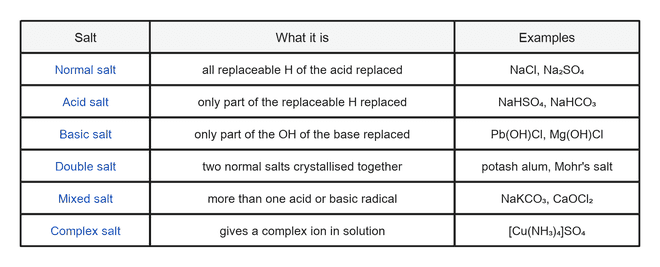
This gives an acid salt, e.g. NaHSO4, formed when only part of the acid's hydrogen is replaced:
NaOH+H2SO4→NaHSO4+H2O
Step 2 — (ii) Water molecules bound to some salts.
This is water of crystallisation, e.g. the 5 molecules of water in blue CuSO4⋅5H2O.
Step 3 — (iii) Absorbing moisture until the substance dissolves.
This process is deliquescence, e.g. iron (III) chloride or magnesium chloride left in air.
Step 4 — (iv) A metal ion surrounded by other ions or molecules.
This is a complex salt, e.g. [Cu(NH3)4]SO4.
Step 5 — (v) A base soluble in water.
This is an alkali, e.g. sodium hydroxide.
Therefore, (i) acid salt, (ii) water of crystallisation, (iii) deliquescence, (iv) complex salt, (v) alkali.
