Solution:
Concept: An acid salt needs more than one replaceable hydrogen; strength depends on the number of H3O+ ions produced; in oxy-acids of phosphorus only the H atoms on oxygen are replaceable; an insoluble product coating a solid stops a reaction.
Step 1 — (a) Carbonic acid gives an acid salt but hydrochloric acid does not.
Carbonic acid, H2CO3, is dibasic. If only one of its two replaceable hydrogens is replaced, an acid salt forms:
NaOH+H2CO3→NaHCO3+H2O
Hydrochloric acid is monobasic. Once its single replaceable hydrogen is replaced, the salt (NaCl) is already a normal salt, so no acid salt is possible.
Step 2 — (b) Dilute HCl is stronger than highly concentrated acetic acid.
Strength depends on the concentration of H3O+ ions, not on the amount of acid present. Dilute HCl is almost completely ionised, so it gives many H3O+ ions. Acetic acid, even when highly concentrated, is only feebly ionised and gives very few H3O+ ions. So dilute HCl is the stronger acid.
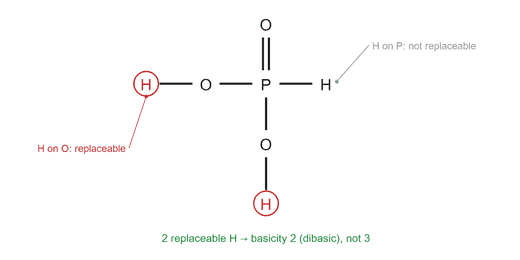
Step 3 — (c) H₃PO₃ is not a tribasic acid.
In H3PO3 only the two hydrogen atoms attached to oxygen (–OH) are replaceable. The third hydrogen is joined directly to phosphorus and does not ionise. So one molecule gives only two H3O+ ions, and H3PO3 is dibasic, not tribasic.
Step 4 — (d) Lead carbonate does not react with dilute HCl.
The reaction starts, but the product, lead chloride, is insoluble in cold water. It forms a coating on the lead carbonate and stops further contact with the acid, so the reaction stops almost at once.

Step 5 — (e) Nitrogen dioxide is a double acid anhydride.
Nitrogen dioxide dissolves in water to form two acids, nitrous acid and nitric acid. An oxide that gives two acids with water is called a double (mixed) acid anhydride:
2NO2+H2O→HNO2+HNO3
Watch out: The number of hydrogen atoms in the formula does not decide basicity; H atoms bonded directly to P (as in H3PO3) or to C (as in acetic acid) do not ionise.
Therefore, (a) only a polybasic acid like H₂CO₃ can be partly neutralised; (b) dilute HCl gives far more H₃O⁺ ions; (c) H₃PO₃ has only two replaceable H, so it is dibasic; (d) an insoluble PbCl₂ coating stops the reaction; (e) NO₂ gives two acids with water.
