
Opening your dashboard
Class 10 Chemistry Chapter 12: Organic Chemistry Solutions
150 textbook questions with step-by-step answers, free to read, for ICSE 2026-27.
Get talked through Ch 12, not just shown the answer
Reading a finished solution is not the same as being able to do it. The AI tutor takes one question at a time and works it with you, in your own words, until you can.
- Ask it out loud, in your own words
- It gives you the next step, not the answer
- Stuck on part (ii)? Start there
150 questions with solutions
1–5 marks · Mixed difficulty
The first 52 solutions are on this page. This chapter is a long one, so the rest open on their own page to keep this one quick to load.
- 14 marks
Question 1
(a) What are organic compounds?
(b) What is vital force theory? Why was it discarded?
Solve with AIWritten solution
Solution:
Concept: Organic chemistry is the chemistry of carbon compounds. The old belief that only living things could make them (the "vital force" theory) was disproved when an organic compound was made in a laboratory from an inorganic one.
Step 1 — (a) Define organic compounds.
Organic compounds are the compounds of carbon, that is, hydrocarbons and their derivatives (compounds formed when hydrogen atoms of a hydrocarbon are replaced by other atoms or groups).
A few simple carbon compounds are not counted as organic: the oxides of carbon, metal carbonates and hydrogen carbonates, and metal cyanides and carbides. Examples of organic compounds: methane , ethanol , sugar and urea.
Step 2 — (b) State the vital force theory.
Berzelius suggested that organic compounds can be made only by living things (plants and animals) through a mysterious "vital force" present in them, so they could never be made in a laboratory.
Step 3 — (b) Explain why it was discarded.
In 1828 Friedrich Wöhler made urea, an organic compound found in urine, in the laboratory simply by heating ammonium cyanate, an inorganic compound. No living cell was involved:
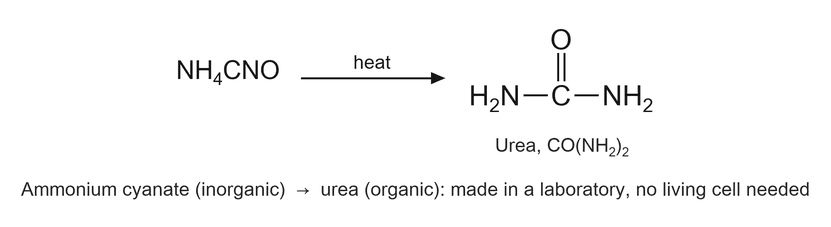
Later, Kolbe (1845) made acetic acid and Berthelot (1856) made methane from inorganic starting materials. So the idea of a vital force was not needed, and the theory was given up.
Watch out: The carbonates and oxides of carbon contain carbon but are studied as inorganic compounds.
Therefore, (a) organic compounds are hydrocarbons and their derivatives; (b) the vital force theory said only living things can make them, and it was discarded after Wöhler made urea from ammonium cyanate in 1828.
- 24 marks
Question 2
(a) Name a few sources of organic compounds.
(b) Give the various applications of organic chemistry.
Solve with AIWritten solution
Solution:
Concept: Organic compounds come from living things (plants and animals), from fossil sources (coal, petroleum, natural gas) and from wood; today most of them are also made in laboratories and factories.
Step 1 — (a) List the sources.
We list where organic compounds are obtained from:
- Plants: sugar, starch, cellulose, oils and many drugs.
- Animals: urea, proteins and fats.
- Coal: its destructive distillation gives benzene, toluene, naphthalene, and from these dyes, drugs and perfumes.
- Petroleum and natural gas: petrol, kerosene, diesel, fuel gases such as methane, naphtha.
- Fermentation: ethyl alcohol (ethanol) and acetic acid.
- Wood: its destructive distillation gives methyl alcohol, acetone and acetic acid.
- Synthesis: most organic compounds are now made in the laboratory.
Step 2 — (b) List the applications.
We list the areas of daily life that depend on organic compounds:
- Food: carbohydrates, proteins, fats and vitamins.
- Clothing: cotton, wool, silk and synthetic fibres such as nylon and polyester.
- Fuels: natural gas, LPG, petrol, kerosene, diesel.
- Medicines and hygiene: drugs, antiseptics, soaps, shampoos, perfumes.
- Industry and farming: dyes, plastics, rubber, paints, explosives, insecticides.
Therefore, (a) organic compounds come from plants, animals, coal, petroleum, natural gas, wood and synthesis; (b) they are used as food, clothing, fuels, medicines, dyes, plastics and much more.
- 32 marks
Question 3
Organic chemistry plays a key role in all walks of life. Discuss.
Solve with AIWritten solution
Solution:
Concept: Almost everything we eat, wear and use every day is an organic compound, so organic chemistry touches every part of life.
Step 1 — List the areas of life that depend on organic compounds.
We take the main needs of daily life one by one:
- Food: carbohydrates, proteins, fats and vitamins are all organic compounds.
- Clothing: cotton, wool, silk and synthetic fibres such as nylon.
- Fuels: natural gas, LPG, petrol, diesel and kerosene.
- Health: medicines, antibiotics and antiseptics.
- Daily use: soaps, detergents, shampoos, perfumes, plastics and paints.
- Farming and industry: insecticides, dyes, rubber and explosives.
Step 2 — Draw the conclusion.
Since our food, clothes, fuels, medicines and household articles are organic, a knowledge of organic chemistry is needed in every walk of life.
Therefore, organic chemistry plays a key role in all walks of life, because food, clothing, fuels, medicines and most articles of daily use are organic compounds.
- 42 marks
Question 4
Carbon shows some unique properties, name them.
Solve with AIWritten solution
Solution:
Concept: Carbon (atomic number 6, electronic configuration 2, 4) has four valence electrons. A few special properties that follow from this let carbon form millions of compounds.
Step 1 — Tetravalency.
Carbon has four valence electrons, which it shares to form four covalent bonds.
Step 2 — Catenation.
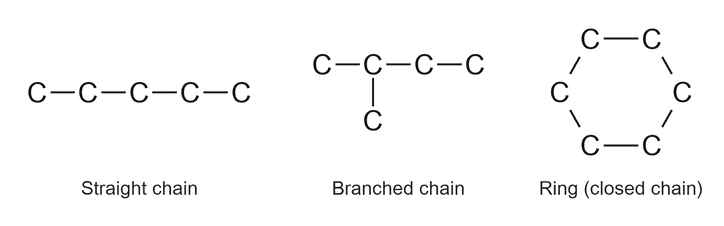
Carbon atoms link with one another through strong C–C bonds to form long straight chains, branched chains and rings:
Step 3 — Multiple bonds.
Two carbon atoms can share one, two or three pairs of electrons, so carbon forms single, double and triple bonds.
Step 4 — Isomerism.
Because the same atoms can be joined in different ways, two or more compounds can have the same molecular formula but different structures.
Therefore, the unique properties of carbon are tetravalency, catenation, the formation of multiple bonds and isomerism.
- 54 marks
Question 5
Explain the following :
(a) tetravalency,
(b) catenation.
Solve with AIWritten solution
Solution:
Concept: Both are properties of the carbon atom (electronic configuration 2, 4). Tetravalency is about how many bonds a carbon atom forms; catenation is about carbon atoms bonding to each other.
Step 1 — (a) Tetravalency.
Carbon has four valence electrons. Losing or gaining four electrons needs too much energy, so carbon shares its four electrons and forms four covalent bonds. This property is called tetravalency.
For example, in methane, , the carbon atom shares one pair of electrons with each of four hydrogen atoms:

Step 2 — (b) Catenation.
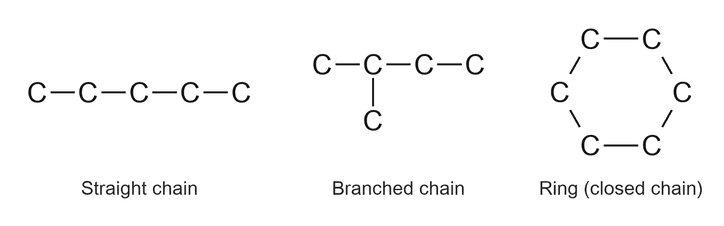
Catenation is the property of self-linking of carbon atoms by covalent bonds to form straight chains, branched chains and rings of different sizes.
It is possible because the C–C bond is strong and each carbon, being tetravalent, still has bonds left for hydrogen or other atoms after joining other carbons:
Watch out: Catenation is carbon bonding to carbon; bonding to hydrogen or oxygen is not catenation.
Therefore, (a) tetravalency is the power of carbon to form four covalent bonds; (b) catenation is the self-linking of carbon atoms into chains and rings.
- 62 marks
Question 6
Write any four properties of organic compounds that distinguish them from inorganic compounds.
Solve with AIWritten solution
Solution:
Concept: Organic compounds are covalent, while most inorganic compounds are ionic. Most of the differences follow from this.
Step 1 — Compare the two kinds of compound.
The table compares them property by property:
Property Organic compounds Inorganic compounds Carbon Always present. Not an essential element. Solubility Generally insoluble in water; soluble in organic solvents (alcohol, benzene). Generally soluble in water; insoluble in organic solvents. Melting and boiling points Low; many decompose on heating. High; usually do not decompose. Burning Inflammable: they burn easily. Generally do not burn. Bonding and conductivity Covalent; non-electrolytes. Mostly ionic; electrolytes. Speed of reaction Slow (molecules react). Fast (ions react). Step 2 — Pick any four.
Any four rows of the table answer the question. For example, sugar (organic) chars on gentle heating, while common salt (inorganic) melts only at a very high temperature.
Therefore, organic compounds always contain carbon, are covalent, have low melting points, burn easily and are mostly insoluble in water, unlike inorganic compounds.
- 72 marks
Question 7
Why are organic compounds studied as a separate branch of chemistry ?
Solve with AIWritten solution
Solution:
Concept: Organic compounds are very many and different in nature from inorganic compounds, so they are studied on their own.
Step 1 — Very large number.
Organic compounds number in millions, far more than all inorganic compounds together, because carbon shows tetravalency, catenation, multiple bonding and isomerism.
Step 2 — Different properties.
Being covalent, they have low melting and boiling points, burn easily, are mostly insoluble in water, and their reactions are slow. Inorganic compounds behave quite differently.
Step 3 — Special features.
They show isomerism, form homologous series, and need their own system of naming (IUPAC nomenclature).
Therefore, because of their huge number, special properties and special features, organic compounds are studied as a separate branch of chemistry.
- 82 marks
Question 8
What are hydrocarbons ? Compare saturated and unsaturated hydrocarbons.
Solve with AIWritten solution
Solution:
Concept: Hydrocarbons contain only carbon and hydrogen. They are saturated when every carbon–carbon bond is single, and unsaturated when there is at least one double or triple bond.
Step 1 — Define hydrocarbons.
Hydrocarbons are organic compounds made up of only carbon and hydrogen atoms, for example methane , ethene and ethyne .
Step 2 — Compare saturated and unsaturated hydrocarbons.
The table sets the two types side by side:
Saturated hydrocarbons Unsaturated hydrocarbons Every carbon's four valencies are satisfied by single bonds. At least two carbon atoms are joined by a double or a triple bond. Less reactive (stable). More reactive: the double or triple bond can open up. Undergo substitution reactions. Undergo addition reactions. Do not decolourise bromine water or alkaline KMnO₄. Decolourise bromine water and alkaline KMnO₄. Example: alkanes, e.g. ethane . Examples: alkenes (ethene ), alkynes (ethyne ). 
Therefore, hydrocarbons are compounds of only carbon and hydrogen; saturated ones have only single bonds and undergo substitution, while unsaturated ones have a double or triple bond and undergo addition.
- 92 marks
Question 9
Give reason for the existence of the large number of organic compounds.
Solve with AIWritten solution
Solution:
Concept: The unique properties of the carbon atom let it build an almost unlimited number of different molecules.
Step 1 — Tetravalency.
Each carbon atom forms four covalent bonds, so it can join four other atoms or groups.
Step 2 — Catenation.
Carbon atoms link with one another into straight chains, branched chains and rings of any size.
Step 3 — Multiple bonds.
Carbon forms single, double and triple bonds, giving both saturated and unsaturated compounds.
Step 4 — Isomerism.
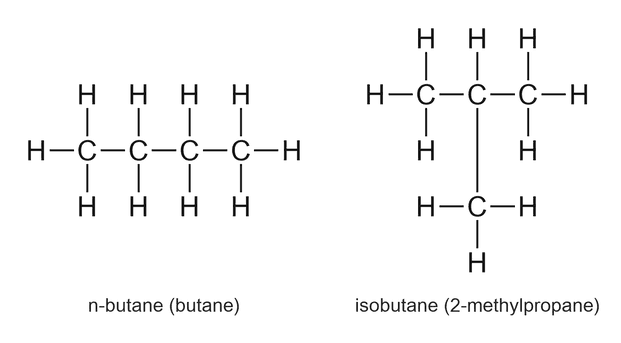
One molecular formula can stand for two or more compounds. For example, is both butane and isobutane (2-methylpropane):
Step 5 — Bonding with other elements.
Carbon also bonds strongly with hydrogen, oxygen, nitrogen, sulphur and the halogens, giving many families of compounds.
Therefore, tetravalency, catenation, multiple bonding, isomerism and bonding with other elements explain the very large number of organic compounds.
- 105 marks
Question 10
Give at least one example in each case to show the structure of :
(a) single bond compound,
(b) double bond compound,
(c) triple bond compound.
Solve with AIWritten solution
Solution:
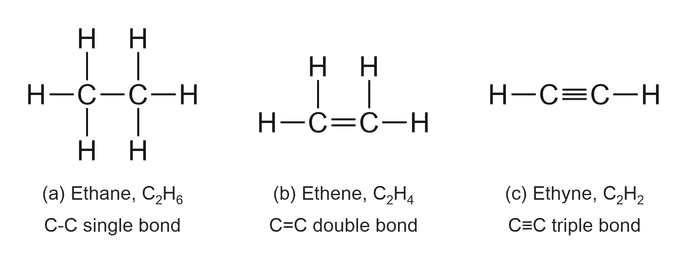
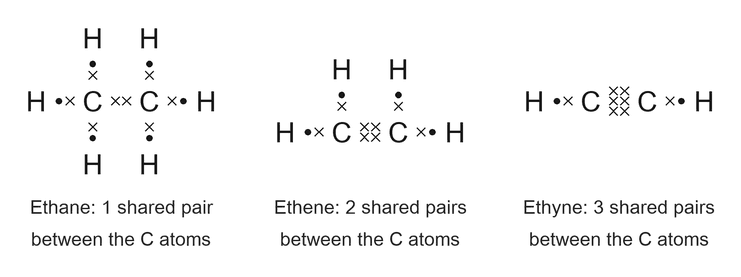
Concept: Ethane, ethene and ethyne each have two carbon atoms, joined by a single, a double and a triple bond: one, two and three shared pairs of electrons.
Step 1 — Draw the three structures.
Each carbon must end up with four bonds, so the number of H atoms falls as the C–C bond gets stronger:
Step 2 — (a) Single bond compound: ethane, .
The two carbon atoms share one pair of electrons (C–C); each carbon also holds three H atoms.
Step 3 — (b) Double bond compound: ethene, .
The two carbon atoms share two pairs of electrons (C=C); each carbon holds two H atoms.
Step 4 — (c) Triple bond compound: ethyne, .
The two carbon atoms share three pairs of electrons (C≡C); each carbon holds one H atom:
Watch out: Count the bonds round each carbon: it must always be four (C=C counts as two, C≡C as three).
Therefore, (a) ethane (C–C), (b) ethene (C=C) and (c) ethyne (C≡C).
- 114 marks
Question 11
Name a compound of each type and draw the figure.
(a) Cyclic compound with single bond.
(b) Cyclic compound with triple bond.
Solve with AIWritten solution
Solution:
Concept: In a cyclic (closed-chain) compound the carbon atoms are joined in a ring; each carbon still forms four bonds.
Step 1 — Draw the two rings.
Both structures are shown below; each corner of a ring is a carbon atom:

Step 2 — (a) Cyclic compound with single bonds: cyclohexane, .
Six groups are joined by single bonds in a ring. Each carbon has two ring bonds and two H atoms. Cyclopropane and cyclopentane are other examples.
Step 3 — (b) Cyclic compound with a triple bond: cyclo-octyne, .
An eight-carbon ring contains one C≡C bond. A triple bond wants its four atoms in a straight line, so it fits only into a large ring; eight carbons is the smallest ring that gives a stable compound.
Note: the usual Class 10 example of a ring with a multiple bond has a double bond: cyclohexene, . If the question meant "double bond", cyclohexene is the answer.
Therefore, (a) cyclohexane is a ring with single bonds; (b) cyclo-octyne is a ring with a triple bond.
- 122 marks
Question 12
Give the name of one member of each of the following:
(a) saturated hydrocarbons,
(b) unsaturated hydrocarbons.
Solve with AIWritten solution
Solution:
Concept: Saturated hydrocarbons have only single bonds (alkanes). Unsaturated hydrocarbons have a double or triple bond (alkenes, alkynes).
Step 1 — (a) Saturated hydrocarbon.
Methane, (or ethane, propane): every carbon's four valencies are satisfied by single bonds.
Step 2 — (b) Unsaturated hydrocarbon.
Ethene, (or ethyne, ): the two carbon atoms are joined by a double bond:
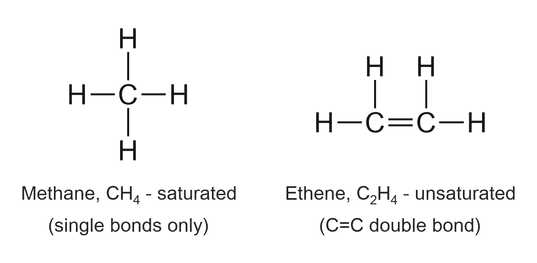
Therefore, (a) methane is saturated; (b) ethene is unsaturated.
- 132 marks
Question 13
Define substitution and addition reactions. Give an example for each.
Solve with AIWritten solution
Solution:
Concept: Saturated compounds react by substitution (an atom is swapped for another). Unsaturated compounds react by addition (atoms add across the double or triple bond).
Step 1 — Define a substitution reaction.
A substitution reaction is one in which an atom (or group) of a molecule is replaced by another atom (or group).
Step 2 — Give an example of substitution.
Methane reacts with chlorine in diffused sunlight; one H atom of methane is replaced by a Cl atom:
Step 3 — Define an addition reaction.
An addition reaction is one in which atoms or molecules add across the double or triple bond of an unsaturated compound, giving a saturated product.
Step 4 — Give an example of addition.
Ethene adds bromine (dissolved in carbon tetrachloride) across its C=C bond to give 1,2-dibromoethane:

Watch out: In substitution there are always two products (here and ); in addition there is only one.
Therefore, substitution replaces an atom (CH₄ + Cl₂ → CH₃Cl + HCl), while addition adds atoms across a multiple bond (C₂H₄ + Br₂ → C₂H₄Br₂).
- 145 marks
Question 14
Define a functional group and give the structural formula of the following functional groups:
(a) ketone,
(b) alcohols,
(c) aldehydes.
Solve with AIWritten solution
Solution:
Concept: The functional group is the reactive part of an organic molecule. Compounds with the same functional group show similar chemical properties, whatever the length of the carbon chain.
Step 1 — Define a functional group.
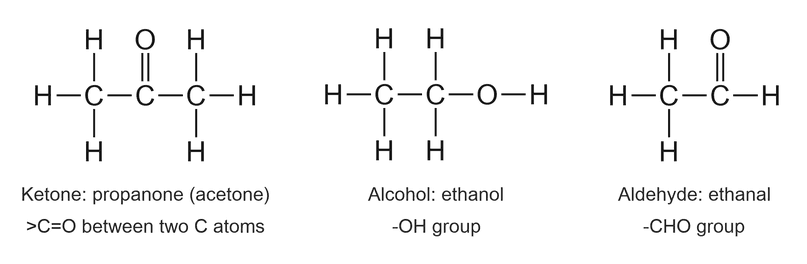
A functional group is an atom or a group of atoms, joined in a specific manner, which is responsible for the characteristic chemical properties of an organic compound. Examples: –OH, –CHO, –COOH, >C=O.
Step 2 — Draw the three groups.
The bond lines left open join the group to the rest of the molecule:
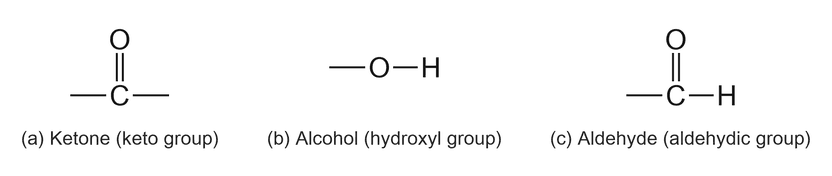
Step 3 — (a) Ketone: keto group, >C=O.
A carbon atom is double-bonded to oxygen and joined to two other carbon atoms. Example: propanone (acetone), .
Step 4 — (b) Alcohols: hydroxyl group, –OH.
An oxygen atom is joined to a carbon on one side and to a hydrogen on the other. Example: ethanol, .
Step 5 — (c) Aldehydes: aldehydic group, –CHO.
A carbon atom is double-bonded to oxygen and single-bonded to one hydrogen, so it is always at the end of the chain. Example: ethanal, :
Watch out: A ketone and an aldehyde both contain C=O; only in the aldehyde does the C=O carbon also carry an H atom.
Therefore, a functional group decides the chemical properties; ketone: >C=O, alcohol: –OH, aldehyde: –CHO.
- 155 marks
Question 15
(a) What is a homologous series ?
(b) What is the difference in the molecular formula of any two adjacent homologues :
(i) in terms of molecular mass,
(ii) in terms of number and kind of atoms per molecule?
Solve with AIWritten solution
Solution:
Concept: In a homologous series each member differs from the next by one group, so neighbouring members always differ by the same atoms and the same mass.
Step 1 — (a) Define a homologous series.
A homologous series is a group of organic compounds with the same general formula and similar chemical properties, in which each member differs from the next by a group. Their physical properties change gradually along the series.
Examples: alkanes (), alkenes (), alkynes (), alcohols.
Step 2 — (b)(i) Find the difference in molecular mass.
The difference is the mass of one group, using C = 12 and H = 1:
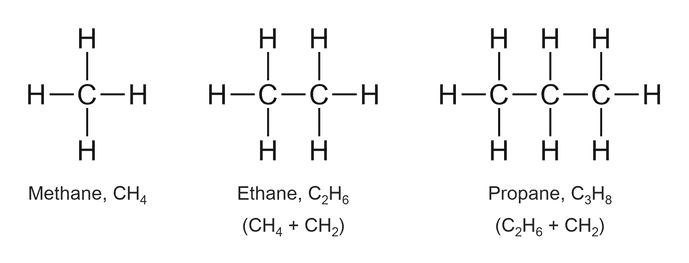
Check with methane and ethane:
Step 3 — (b)(ii) State the difference in atoms.
Adjacent homologues differ by one carbon atom and two hydrogen atoms (a group), for example → → :
Therefore, (a) a homologous series is a family with one general formula whose members differ by CH₂; (b) adjacent members differ by (i) 14 u and (ii) one C atom and two H atoms.
- 164 marks
Question 16
Write the name and formula of fourth member of the following homologous series :
(a) Alkyne
(b) Alcohol
Solve with AIWritten solution
Solution:
Concept: Count from the first member of each series. Alkynes need a C≡C bond, so they start at two carbons (ethyne); alcohols start at one carbon (methanol).
Step 1 — (a) List the alkynes.
The series () runs: ethyne (1st), propyne (2nd), butyne (3rd), pentyne (4th).
Step 2 — (a) Find the formula of the fourth alkyne.
The fourth member has n = 5 carbon atoms, so its number of hydrogen atoms is:
So the fourth alkyne is pentyne, .
Step 3 — (b) List the alcohols.
The series () runs: methanol (1st), ethanol (2nd), propanol (3rd), butanol (4th).
Step 4 — (b) Find the formula of the fourth alcohol.
The fourth member has n = 4, so the alkyl part has this many hydrogen atoms:
So the fourth alcohol is butanol, :

Watch out: The alkyne series starts at ethyne (n = 2), not at n = 1, so its fourth member has five carbons.
Therefore, (a) the fourth alkyne is pentyne, C₅H₈; (b) the fourth alcohol is butanol, C₄H₉OH.
- 172 marks
Question 17
Which part of an organic compound determines
(i) physical properties (ii) chemical properties ?
Solve with AIWritten solution
Solution:
Concept: An organic molecule has two parts: the carbon chain (alkyl part) and the functional group. The chain decides the size of the molecule; the functional group decides how it reacts.
Step 1 — (i) Physical properties.
These depend on the size of the alkyl part (the number of carbon atoms, so the molecular mass). For example, along a homologous series the boiling point rises steadily as the chain grows.
Step 2 — (ii) Chemical properties.
These depend on the functional group. For example, all alcohols (–OH) react with sodium to give hydrogen, whatever their chain length:

Ethanol and ethanoic acid have equally small chains but different functional groups, so they react very differently: ethanoic acid is acidic, ethanol is not.
Therefore, (i) physical properties are decided by the alkyl part (size of the molecule); (ii) chemical properties are decided by the functional group.
- 184 marks
Question 18
(a) What is an alkyl group ?
(b) Give the names of any three alkyl groups. How are they formed ?
Solve with AIWritten solution
Solution:
Concept: An alkyl group is an alkane minus one hydrogen atom. Its free bond lets it join to a functional group or to another chain. It is named by changing -ane to -yl.
Step 1 — (a) Define an alkyl group.
An alkyl group is the group of atoms left when one hydrogen atom is removed from an alkane molecule. Its general formula is –, and it is written R–.
Step 2 — (b) Name three alkyl groups and show how they form.
Each group comes from the alkane with the same number of carbons:
- Methyl, –: methane minus one H atom.
- Ethyl, –: ethane minus one H atom.
- Propyl, –: propane minus one H atom.

The suffix -ane of the alkane changes to -yl: methane → methyl, ethane → ethyl, propane → propyl.
Watch out: An alkyl group is not a compound on its own; it always has one free bond.
Therefore, (a) an alkyl group is an alkane minus one H atom (CₙH₂ₙ₊₁–); (b) methyl CH₃–, ethyl C₂H₅– and propyl C₃H₇– are formed from methane, ethane and propane.
- 192 marks
Question 19
Give the names and the structural formula of the first three members of the homologous series of alkanes.
Solve with AIWritten solution
Solution:
Concept: Alkanes have the general formula and only single bonds. Put n = 1, 2 and 3, and give every carbon four bonds.
Step 1 — Find the formulae.
Using for the first three values of n:
n Name Molecular formula Condensed formula 1 Methane 2 Ethane 3 Propane Step 2 — Draw the structures.
Join the carbons in a chain by single bonds and fill every remaining bond with H:

Each member differs from the next by one group, which is why they form a homologous series.
Therefore, the first three alkanes are methane CH₄, ethane C₂H₆ and propane C₃H₈.
- 205 marks
Question 20
Name the alkyl radical and the functional group of the following organic compounds :
(a) , (b) ,
(c) , (d) ,
(e) (f) .
Solve with AIWritten solution
Solution:
Concept: Split each formula into an alkyl group (–, named from the alkane with -yl) and the functional group written after it.
Step 1 — Split each formula.
The table shows the two parts of each compound:
Compound Alkyl radical Functional group (a) methyl, – –OH (hydroxyl, alcohol) (b) ethyl, – –OH (hydroxyl, alcohol) (c) propyl, – –CHO (aldehyde) (d) butyl, – –COOH (carboxyl, acid) (e) methyl, – –COOH (carboxyl, acid) (f) ethyl, – –Br (halo / bromo) Step 2 — Check the alkyl parts.
Each alkyl part fits : for (c), n = 3 gives ; for (d), n = 4 gives :

Watch out: In (c) and (d) the carbon of –CHO or –COOH belongs to the functional group, so it is not counted in the alkyl radical.
Therefore, (a) methyl, –OH; (b) ethyl, –OH; (c) propyl, –CHO; (d) butyl, –COOH; (e) methyl, –COOH; (f) ethyl, –Br.
- 215 marks
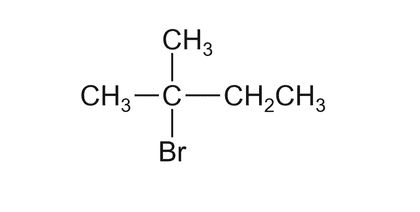
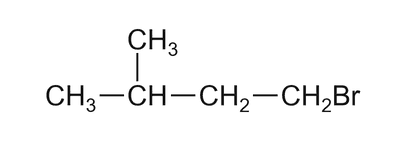
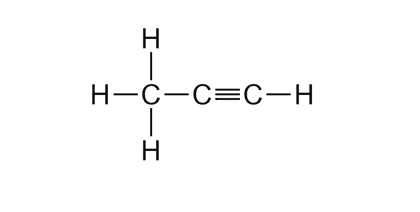
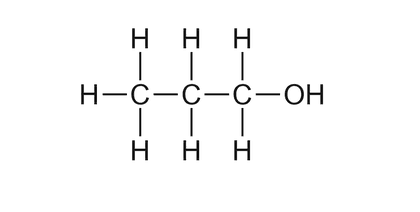
Question 21
Write the IUPAC name of the following :
(a)
(b)

(c)

(d)
(e)
(f)

(g)

(h)

(i)
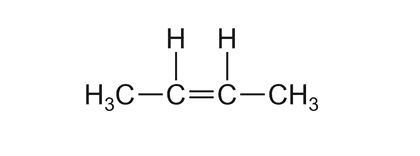
(j)
(k)
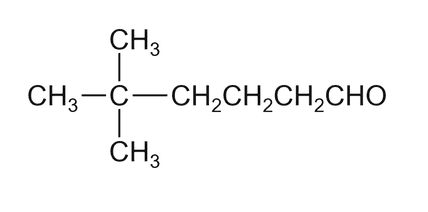
(l)
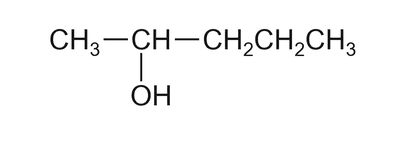
(m)
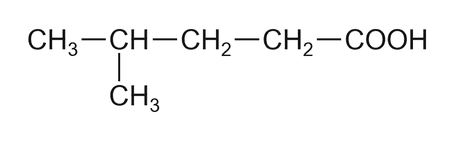
(n)
(o)
(p)
(q)

(r)

(s)
(t)

(u)

(v)
 Solve with AI
Written solution
Solution:
Concept: An IUPAC name is built as locants + substituents (in alphabetical order) + root word + suffix. The root word counts the carbons of the longest chain that contains the functional group or multiple bond (meth 1, eth 2, prop 3, but 4, pent 5, hex 6, hept 7). The chain is numbered from the end that gives the lowest number to the functional group (a –CHO or –COOH carbon is always C-1), then to the double or triple bond, then to the branches. The suffix shows the family: -ane, -ene, -yne, -ol, -al, -oic acid.
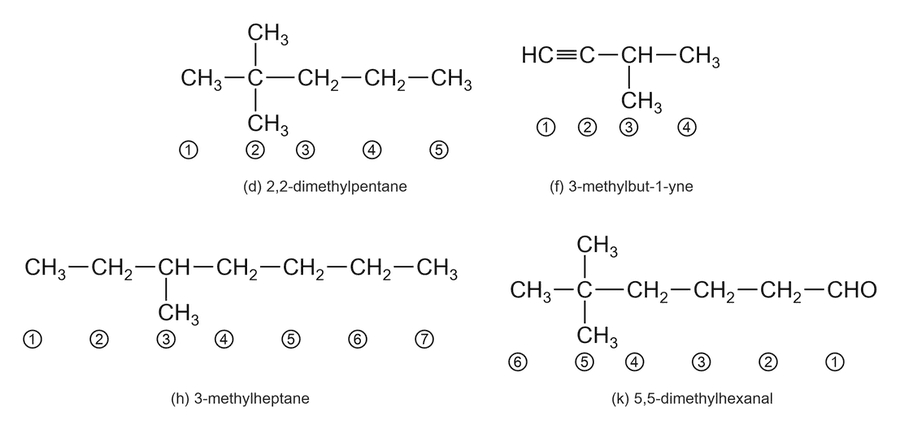
Step 1 — Alkanes: (a), (b), (d), (h), (r).
For an alkane we find the longest chain, then number it so the branches get the lowest locants:
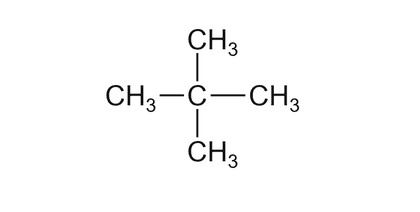
- (a) The central carbon carries four groups: the longest chain is 3 C with two methyls on C-2 → 2,2-dimethylpropane.
- (b) : 4 C chain; from the branched end the methyl is on C-2 → 2-methylbutane.
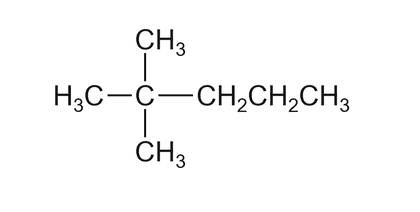
- (d) : 5 C chain with both methyls on C-2 → 2,2-dimethylpentane.
- (h) The drawn on the first is part of the main chain: has 7 C with a methyl on C-3 → 3-methylheptane.
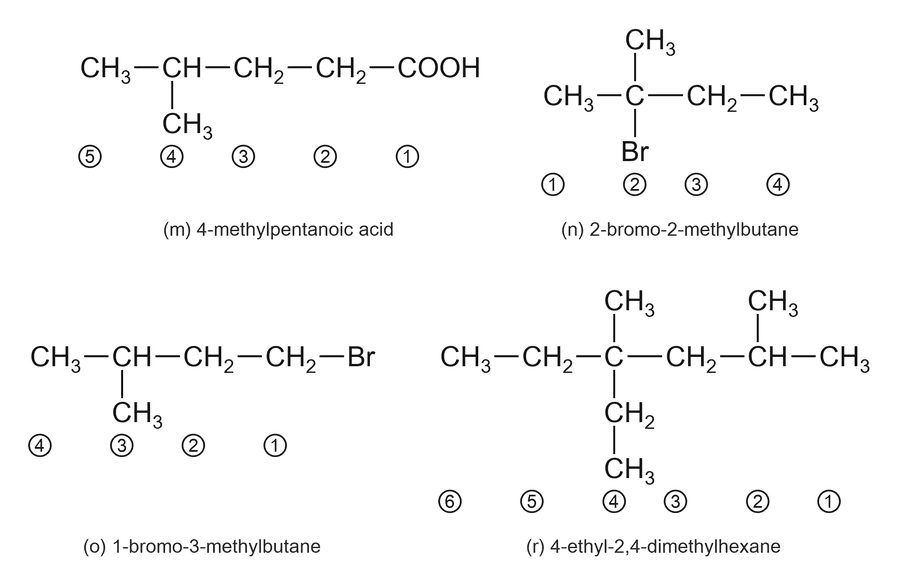
- (r) Longest chain 6 C. From the right the branches are at 2, 4, 4; from the left at 3, 3, 5. At the first point of difference 2 < 3, so we number from the right: ethyl on C-4, methyls on C-2 and C-4 → 4-ethyl-2,4-dimethylhexane (ethyl before methyl, alphabetically).
Step 2 — Alkenes and alkynes: (c), (e), (f), (i), (j), (p).
Here the chain must contain the multiple bond, and it is numbered to give that bond the lowest locant:
- (c) : 3 C, double bond from C-1 → propene (prop-1-ene).
- (e) : 5 C, triple bond starts at C-2 → pent-2-yne.
- (f) : the chain through the triple bond has 4 C (the second is a branch); triple bond at C-1, methyl at C-3 → 3-methylbut-1-yne.
- (i) : 4 C, double bond at C-2 → but-2-ene.
- (j) : 7 C, triple bond at C-2 → hept-2-yne.
- (p) : 3 C, triple bond from C-1 → propyne (prop-1-yne).
Step 3 — Halogen compounds: (g), (n), (o), (v).
A halogen is named as a prefix (chloro-, bromo-) with its locant, like a branch:
- (g) 5 C chain with Cl on two carbons: from the left the locants are 2, 3; from the right 3, 4. The lower set wins → 2,3-dichloropentane.
- (n) 4 C chain; Br and a methyl both on C-2; bromo comes before methyl → 2-bromo-2-methylbutane.
- (o) 4 C chain numbered from the end: Br on C-1, methyl on C-3 → 1-bromo-3-methylbutane.
- (v) : 2 C, one Cl on each carbon → 1,2-dichloroethane.
Step 4 — Oxygen compounds: (k), (l), (m), (q), (s), (t), (u).
The functional group sets the suffix and the start of the numbering:
- (k) The –CHO carbon is C-1: has 6 C with two methyls on C-5 → 5,5-dimethylhexanal.
- (l) : 5 C, numbered from the end nearer –OH, so –OH is on C-2 → pentan-2-ol.
- (m) The –COOH carbon is C-1: has 5 C with a methyl on C-4 → 4-methylpentanoic acid.
- (q) : a one-carbon aldehyde → methanal.
- (s) : 3 C, –OH on C-1 → propan-1-ol.
- (t) : a 2 C carboxylic acid → ethanoic acid.
- (u) : a 2 C aldehyde → ethanal.
Watch out: A branch drawn at the end of a chain (as in (h)) is part of the main chain; always look for the longest chain before naming the branches.
Therefore, (a) 2,2-dimethylpropane, (b) 2-methylbutane, (c) propene, (d) 2,2-dimethylpentane, (e) pent-2-yne, (f) 3-methylbut-1-yne, (g) 2,3-dichloropentane, (h) 3-methylheptane, (i) but-2-ene, (j) hept-2-yne, (k) 5,5-dimethylhexanal, (l) pentan-2-ol, (m) 4-methylpentanoic acid, (n) 2-bromo-2-methylbutane, (o) 1-bromo-3-methylbutane, (p) propyne, (q) methanal, (r) 4-ethyl-2,4-dimethylhexane, (s) propan-1-ol, (t) ethanoic acid, (u) ethanal, (v) 1,2-dichloroethane.
- 225 marks
Question 22
Draw the structures of the following compounds:
(a) Prop-1-ene, (b) 2, 3-dimethyl butane,
(c) 2-methyl propane, (d) 3-hexene,
(e) Prop-1-yne, (f) 2-methyl prop-1-ene,
(g) Alcohol with molecular formula .
Solve with AIWritten solution
Solution:
Concept: Read a name backwards: the root word gives the chain length, the suffix the bond or group, and the locant where it sits. Draw the chain, put in the bond or branch, then add H atoms until every carbon has four bonds.
Step 1 — (a) Prop-1-ene.
Three carbons with a double bond between C-1 and C-2: .

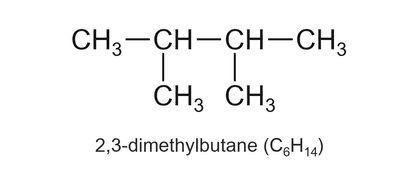
Step 2 — (b) 2,3-dimethylbutane.
A 4 C chain with one methyl on C-2 and one on C-3: .
Step 3 — (c) 2-methylpropane.
A 3 C chain with a methyl on C-2 (isobutane): .

Step 4 — (d) 3-hexene (hex-3-ene).
A 6 C chain with the double bond between C-3 and C-4: .

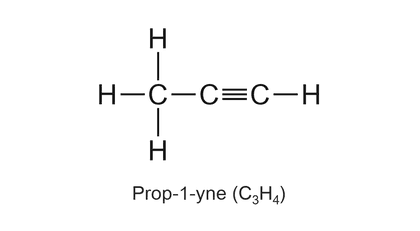
Step 5 — (e) Prop-1-yne.
Three carbons with a triple bond between C-1 and C-2: .
Step 6 — (f) 2-methylprop-1-ene.
A 3 C chain with the double bond from C-1 and a methyl on C-2: .

Step 7 — (g) An alcohol C₄H₁₀O.
is , a four-carbon alcohol, for example butan-1-ol, :

Four alcohols have this formula, and any one of them is correct:

Watch out: After drawing, count the H atoms against the formula (for example 2,3-dimethylbutane must be ).
Therefore, the structures are (a) CH₃–CH=CH₂, (b) CH₃–CH(CH₃)–CH(CH₃)–CH₃, (c) CH₃–CH(CH₃)–CH₃, (d) CH₃CH₂–CH=CH–CH₂CH₃, (e) CH₃–C≡CH, (f) CH₂=C(CH₃)–CH₃ and (g) CH₃CH₂CH₂CH₂OH (butan-1-ol).
- 231 mark
Question 23
Choose the correct answer :
(a) is an
Solve with AIAnswer
(A) alkane
(B) alkene
(C) alkyne
- Correct
(D) alkyl group
Answer: (D) alkyl group
Concept: The general formulae decide the family: alkane , alkene , alkyne , and an alkyl group (an alkane minus one H) –.
Step 1 — Count the hydrogen atoms for n = 5.
With n = 5, the alkyl-group formula needs this many H atoms:
Step 2 — Identify the group.
So is pentane () with one H atom removed: the pentyl group, with one free bond:
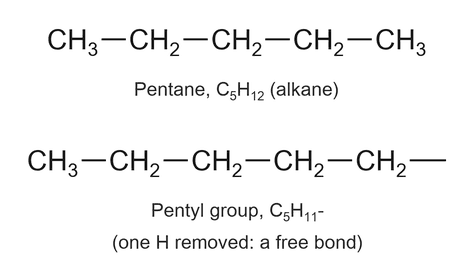
Watch out: cannot exist as a stable molecule on its own; it is a group (radical) with a free bond.
Why the other options are wrong:
- (A) alkane: a 5-carbon alkane is (2 × 5 + 2 = 12 H), not .
- (B) alkene: a 5-carbon alkene is (2 × 5 = 10 H).
- (C) alkyne: a 5-carbon alkyne is (2 × 5 − 2 = 8 H).
Therefore, C₅H₁₁ is an alkyl group (pentyl), option (D).
- 241 mark
Question 24
(b) A hydrocarbon of the general formula is
Solve with AIAnswer
- Correct
(A)
(B)
(C)
(D)
Answer: (A)
Concept: In (the alkene formula) the number of H atoms is exactly twice the number of C atoms.
Step 1 — Test option (A).
For , n = 15, so the formula needs this many H atoms:
This matches the 30 H atoms of , so it fits .
Why the other options are wrong:
- (B) : 2 × 12 + 2 = 26, so fits : an alkane.
- (C) : 2 × 8 = 16, not 20; fits no hydrocarbon series, since even the 8-carbon alkane has only 18 H ().
- (D) : 2 × 6 + 2 = 14, so is an alkane.
Therefore, C₁₅H₃₀ has the general formula CₙH₂ₙ, option (A).
- 251 mark
Question 25
(c) The total number of different carbon chains that four carbon atoms form in alkane is
Solve with AIAnswer
(A) 5
(B) 4
(C) 3
- Correct
(D) 2
Answer: (D) 2
Concept: Four carbon atoms can be joined in only two different ways: all four in a line, or three in a line with the fourth as a branch on the middle carbon.
Step 1 — Draw the straight chain.
All four carbons in a row give , butane (n-butane).
Step 2 — Draw the branched chain.
Three carbons in a row with the fourth on the middle carbon give , 2-methylpropane (isobutane):
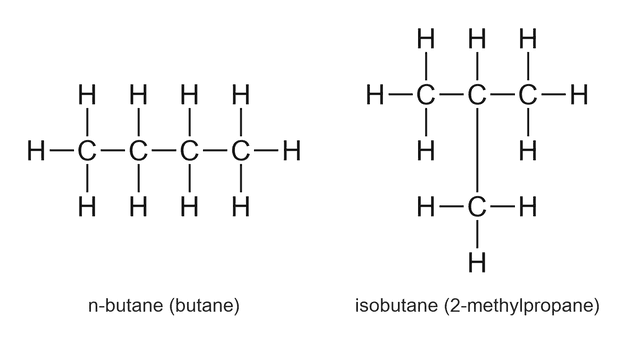
Step 3 — Check for any other arrangement.
A branch on an end carbon only makes the straight chain longer, so every other drawing is one of these two chains turned or bent.
Watch out: Bending a chain on paper does not make a new compound; only a different joining of atoms does.
Why the other options are wrong:
- (A) 5: there are not five ways; five isomers belong to hexane, , not to a four-carbon alkane.
- (B) 4: four is too many: only two different skeletons exist.
- (C) 3: three is the number of chain isomers of pentane, , not of butane.
Therefore, four carbon atoms form 2 different chains, option (D).
- 261 mark
Question 26
(d) and are
Solve with AIAnswer
(A) position isomers
(B) chain isomers
(C) homologous
- Correct
(D) functional-isomers
Answer: (D) functional-isomers
Concept: functional isomers have the same molecular formula but different functional groups.
Step 1 — Compare the molecular formulae.
Counting the atoms, is and is also , so the formula is the same.
Step 2 — Compare the functional groups.
The first is an alcohol (–OH, ethanol); the second is an ether (–O–, methoxymethane). The groups are different:
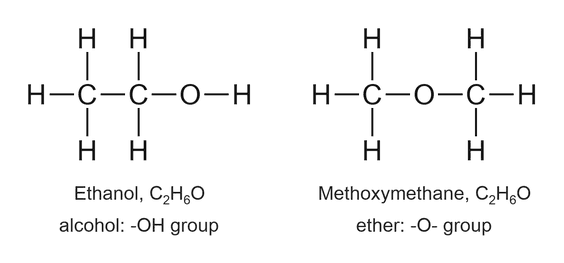
Why the other options are wrong:
- (A) position isomers: position isomers keep the same functional group and differ only in its position on the chain.
- (B) chain isomers: chain isomers differ only in the carbon skeleton (straight or branched), with the same functional group.
- (C) homologous: homologues differ by a group; these two have exactly the same formula.
Therefore, ethanol and methoxymethane are functional isomers, option (D).
- 271 mark
Question 27
(e) The IUPAC name of the compound is
 Solve with AI
Answer
(A) 3-trimethylhexane
- Correct
(B) 3-methyl hexane
(C) 4-methyl hexane
Answer: (B) 3-methyl hexane
Concept: Find the longest chain, then number it from the end that gives the branch the lowest number.
Step 1 — Find the longest chain.
has 6 carbons, all joined by single bonds, so the parent is hexane.
Step 2 — Number the chain.
From the right end the methyl branch is on C-3; from the left it would be on C-4. The lower number wins:
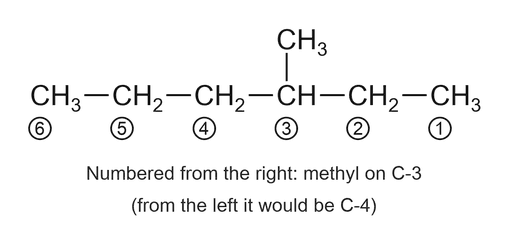
Step 3 — Write the name.
One methyl group on C-3 of hexane gives 3-methylhexane.
Watch out: Always compare both directions of numbering before writing the locant.
Why the other options are wrong:
- (A) 3-trimethylhexane: there is only one methyl group, so "trimethyl" is wrong (and three groups would need three locants).
- (C) 4-methyl hexane: this numbers the chain from the wrong end and gives a higher locant (4 instead of 3).
Therefore, the compound is 3-methylhexane, option (B).
- 285 marks
Question 28
Fill in the blanks.
(a) Propane and ethane are ………. (homologous, isomers)
(b) A saturated hydrocarbon does not participate in a/an ………… reaction (substitution, addition)
(c) Succeeding members of a homologous series differ by ………… (, , )
(d) As the molecular masses of hydrocarbons increase, their boiling points ……. and melting points …………… (increase, decrease)
(e) and belong to ….. homologous series (the same, different)
(f) CO is an ………… compound. (organic, inorganic)
(g) The chemical properties of an organic compound are largely decided by the ……………. and the physical properties of an organic compound are largely decided by the …………… (functional group, number of carbon atoms)
(h) CHO is the functional group of an ………… . (alcohol, aldehyde)
(i) The root word in the IUPAC name of an organic compound depends upon the number of carbon atoms in ………. . (any chain, principal chain)
(j) But-1-ene and but-2-ene are examples of …….. isomerism. (chain, position, functional)
Solve with AIWritten solution
Solution:
Concept: These blanks test the features of a homologous series, saturation, isomerism and IUPAC naming.
Step 1 — (a) to (c): homologous series and saturation.
We use the definitions:
- (a) homologous: propane and ethane have the same general formula and differ by .
- (b) addition: a saturated hydrocarbon has no double or triple bond for atoms to add across.
- (c) : each member differs from the next by one carbon and two hydrogen atoms (14 u).
Step 2 — (d) and (e): physical properties and general formulae.
We compare sizes and formulae:
- (d) increase, increase: bigger molecules have stronger forces between them, so both boiling and melting points rise.
- (e) the same: both fit (2 × 25 + 2 = 52 and 2 × 50 + 2 = 102), so both are alkanes.
Step 3 — (f) to (i): organic compounds and naming.
We recall which part of a molecule does what:
- (f) inorganic: the oxides of carbon are studied with inorganic compounds.
- (g) functional group; number of carbon atoms: the functional group decides the chemical properties, the size of the chain the physical ones.
- (h) aldehyde: –CHO is the aldehydic group (an alcohol has –OH).
- (i) principal chain: the root word counts only the carbons of the longest (principal) chain.
Step 4 — (j): type of isomerism.
But-1-ene and but-2-ene have the same chain and differ only in where the double bond is:

Therefore, (a) homologous, (b) addition, (c) CH₂, (d) increase, increase, (e) the same, (f) inorganic, (g) functional group; number of carbon atoms, (h) aldehyde, (i) principal chain, (j) position.
- 292 marks
Question 29
Define or explain chain isomerism and position isomerism with examples in each case.
Solve with AIWritten solution
Solution:
Concept: Both are kinds of structural isomerism: the compounds have the same molecular formula, but their atoms are linked differently.
Step 1 — Define chain isomerism.
Chain isomers have the same molecular formula but a different arrangement of the carbon chain (straight or branched).
Step 2 — Give an example of chain isomers.
gives two chain isomers:
- : butane (n-butane), a straight chain;
- : 2-methylpropane (isobutane), a branched chain.
Step 3 — Define position isomerism.
Position isomers have the same molecular formula and the same carbon chain, but differ in the position of the functional group, multiple bond or substituent.
Step 4 — Give an example of position isomers.
gives two position isomers with the double bond in different places:
- : but-1-ene;
- : but-2-ene.
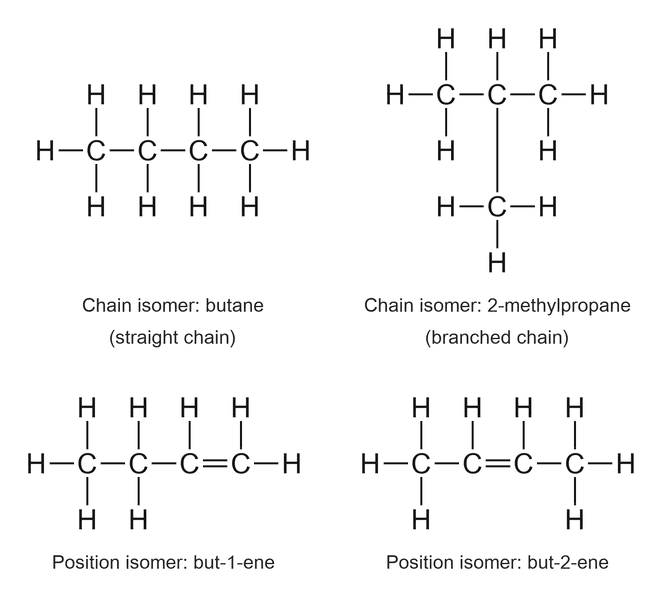
Watch out: In chain isomerism the skeleton changes; in position isomerism the skeleton stays the same and only the position of the group or bond moves.
Therefore, chain isomers differ in the carbon skeleton (butane and 2-methylpropane), and position isomers differ in the position of a bond or group (but-1-ene and but-2-ene).
- 305 marks
Question 30
(a) Define the term isomerism. State the main cause of isomerism.
(b) Draw the chain isomers of hexane ().
(c) Draw position isomers of butene ().
Solve with AIWritten solution
Solution:
Concept: Isomers have the same molecular formula but different structural formulae, so their properties differ.
Step 1 — (a) Define isomerism and give its cause.
Isomerism is the existence of two or more compounds with the same molecular formula but different structural formulae (and so different properties).
Its main cause is the different way of linking the atoms: a different arrangement of the carbon chain, or a different position of the functional group or multiple bond.
Step 2 — (b) Draw the chain isomers of hexane, C₆H₁₄.
Six carbons can be arranged in five ways: hexane, 2-methylpentane, 3-methylpentane, 2,2-dimethylbutane and 2,3-dimethylbutane:
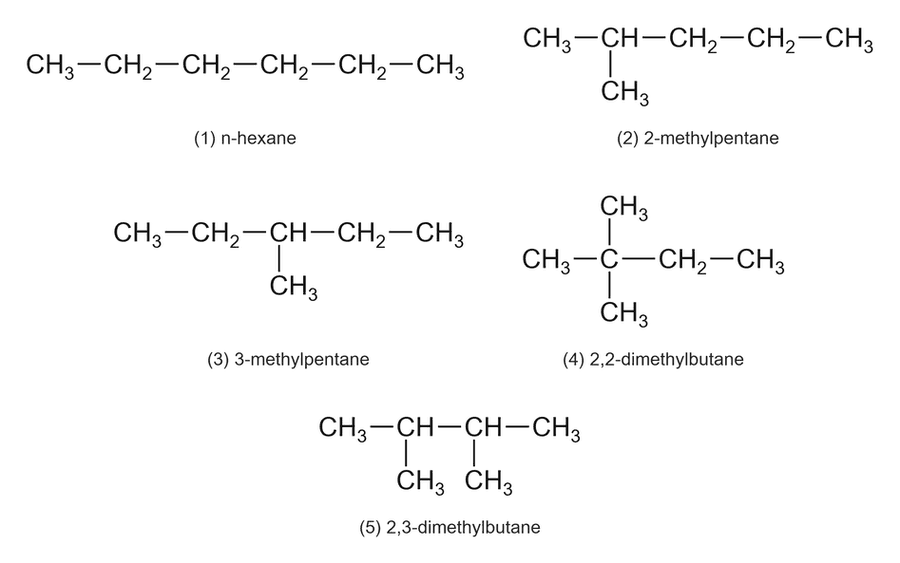
Each has 6 C and 14 H atoms; only the shape of the carbon skeleton changes.
Step 3 — (c) Draw the position isomers of butene, C₄H₈.
The double bond can be at C-1 or at C-2 of the four-carbon chain: but-1-ene, , and but-2-ene, :
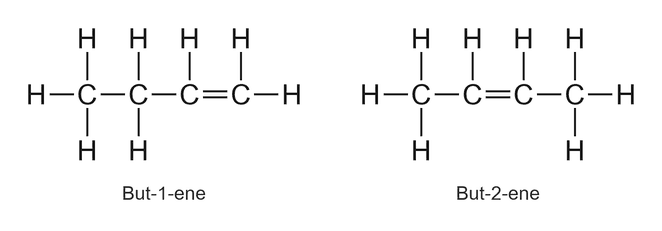
Watch out: 2-methylpentane drawn from the other end is still 2-methylpentane, not "4-methylpentane"; do not count it twice.
Therefore, (a) isomerism is the same molecular formula with different structures, caused by different linking of atoms; (b) hexane has 5 chain isomers; (c) butene has the position isomers but-1-ene and but-2-ene.
- 315 marks
Question 31
Draw structural formula for each of the following compounds :
(a) isomer of n-butane, (b) vinegar,
(c) 2-propanol (d) ethanal,
(e) acetone (f) diethyl ether
(g) propanoic acid (h) pentan-2-ol
(i) 2, 2-dibromobutane
What is used to describe these compounds taken together?
Solve with AIWritten solution
Solution:
Concept: From the name we get the chain length (root word) and the functional group (suffix); we place the group and fill each carbon up to four bonds with H.
Step 1 — (a) Isomer of n-butane.
The isomer is isobutane (2-methylpropane), .
Step 2 — (b) Vinegar.
Vinegar is a dilute solution of ethanoic (acetic) acid, .

Step 3 — (c) 2-propanol (propan-2-ol).
Three carbons with –OH on the middle carbon: .
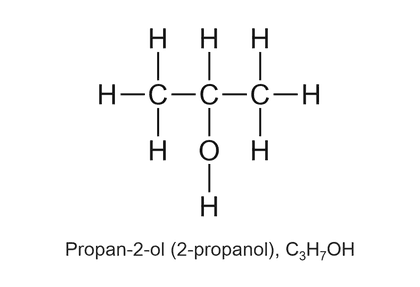
Step 4 — (d) Ethanal.
A two-carbon aldehyde: .

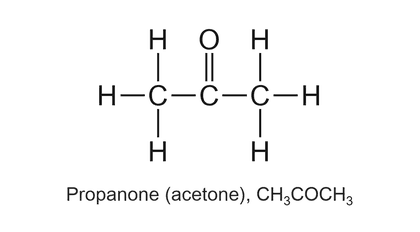
Step 5 — (e) Acetone (propanone).
A ketone with the C=O on the middle carbon: .
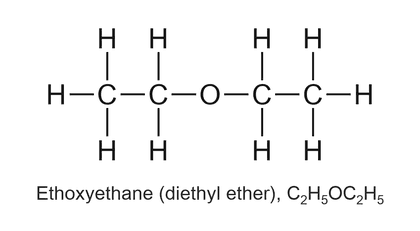
Step 6 — (f) Diethyl ether (ethoxyethane).
Two ethyl groups joined through an oxygen atom: .
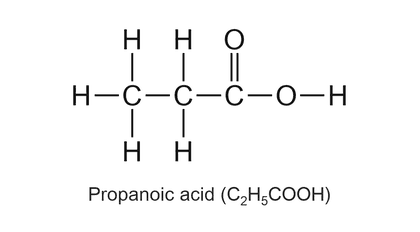
Step 7 — (g) Propanoic acid.
Three carbons including the –COOH carbon: .
Step 8 — (h) Pentan-2-ol.
Five carbons with –OH on C-2: .

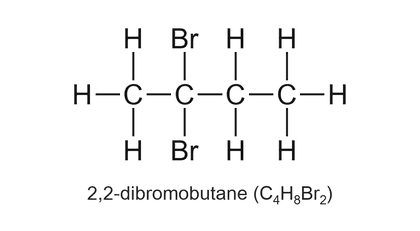
Step 9 — (i) 2,2-dibromobutane.
Four carbons with both Br atoms on C-2: .
Step 10 — Describe them together.
Each compound is a hydrocarbon or is made from one by putting in a functional group (–OH, –CHO, >C=O, –O–, –COOH, –Br), so together they are organic compounds: hydrocarbons and their derivatives.
Watch out: In propanoic acid the –COOH carbon is one of the three carbons, so the formula is , not .
Therefore, the nine structures are drawn above, and taken together these compounds are organic compounds (hydrocarbons and their derivatives).
- 325 marks
Question 32
(a) What is the special feature of the structure of :
(i) ethene, (ii) ethyne ? (2019)
(b) What type of reaction is common to both the above compounds ? Why methane does not undergo this type of reaction?
(c) What is the IUPAC, name of dimethyl ether. (2018)
Solve with AIWritten solution
Solution:
Concept: Ethene and ethyne are unsaturated (they have a multiple bond); methane is saturated.
Step 1 — (a)(i) Ethene.
The two carbon atoms are joined by a double bond (C=C), and the molecule is planar.
Step 2 — (a)(ii) Ethyne.
The two carbon atoms are joined by a triple bond (C≡C), and the molecule is linear.
Step 3 — (b) Name the common reaction.
Both undergo addition: one bond of the double or triple bond opens and atoms add on, for example:
Step 4 — (b) Explain why methane does not add.
Methane is saturated. All four valencies of its carbon are already used by single bonds to H atoms, so there is no double or triple bond to add across; it reacts only by substitution.
Step 5 — (c) Name dimethyl ether.
Dimethyl ether, , is an ether with two methyl groups, so its IUPAC name is methoxymethane:
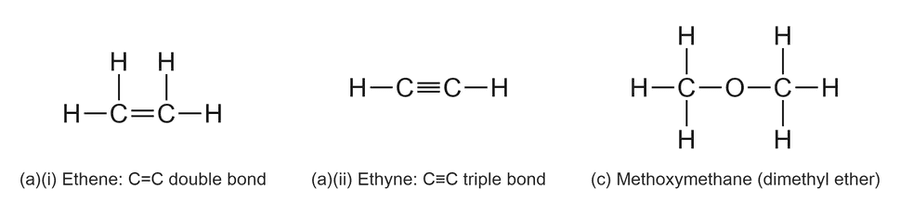
Therefore, (a) ethene has a C=C double bond and ethyne a C≡C triple bond; (b) both undergo addition, which saturated methane cannot; (c) dimethyl ether is methoxymethane.
- 332 marks
Question 33
Which type of reaction will (i) ethane and (ii) ethene undergo ?
Solve with AIWritten solution
Solution:
Concept: Saturated compounds undergo substitution; unsaturated compounds undergo addition.
Step 1 — (i) Ethane.
Ethane is saturated (only single bonds), so it undergoes substitution: an H atom is replaced, for example by chlorine in diffused sunlight:
Step 2 — (ii) Ethene.
Ethene is unsaturated (C=C), so it undergoes addition: chlorine adds across the double bond:
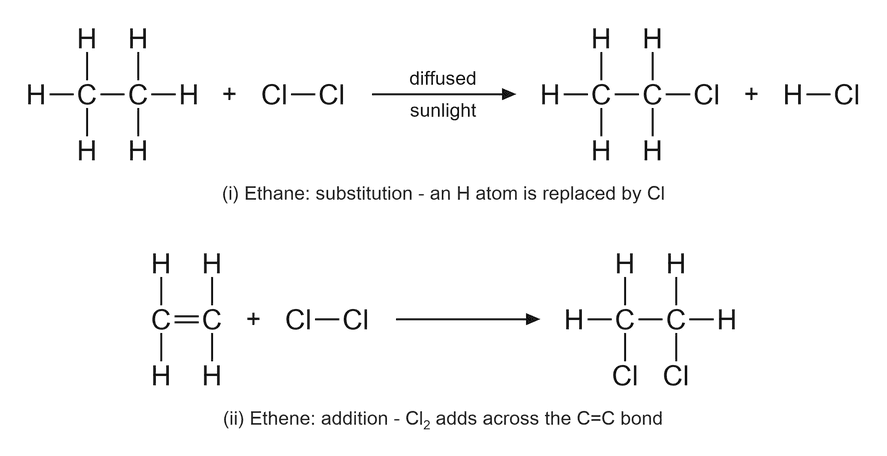
Therefore, (i) ethane undergoes substitution and (ii) ethene undergoes addition.
- 345 marks
Question 34
Choosing only words from the following list, write down appropriate words to fill in the blanks from (a) to (e) given below. [Addition, carbohydrates, , , , electrochemical, homologous, hydrocarbon, saturated, substitution, unsaturated].
The alkanes form an (a) …….. series with the general formula (b) ……… The alkanes are (c) …….. (d) …….. which generally undergo (e) …….. reactions.
Solve with AIWritten solution
Solution:
Concept: Alkanes are saturated hydrocarbons with the general formula , and saturated compounds react by substitution.
Step 1 — Fill in the blanks.
Putting the facts about alkanes into the sentence:
The alkanes form an (a) homologous series with the general formula (b) . The alkanes are (c) saturated (d) hydrocarbons which generally undergo (e) substitution reactions.
Step 2 — Give the reasons.
Methane, ethane, propane … differ by (homologous); they contain only C and H (hydrocarbons) joined by single bonds (saturated), so an H atom can only be replaced, not added to:
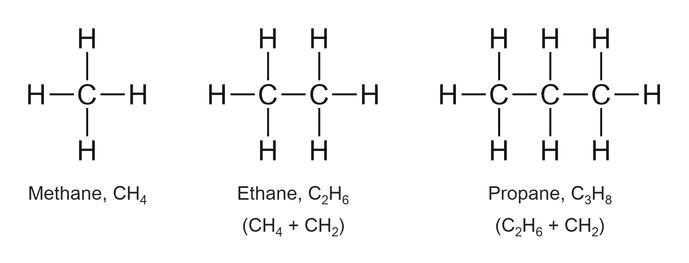
Therefore, (a) homologous, (b) CₙH₂ₙ₊₂, (c) saturated, (d) hydrocarbons, (e) substitution.
- 355 marks
Question 35
Draw the structural formula of a compound with two carbon atoms in each of the following cases.
(a) An alkane with a carbon to carbon single bond,
(b) An alcohol containing two carbon atoms,
(c) An unsaturated hydrocarbon with a carbon to carbon triple bond.
Solve with AIWritten solution
Solution:
Concept: Two carbons give the root word eth-. The suffix tells the type: -ane (single bond), -ol (alcohol), -yne (triple bond).
Step 1 — (a) Alkane with a C–C single bond.
This is ethane, (); each carbon has three H atoms.
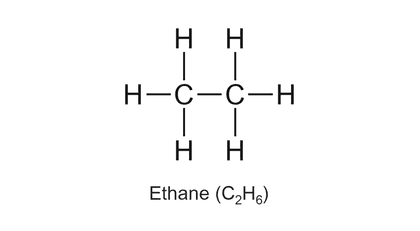
Step 2 — (b) Alcohol with two carbon atoms.
This is ethanol, (); the –OH group takes the place of one H of ethane.

Step 3 — (c) Unsaturated hydrocarbon with a C≡C bond.
This is ethyne, (); each carbon has one H atom.

Watch out: Check every carbon: 3 C–H + 1 C–C in ethane, but 1 C–H + the 3 bonds of C≡C in ethyne.
Therefore, (a) ethane CH₃–CH₃, (b) ethanol CH₃–CH₂–OH, (c) ethyne HC≡CH.
- 363 marks
Question 36
[Ethane, Ethene, Ethanoic acid, Ethyne, Ethanol]
From the above list name
(a) The compound with –OH as the part of its structure.
(b) The compound with –COOH as the part of its structure.
(c) Homologue of Homologous series with general formula .
Solve with AIWritten solution
Solution:
Concept: Match each clue with the functional group or the general formula of each compound in the list.
Step 1 — (a) –OH in the structure.
The hydroxyl group belongs to alcohols, so the compound is ethanol, .
Step 2 — (b) –COOH in the structure.
The carboxyl group belongs to acids, so the compound is ethanoic acid, .
Step 3 — (c) General formula CₙH₂ₙ.
For ethene, , n = 2 and 2n = 4, so it fits; it is the first member of the alkenes. (Ethane fits and ethyne fits .)
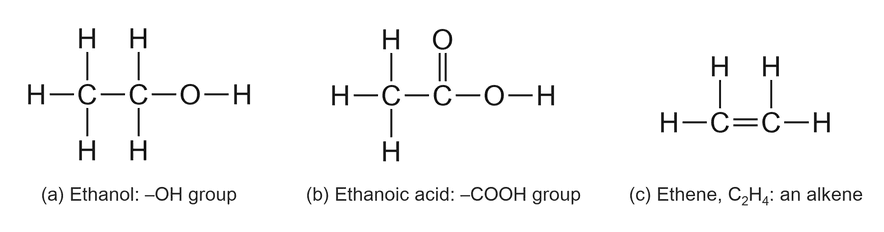
Therefore, (a) ethanol, (b) ethanoic acid, (c) ethene.
- 374 marks
Question 37
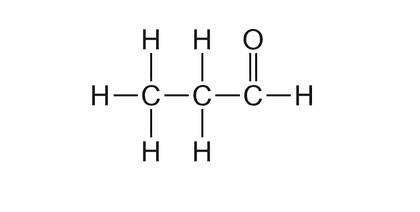
Give the correct IUPAC name and the functional group for each of the compounds whose structural formulae are given below :
(a)
(b)
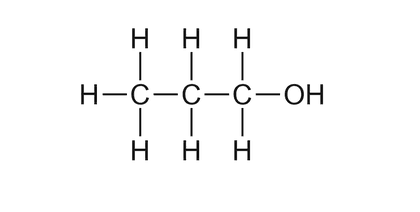 Solve with AI
Written solution
Solution:
Concept: Count the carbons (root word), spot the functional group (suffix), and number the chain from the functional group.
Step 1 — (a) Read the first structure.
The structure is : three carbons, and the end carbon carries =O and H, an aldehyde group. The –CHO carbon is C-1, so the name is propanal and the functional group is –CHO (aldehyde).
Step 2 — (b) Read the second structure.
The structure is : three carbons with –OH on the end carbon (C-1), so the name is propan-1-ol and the functional group is –OH (hydroxyl, alcohol):
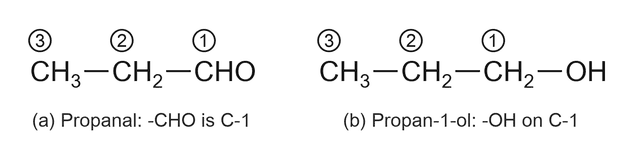
Watch out: An aldehyde's –CHO carbon is always C-1, so no locant is written in "propanal".
Therefore, (a) propanal, –CHO (aldehyde); (b) propan-1-ol, –OH (alcohol).
- 385 marks
Question 38
Copy and complete the following table which relates to three homologous series of hydrocarbons:
General Formula IUPAC name of the homologous series Characteristic bond type Single bonds IUPAC name of the first member of the series Type of reaction with chlorine. Addition Solve with AIWritten solution
Solution:
Concept: Match the H count: = alkenes (C=C), = alkynes (C≡C), = alkanes (single bonds). A multiple bond needs two carbons, so alkenes and alkynes start at n = 2.
Step 1 — Complete the table.
Each column is filled from its general formula:
General Formula IUPAC name of the homologous series Alkenes Alkynes Alkanes Characteristic bond type Double bond (C=C) Triple bond (C≡C) Single bonds IUPAC name of the first member Ethene Ethyne Methane Type of reaction with chlorine Addition Addition Substitution Step 2 — Draw the first members.
The first member of each series is shown below:
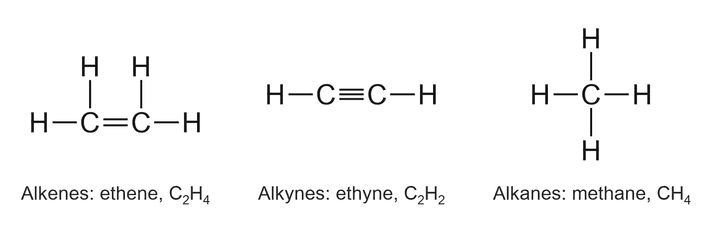
Therefore, CₙH₂ₙ: alkenes, C=C, ethene, addition; CₙH₂ₙ₋₂: alkynes, C≡C, ethyne, addition; CₙH₂ₙ₊₂: alkanes, single bonds, methane, substitution.
- 395 marks
Question 39
Fill in the blanks with the correct words from the brackets :
(a) Alkenes are the (i) ……………… (analogous/homologous) series of (ii) ……………… (saturated/unsaturated) hydrocarbons. They differ from alkanes due to the presence of (iii) ……………… (double/single) bonds. Alkenes mainly undergo (iv) ……………… (addition/substitution) reactions.
(b) The organic compound which undergoes substitution reaction is (v) …………… (, , , ) (2018)
(c) Draw the structural formulae of the two isomers of Butane. Give the correct IUPAC name of each isomer.
Solve with AIWritten solution
Solution:
Concept: Alkenes are unsaturated and react by addition; alkanes are saturated and react by substitution.
Step 1 — (a) Fill in the blanks about alkenes.
Alkenes are the (i) homologous series of (ii) unsaturated hydrocarbons. They differ from alkanes due to the presence of (iii) double bonds. Alkenes mainly undergo (iv) addition reactions.
Step 2 — (b) Pick the compound that undergoes substitution.
We test each formula against the general formulae:
- : 2 × 2 + 2 = 6, an alkane, saturated → substitution;
- : 2 × 2 = 4, an alkene, unsaturated → addition;
- and : 2n − 2, alkynes, unsaturated → addition.
So (v) is (ethane).
Step 3 — (c) Draw the two isomers of butane.
Butane, , has a straight-chain and a branched-chain isomer:
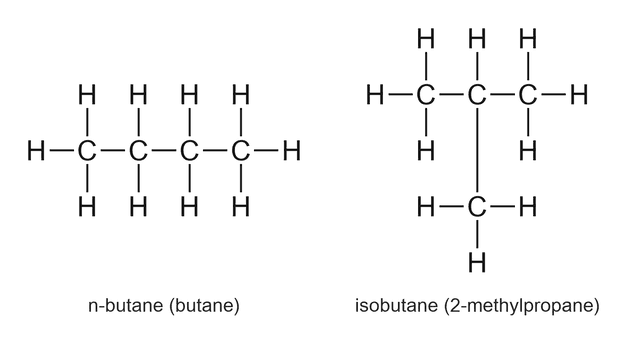
Their IUPAC names are butane (n-butane, straight chain) and 2-methylpropane (isobutane, branched).
Therefore, (a) homologous, unsaturated, double, addition; (b) C₂H₆; (c) butane and 2-methylpropane.
- 403 marks
Question 40
Name :
(a) The saturated hydrocarbon containing two carbon atoms.
(b) An alcohol with three carbon atom.
(c) A triple bond hydrocarbon with two carbon atoms.
Solve with AIWritten solution
Solution:
Concept: Two carbons give eth-, three carbons give prop-. The suffix then tells the type: -ane (saturated), -ol (alcohol), -yne (triple bond).
Step 1 — (a) Saturated hydrocarbon with two carbons.
This is ethane, .
Step 2 — (b) Alcohol with three carbons.
This is propanol (propan-1-ol), .
Step 3 — (c) Triple-bond hydrocarbon with two carbons.
This is ethyne (acetylene), :
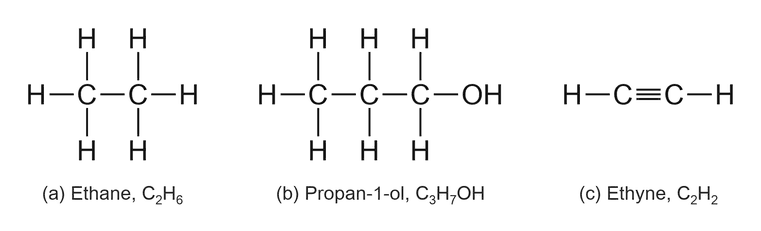
Therefore, (a) ethane, (b) propan-1-ol, (c) ethyne.
- 412 marks
Question 41
State the sources of Alkanes.
Solve with AIWritten solution
Solution:
Concept: Alkanes, especially methane, form wherever plant matter decays without air, and they are the main part of natural gas.
Step 1 — List the sources of methane (marsh gas).
Methane is found in these places:
- Marshes: formed at the bottom of marshes by the bacterial decay of cellulose (plant matter) without air.
- Animals: given out by cattle and other animals whose food contains cellulose (intestinal gases).
- Coal mines: the pockets of gas in coal seams are mostly methane, called fire-damp.
- Destructive distillation of wood, peat and coal.
- Natural gas, petroleum and biogas: methane is the chief constituent of natural gas and of biogas.
Step 2 — State the source of ethane.
Ethane occurs along with methane in natural gas (about 10–20%), and is obtained from it.
Therefore, alkanes come mainly from natural gas and petroleum, and methane also from marshes, animals, coal mines, biogas and the destructive distillation of wood and coal.
- 422 marks
Question 42
Methane is a green house gas. Comment.
Solve with AIWritten solution
Solution:
Concept: A greenhouse gas lets sunlight in but absorbs the heat (infrared) radiated back by the earth, so it warms the atmosphere.
Step 1 — Explain how methane traps heat.
Sunlight warms the earth's surface, and the earth gives this energy back as heat (infrared) radiation. Methane in the air absorbs part of this outgoing heat and sends some of it back down, so the air near the earth becomes warmer:
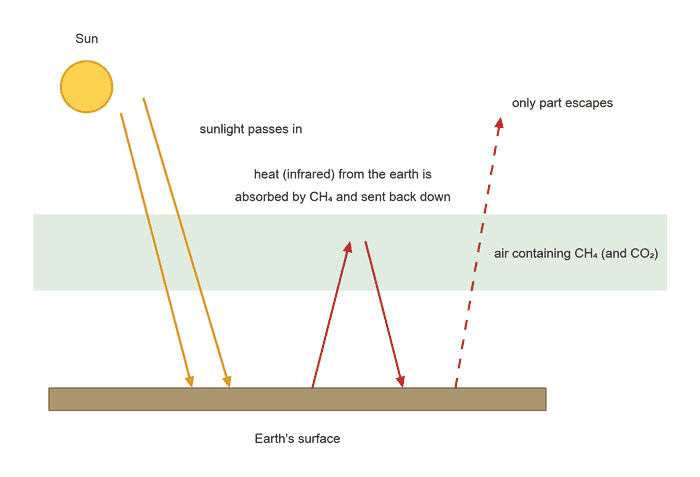
Step 2 — Compare it with carbon dioxide.
Methane stays in the atmosphere for only about 12 years, but it absorbs heat far more strongly than carbon dioxide. Over 100 years, one kilogram of methane traps about 28 times as much heat as one kilogram of carbon dioxide.
Step 3 — Name its sources.
It comes from landfills, natural gas and petroleum systems, paddy fields and cattle, coal mining and waste-water treatment.
Therefore, methane is a greenhouse gas: it absorbs the heat radiated by the earth and adds to global warming, so its emissions should be cut or the gas used as a fuel.
- 431 mark
Question 43
Give the general formula of alkanes.
Solve with AIWritten solution
Solution:
Concept: Alkanes are saturated hydrocarbons: every carbon carries as many H atoms as it can.
Step 1 — State the general formula.
For an alkane with n carbon atoms the formula is (n = 1, 2, 3, …).
Step 2 — Check it with the first two members.
For n = 1 it gives (methane), and for n = 2 the number of H atoms is:
which is ethane, .
Therefore, the general formula of alkanes is CₙH₂ₙ₊₂.
- 444 marks
Question 44
Draw the structures of isomers of :
(a) butane, (2018) (b) pentane.
Write the IUPAC and common names of these isomers.
Solve with AIWritten solution
Solution:
Concept: Alkanes with four or more carbon atoms show chain isomerism: the same molecular formula, but a straight or a branched chain.
Step 1 — (a) Draw the isomers of butane, C₄H₁₀.
Four carbons give two chains:
Structure IUPAC name Common name Butane n-butane 2-methylpropane isobutane Step 2 — (b) Draw the isomers of pentane, C₅H₁₂.
Five carbons give three chains:
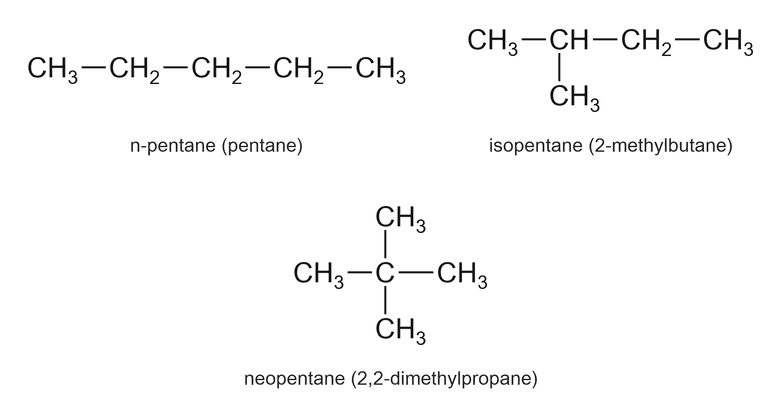
Structure IUPAC name Common name Pentane n-pentane 2-methylbutane isopentane 2,2-dimethylpropane neopentane Step 3 — Explain the common-name prefixes.
n- (normal): no carbon is joined to more than two others; iso-: one carbon is joined to three others; neo-: one carbon is joined to four others.
Watch out: A methyl group on the second carbon from either end gives the same compound (2-methylbutane), so count it once.
Therefore, (a) butane has two isomers, butane and 2-methylpropane; (b) pentane has three, pentane, 2-methylbutane and 2,2-dimethylpropane.
- 455 marks
Question 45
Write the :
(a) molecular formula, (b) electron dot formula and
(c) structural formula of methane and ethane.
Solve with AIWritten solution
Solution:
Concept: Carbon shares its four valence electrons with the electrons of hydrogen and, in ethane, with the other carbon atom. Each shared pair is one single covalent bond.
Step 1 — (a) Write the molecular formulae.
Methane has one carbon and four hydrogens, ; ethane has two carbons and six hydrogens, .
Step 2 — (b) Draw the electron dot formulae.
In methane the carbon shares four pairs (four C–H bonds):
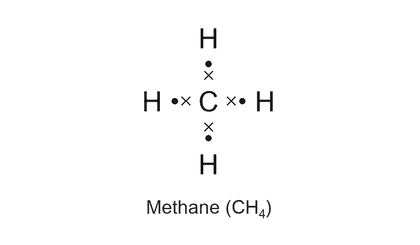
In ethane each carbon shares three pairs with H atoms and one pair with the other carbon:
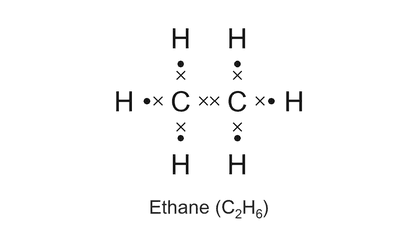
Every carbon ends with 8 electrons round it, and every hydrogen with 2.
Step 3 — (c) Draw the structural formulae.
Each shared pair becomes one line (single bond):
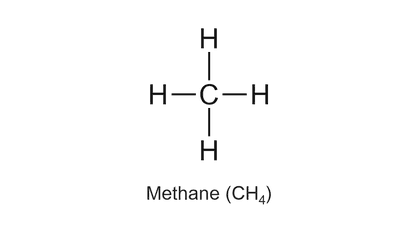
In space methane is tetrahedral, with an H–C–H angle of 109.5°.
Therefore, methane is CH₄ with four C–H bonds, and ethane is C₂H₆ with six C–H bonds and one C–C bond.
- 464 marks
Question 46
How is :
(a) methane and
(b) ethane prepared in the laboratory ?
Solve with AIWritten solution
Solution:
Concept: Heating the sodium salt of a carboxylic acid with soda lime (NaOH + CaO) removes the –COONa group as sodium carbonate (decarboxylation), so the alkane formed has one carbon fewer than the salt.
Step 1 — (a) Methane: take the reactants.
Sodium ethanoate (sodium acetate) is mixed with soda lime. Soda lime is used instead of NaOH alone because NaOH absorbs moisture (deliquescent) and attacks the glass; the CaO keeps the mixture dry.
Step 2 — (a) Methane: heat and write the equation.
The mixture is heated in a hard-glass test tube; methane is given off:
Step 3 — (a) Methane: collect the gas.
Methane is almost insoluble in water, so it is collected by the downward displacement of water:
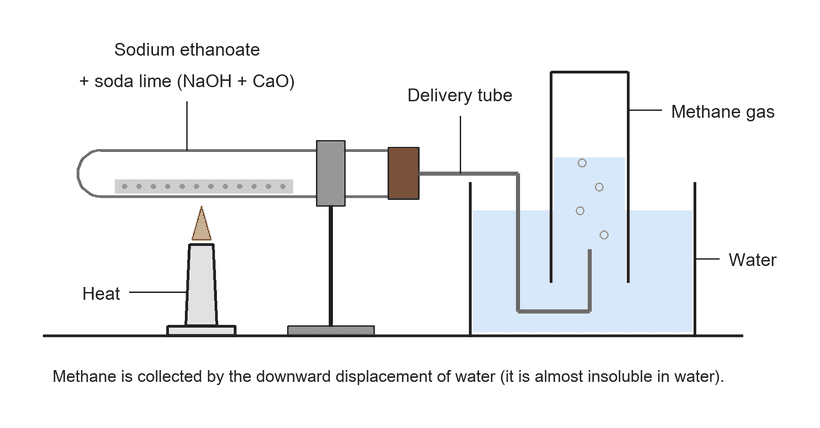
Step 4 — (b) Ethane.
Sodium propanoate (sodium propionate) is heated with soda lime in the same apparatus, and ethane is collected over water in the same way:
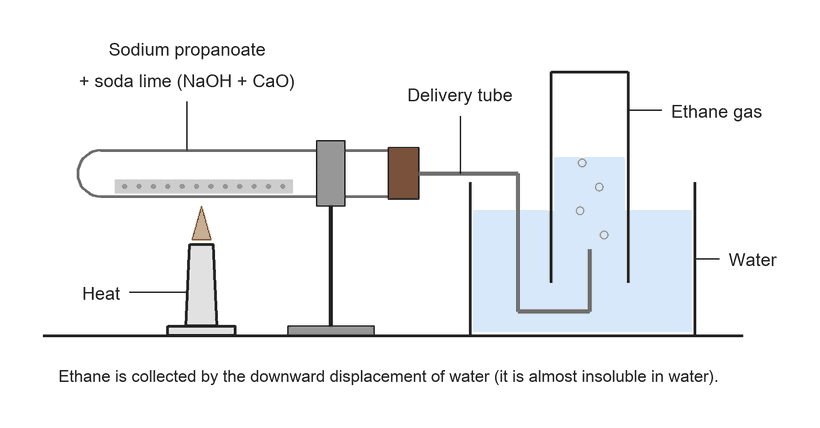
Watch out: The alkane has one carbon fewer than the salt: sodium ethanoate (2 C) gives methane (1 C), sodium propanoate (3 C) gives ethane (2 C).
Therefore, methane is made by heating sodium ethanoate with soda lime, and ethane by heating sodium propanoate with soda lime; both are collected over water.
- 472 marks
Question 47
How are methane and ethane prepared from methyl iodide and ethyl bromide ?
Solve with AIWritten solution
Solution:
Concept: Nascent hydrogen [H] (from a zinc–copper couple and alcohol) reduces an alkyl halide: the halogen atom is replaced by H, so the alkane has the same number of carbons as the halide.
Step 1 — Methane from methyl iodide (iodomethane).
Nascent hydrogen replaces the iodine atom by hydrogen:
Step 2 — Ethane from ethyl bromide (bromoethane).
In the same way the bromine atom is replaced by hydrogen:

Step 3 — Another route to ethane.
Ethane can also be made from methyl iodide by warming it with sodium in dry ether (the Wurtz reaction); two methyl groups join:
Watch out: Reduction keeps the carbon number (CH₃I → CH₄); only the Wurtz reaction doubles it (2CH₃I → C₂H₆).
Therefore, methyl iodide and ethyl bromide are reduced by nascent hydrogen (Zn/Cu couple in alcohol) to methane and ethane respectively.
- 482 marks
Question 48
What is a substitution reaction ?
Give the reaction of chlorine with ethane and name the product formed.
Solve with AIWritten solution
Solution:
Concept: In a substitution reaction an H atom of a saturated hydrocarbon is replaced by another atom; nothing adds across a bond, because there is no double bond.
Step 1 — Define a substitution reaction.
A substitution reaction is one in which an atom (or group of atoms) of a molecule is replaced by another atom (or group of atoms).
Step 2 — Write the reaction of ethane with chlorine.
In diffused sunlight, one H atom of ethane is replaced by a Cl atom:

Step 3 — Name the product.
The product is chloroethane (ethyl chloride), , along with hydrogen chloride. With more chlorine the other H atoms are replaced one by one, up to hexachloroethane, .
Therefore, substitution is the replacement of an atom by another; ethane and chlorine in diffused sunlight give chloroethane (C₂H₅Cl) and HCl.
- 494 marks
Question 49
Name the compounds formed when methane burns in :
(a) sufficient air, (b) insufficient air.
Give a balanced equation.
Solve with AIWritten solution
Solution:
Concept: With enough oxygen carbon is fully oxidised to (complete combustion). With too little oxygen it is only partly oxidised, to or even to carbon (soot).
Step 1 — (a) Sufficient air.
Methane burns completely to carbon dioxide and water vapour, with a bluish, non-sooty flame and much heat:
Step 2 — (b) Insufficient air.
Methane burns incompletely to carbon monoxide and water:
With still less oxygen, carbon (soot) and water form:
Watch out: Carbon monoxide is very poisonous, so methane should always burn in plenty of air.
Therefore, (a) in sufficient air methane gives CO₂ and H₂O; (b) in insufficient air it gives CO and H₂O.
- 504 marks
Question 50
Write the names and the formula of the products formed when :
(a) methane, (b) ethane,
reacts with : (i) chlorine (ii) bromine
Write the chemical equations.
Solve with AIWritten solution
Solution:
Concept: Alkanes react with halogens in sunlight by substitution: each step replaces one H atom by a halogen atom and gives one molecule of the hydrogen halide.
Step 1 — (a)(i) Methane with chlorine.
In diffused sunlight the four H atoms are replaced one at a time, giving chloromethane, dichloromethane, trichloromethane (chloroform) and tetrachloromethane (carbon tetrachloride):
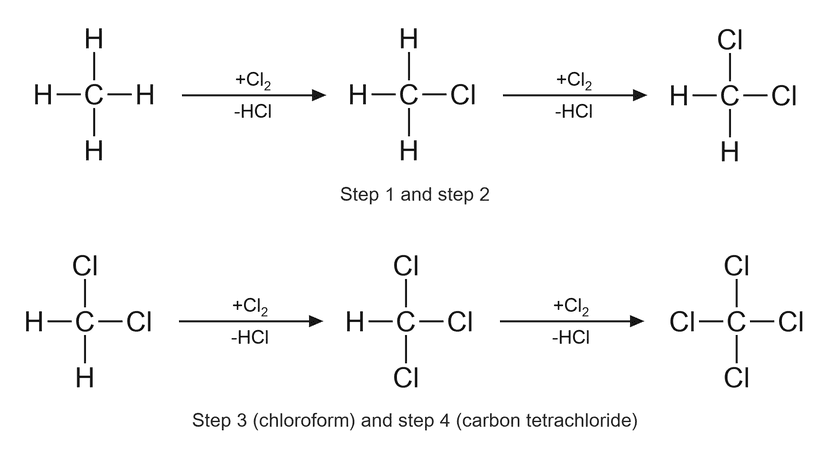
Step 2 — (a)(ii) Methane with bromine.
Bromine substitutes in the same way, first giving bromomethane, (then , , ):
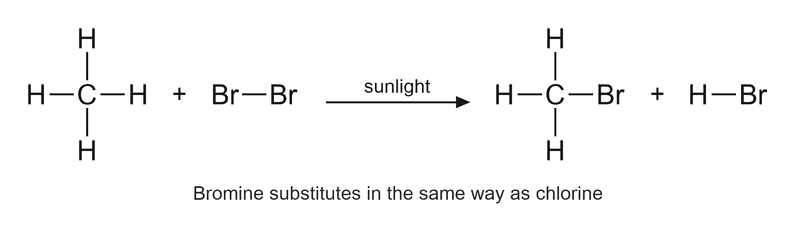
Step 3 — (b)(i) Ethane with chlorine.
The first product is chloroethane, (further substitution goes up to hexachloroethane, ):
Step 4 — (b)(ii) Ethane with bromine.
The first product is bromoethane, :
Watch out: Every substitution step gives two products: the halogen compound and HCl (or HBr).
Therefore, (a) methane gives CH₃Cl → CH₂Cl₂ → CHCl₃ → CCl₄ with chlorine and CH₃Br with bromine; (b) ethane gives C₂H₅Cl with chlorine and C₂H₅Br with bromine.
- 515 marks
Question 51
Name the compound prepared from :
(a) sodium propionate, (b) methyl iodide and
(c) ethyl bromide.
Write a balanced equation for the same.
Solve with AIWritten solution
Solution:
Concept: A sodium carboxylate loses its –COONa group on heating with soda lime (decarboxylation, one carbon fewer); an alkyl halide is reduced by nascent hydrogen (same number of carbons).
Step 1 — (a) Sodium propionate gives ethane.
Heated with soda lime, the three-carbon salt gives the two-carbon alkane:
Step 2 — (b) Methyl iodide gives methane.
Nascent hydrogen (zinc–copper couple and alcohol) replaces I by H:
(Warmed with sodium in dry ether instead, methyl iodide gives ethane by the Wurtz reaction.)
Step 3 — (c) Ethyl bromide gives ethane.
Nascent hydrogen replaces Br by H:
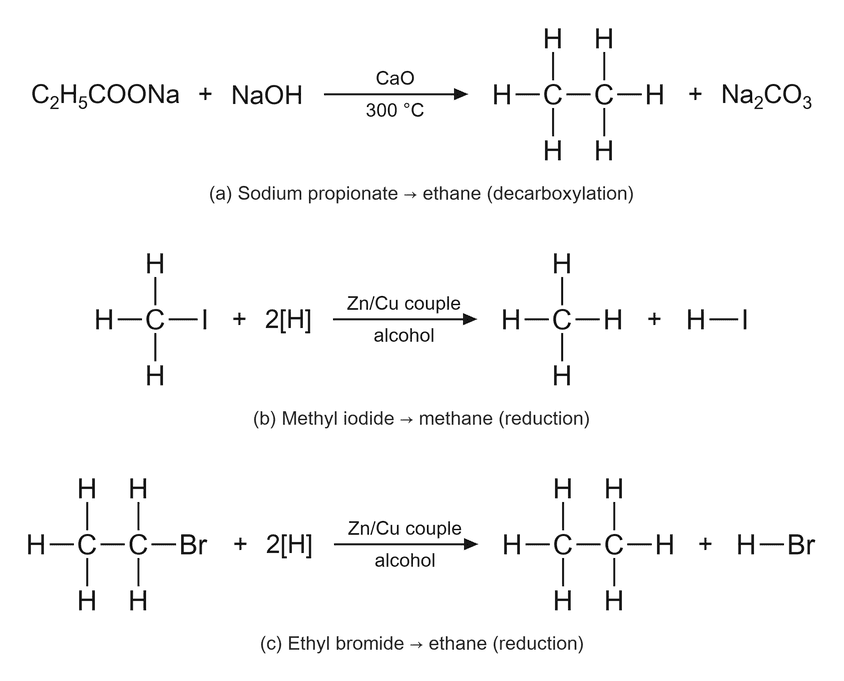
Therefore, (a) sodium propionate gives ethane, (b) methyl iodide gives methane, and (c) ethyl bromide gives ethane.
- 524 marks
Question 52
Write the equation for the complete combustion of (i) methane (ii) ethane.
Solve with AIWritten solution
Solution:
Concept: In complete combustion every C atom becomes and every H atom ends up in . Balance C first, then H, then O.
Step 1 — (i) Balance the combustion of methane.
One C gives one , four H give two , and these need 2 + 2 = 4 O atoms, that is 2 :
Step 2 — (ii) Count the oxygen needed for ethane.
One gives 2 and 3 , which hold this many O atoms:
Seven O atoms are 3½ molecules, so we double every coefficient to remove the half.
Step 3 — (ii) Write the balanced equation for ethane.
Doubling gives whole numbers:
Both gases burn with a bluish, non-sooty flame and give out much heat, so they are good fuels.
Watch out: Check the oxygen last: 14 O atoms on the left = 8 (in 4CO₂) + 6 (in 6H₂O) on the right.
Therefore, (i) CH₄ + 2O₂ → CO₂ + 2H₂O and (ii) 2C₂H₆ + 7O₂ → 4CO₂ + 6H₂O.
- 535 marks
Question 53
Convert :
(a) Methane into chloroform,
(b) Sodium acetate into methane,
(c) Methyl iodide into ethane,
(d) Methane to methyl alcohol
- 544 marks
Question 54
Give three uses of :
(a) methane, (b) ethane.
- 555 marks
Question 55
Under what conditions does ethane get converted to :
(a) ethyl alcohol, (b) acetaldehyde,
(c) acetic acid.
- 562 marks
Question 56
Using appropriate catalysts, ethane can be oxidized to an alcohol, an aldehyde and an acid. Name the alcohol, aldehyde and acid formed when ethane is oxidized.
- 575 marks
Question 57
Write : (a) molecular formula, (b) electron dot formula and (c) structural formula of ethene (ethylene).
- 585 marks
Question 58
The molecules of alkene family are represented by a general formula . Answer the following:
(a) What do n and 2n signify ?
(b) What is the name of alkene when n = 4 ?
(c) What is the molecular formula of alkene when n = 4 ?
(d) What is the molecular formula of the alkene if there are ten H atoms in it ?
(e) What is the structural formula of the third member of the alkene family ?
(f) Write the molecular formula of lower and higher homologous of an alkene which contains four carbon atoms.
- 594 marks
Question 59
(a) Distinguish between the saturated hydrocarbon ethane and the unsaturated hydrocarbon ethene by drawing their structural formulae.
(b) Draw the structures of isomers of butene and write their IUPAC names.
- 602 marks
Question 60
Give a balanced equation for the lab. preparation of ethylene. How is the gas collected ?
- 614 marks
Question 61
How is ethene prepared by :
(a) dehydrohalogenation reaction ?
(b) dehydration reaction ?
Give equations and name the products formed.
- 624 marks
Question 62
(a) Ethene when reacts with halogens (chlorine and bromine) form saturated products. Name them and write balanced equations.
(b) Give the conditions and the main product formed by hydrogenation of ethene.
- 634 marks
Question 63
Convert ethanol into ethene using
(a) solid dehydrating agent
(b) hot conc. .
Give only balanced equations.
- 644 marks
Question 64
Write the following properties of ethene :
(a) Physical state, (b) Odour,
(c) Density as compared to air, (d) Solubility.
- 655 marks
Question 65
How would you convert :
(a) ethyl bromide into ethene ?
(b) ethene into 1, 2-dibromoethane ?
(c) ethene into ethane ?
- 665 marks
Question 66
Give balanced equations when :
(a) ethene is burnt in excess of oxygen.
(b) ethene reacts with chlorine gas. (2019)
(c) ethene combines with hydrogen chloride.
(d) a mixture of ethene and hydrogen is passed over nickel at 200°C.
- 675 marks
Question 67
Give the formula and names of A, B, C and D in the following equations :
(a)
(b)
(c)
- 684 marks
Question 68
Write the name and formula of the product formed in each case below :
(a) ………………
(b) ………………
(c) ………………
(d) ………………
- 692 marks
Question 69
What do you observe when ethene is passed through alkaline solution ?
- 702 marks
Question 70
Name three compounds formed by ethene and give one use of each compound.
- 712 marks
Question 71
What are the sources for alkynes ? Give the general formula of alkynes.
- 722 marks
Question 72
Give an example of isomers shown by triple bond hydrocarbons (alkynes) and write their IUPAC names.
- 735 marks
Question 73
How is ethyne prepared in the laboratory ?
(a) Draw a diagram. (b) Give an equation.
(c) How is pure dry gas collected ?
- 742 marks
Question 74
Give the method of preparation of ethyne by : 1, 2-dibromoethane.
- 755 marks
Question 75
Name the organic compound which :
(a) is a tetrahedral molecule,
(b) is a planar molecule,
(c) is a linear molecule,
(d) forms a red precipitate with ammoniacal solution of copper (I) chloride,
(e) is known as paraffin,
(f) is known as olefin,
(g) will give ethyne (acetylene) gas when treated with water.
- 762 marks
Question 76
Classify the following compounds as alkanes, alkenes and alkynes : , , ,
- 775 marks
Question 77
Give a chemical test to distinguish between
(a) saturated and unsaturated compounds.
(b) ethane and ethene,
(c) ethene (ethylene) and ethyne (acetylene).
- 784 marks
Question 78
Compound X is bubbled through bromine dissolved in carbon tetrachloride;
(a) Draw the structure of X.
(b) State your observation during the reaction.
- 795 marks
Question 79
Give balanced equations for the following conversions.
(a) An alkene to an alkane.
(b) An alkene to an alcohol.
(c) An alkyne to an alkene.
- 805 marks
Question 80
Name the products formed and write an equation when ethyne is added to the following in an inert solvent :
(a) chlorine, (b) bromine,
(c) iodine, (d) hydrogen.
(e) excess of hydrochloric acid.
- 811 mark
Question 81
Substitution reactions are characteristic reactions of ……………………. (alkynes/alkenes/alkanes).
- 825 marks
Question 82
(a) Write an equation for the laboratory preparation of
(i) an unsaturated hydrocarbon from calcium carbide. (ii) an alcohol from ethyl bromide.
(b) What would you see, when ethyne is bubbled through a solution of bromine in carbon tetrachloride ?
(c) Name the addition product formed between ethene and water.
- 835 marks
Question 83
Give reasons :
(a) Ethyne is more reactive than ethene.
(b) Ethene is more reactive than ethane.
(c) Hydrocarbons are excellent fuels.
- 845 marks
Question 84
(a) Write balanced equations
(i) when butane is burnt in oxygen
(ii) for preparation of ethylene from ethyl alcohol.
(b) (i) Convert ethyne to tetrabromoethane
(ii) Convert ethyne to ethane
- 855 marks
Question 85
(a) Write the equation for the preparation of carbon tetrachloride from methane.
(b) Draw the structural formula of ethyne.
(c) How is the structure of alkynes different from that of alkenes ?
- 863 marks
Question 86
(a) What are alcohols ? State their sources.
(b) Give general formulae of monohydric alcohol.
- 875 marks
Question 87
Give the :
(a) dot diagram of first member of alcohol,
(b) abbreviated formula of third member of alcohol,
(c) structure of second member of the alcohol group.
(d) structure of alcohol with 4 carbon atoms.
- 884 marks
Question 88
State the method of preparation of ethanol :
(a) by hydrolysis of ethene,
(b) by hydrolysis of ethyl bromide.
- 892 marks
Question 89
Halo alkanes react with alkalies to produce alcohol. Give the equation for the preparation of second member of homologous series of alcohol. State under what condition the reaction occurs.
- 905 marks
Question 90
(a) How do the boiling point and melting point change in the homologous series of alcohols ?
(b) Name the product formed when ethanol reacts with acetic acid. Give an equation.
(c) What is the name given to this type of reaction ?
- 915 marks
Question 91
Complete and balance the following equations. State the conditions wherever necessary.
(a) ________ ________
(b) ________
(c) ________
(d) ________
(e) ________
(f) ________
- 922 marks
Question 92
What is the effect of ethanol on human body ?
- 935 marks
Question 93
How are the following obtained :
(a) absolute alcohol, (b) spurious alcohol,
(c) methylated spirit ?
- 944 marks
Question 94
Name the products formed and give appropriate chemical equations for the following :
(a) Sodium reacting with ethyl alcohol.
(b) Ethanol oxidised by acidified potassium dichromate.
- 955 marks
Question 95
Give the trivial (common) names and the IUPAC names of the following :
(a) , (b) , (c) ,
(d) , (e) .
- 962 marks
Question 96
Ethanol can be oxidised to ethanoic acid. Write the equation and name the oxidising agent.
- 975 marks
Question 97
Name an organic compound which is :
(a) used for illuminating country houses,
(b) used for making a household plastic material,
(c) called 'wood spirit',
(d) poisonous and contain OH group,
(e) consumed as a drink,
(f) used in thermometer
(g) solvent for gums and resins,
(h) dehydrated to produce ethene.
- 984 marks
Question 98
Ethanol can be converted into ethene which can be changed into ethane. Choose the correct word or phrase from the brackets to complete the following sentences.
(a) The conversion of ethanol into ethene is an example of ______ (dehydration, dehydrogenation).
(b) Converting ethanol into ethene requires the use of ______ (conc. HCl, conc. , conc. ).
(c) The conversion of ethene into ethane is an example of ______ (hydration, hydrogenation).
(d) The catalyst used in the conversion of ethene into ethane is commonly ______ (iron, nickel, cobalt).
- 995 marks
Question 99
Write the equations for the following lab. preparations:
(a) Ethane from sodium propionate,
(b) Ethene from Iodoethane,
(c) Ethyne from calcium carbide,
(d) Methanol from Iodomethane.
- 1005 marks
Question 100
Name the compound prepared by each of the following reactions :
(i) + NaOH →
(ii) + 2H →
(iii) + KOH (alcoholic solution) →
(iv) CO + (Zinc oxide catalyst) →
(v) + →
- 1015 marks
Question 101
Write the equations for the following reactions :
(a) Calcium carbide and water.
(b) Ethene and water (steam).
(c) Bromoethane and an aqueous solution of sodium hydroxide.
- 1022 marks
Question 102
What are carboxylic acids ? Give their general formula.
- 1034 marks
Question 103
Write the names of :
(a) first three members of carboxylic acid series.
(b) three compounds which can be oxidised directly, or in stages to produce acetic acid.
- 1045 marks
Question 104
(a) Give the structural formulae of acetic acid.
(b) IUPAC name of acetic acid.
(c) What is glacial acetic acid ?
- 1052 marks
Question 105
Vinegar is greyish in colour with a particular taste. Explain.
- 1063 marks
Question 106
Complete :
(a) Vinegar is prepared by the bacterial oxidation of ……………………. .
(b) The organic acid present in vinegar is ………. .
(c) The next higher homologue of ethanoic acid is ……………………… .
- 1074 marks
Question 107
How is acetic acid prepared from
(a) ethanol (b) acetylene ?
- 1085 marks
Question 108
What do you notice when acetic acid reacts with
(a) litmus, (b) metals,
(c) alkalies, (d) alcohol ?
- 1095 marks
Question 109
Acetic acid is a typical acid. Write one equation in each case for its reaction with
(a) a metal, (b) a base/alkali,
(c) a carbonate, (d) a bicarbonate.
- 1105 marks
Question 110
What do you observe when acetic acid is added to :
(a) sodium bicarbonate,
(b) ethyl alcohol in the presence of sulphuric acid,
(c) neutral solution ?
- 1112 marks
Question 111
Name :
(a) compound formed when acetic acid and ethanol react together.
(b) substance used to change acetic acid to acetic anhydride.
- 1121 mark
Question 112
Which of the following statements is wrong about alkanes ?
- 1131 mark
Question 113
The organic compound obtained as the end product of the fermentation of sugar solution is :
- 1141 mark
Question 114
An organic compound undergoes addition reactions and gives a red colour precipitate with ammoniacal cuprous chloride. Therefore, the organic compound could be :
- 1151 mark
Question 115
An organic weak acid is :
- 1161 mark
Question 116
The organic compound mixed with ethanol to make it spurious is :
- 1171 mark
Question 117
The functional group present in acetic acid is :
- 1181 mark
Question 118
The unsaturated hydrocarbons undergo :
- 1191 mark
Question 119
The number of C-H bonds in ethane molecule are:
- 1201 mark
Question 120
Hydrocarbon which is a greenhouse gas is :
- 1211 mark
Question 121
The I.U.P.A.C. name of acetylene is :
- 1221 mark
Question 122
The organic compound having a double carbon-carbon bond is :
- 1231 mark
Question 123
An example of a cyclic organic compound is :
- 1241 mark
Question 124
The IUPAC name of methyl acetylene is :
- 1251 mark
Question 125
The structures of four hydrocarbons are shown below:
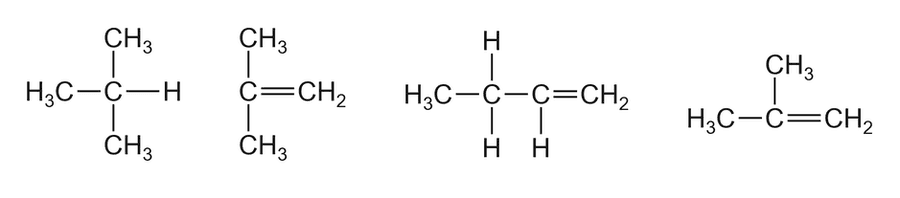
How many isomers of butene are there ?
- 1261 mark
Question 126
Which of the following is the best reagent to distinguish between ethylene and acetylene ?
P Bromine water
Q Ammoniacal silver nitrate solution
R Acidified potassium dichromate solution
- 1271 mark
Question 127
Which of the following molecules contains bond between adjacent carbon atoms ?
P Q R
- 1281 mark
Question 128
The following questions are Assertion-Reason based questions. Choose the answer based on the codes given below.
(1) Both A and R are true and R is the correct explanation of A.
(2) Both A and R are true but R is not the correct explanation of A.
(3) A is true but R is false.
(4) A is false but R is true.
Assertion (A) : Carbon shows catenation.
Reason (R) : Catenation is the property of self linking by covalent bonds.
- 1291 mark
Question 129
The following questions are Assertion-Reason based questions. Choose the answer based on the codes given below.
(1) Both A and R are true and R is the correct explanation of A.
(2) Both A and R are true but R is not the correct explanation of A.
(3) A is true but R is false.
(4) A is false but R is true.
Assertion (A) : Alkynes show addition reactions.
Reason (R) : Alkanes show substitution reactions.
- 1301 mark
Question 130
The following questions are Assertion-Reason based questions. Choose the answer based on the codes given below.
(1) Both A and R are true and R is the correct explanation of A.
(2) Both A and R are true but R is not the correct explanation of A.
(3) A is true but R is false.
(4) A is false but R is true.
Assertion (A) : The members of a homologous series can be prepared by using the same general method.
Reason (R) : The members of a homologous series have the same physical properties.
- 1311 mark
Question 131
The following questions are Assertion-Reason based questions. Choose the answer based on the codes given below.
(1) Both A and R are true and R is the correct explanation of A.
(2) Both A and R are true but R is not the correct explanation of A.
(3) A is true but R is false.
(4) A is false but R is true.
Assertion (A) : The brown colour of bromine fades when it is added to ethylene.
Reason (R) : Ethylene shows substitution reactions.
- 1321 mark
Question 132
The following questions are Assertion-Reason based questions. Choose the answer based on the codes given below.
(1) Both A and R are true and R is the correct explanation of A.
(2) Both A and R are true but R is not the correct explanation of A.
(3) A is true but R is false.
(4) A is false but R is true.
Assertion (A) : Acetylene burns with a sooty flame.
Reason (R) : Acetylene contains a greater carbon content.
- 1331 mark
Question 133
The following questions are Assertion-Reason based questions. Choose the answer based on the codes given below.
(1) Both A and R are true and R is the correct explanation of A.
(2) Both A and R are true but R is not the correct explanation of A.
(3) A is true but R is false.
(4) A is false but R is true.
Assertion (A) : On adding ammoniacal silver nitrate to ethyne, it gives a white precipitate.
Reason (R) : The above reaction forms silver acetylide.
- 1341 mark
Question 134
The following questions are Assertion-Reason based questions. Choose the answer based on the codes given below.
(1) Both A and R are true and R is the correct explanation of A.
(2) Both A and R are true but R is not the correct explanation of A.
(3) A is true but R is false.
(4) A is false but R is true.
Assertion (A) : Carboxylic acids react with alcohol in presence of concentrated to produce a fruity smell.
Reason (R) : It is due to the formation of an aldehyde.
- 1355 marks
Question 135
Choose the correct word/phrase from within the brackets to complete the following sentences :
(a) The catalyst used for conversion of ethene to ethane is commonly ……….. (nickel / iron / cobalt)
(b) When acetaldehyde is oxidized with acidified potassium dichromate, it forms ……… (ester / ethanol/ acetic acid)
(c) Ethanoic acid reacts with ethanol in presence of concentrated , so as to form a compound and water. The chemical reaction which takes place is called …………… (dehydration / hydrogenation / esterification)
(d) Write the equation for the reaction taking place between 1, 2-dibromoethane and alcoholic potassium hydroxide.
(e) The product formed when ethene gas reacts with water in the presence of sulphuric acid ……….. (ethanol /ethanal / ethanoic acid)
- 1364 marks
Question 136
From the following organic compounds given below, choose one compound in each case which relates to the description [a] to [d] : [Ethyne, ethanol, acetic acid, ethene, methane].
(a) An unsaturated hydrocarbon used for welding purposes.
(b) An organic compound whose functional group is carboxyl.
(c) A hydrocarbon which on catalytic hydrogenation gives a saturated hydrocarbon.
(d) An organic compound used as a thermometric liquid.
- 1375 marks
Question 137
Name the following :
(a) The process by which ethane is obtained from ethene.
(b) A hydrocarbon which contributes towards the greenhouse effect.
(c) The distinctive reaction that takes place when ethanol is treated with acetic acid.
(d) The property of elements by virtue of which atoms of the element can link to each other in the form of a long chain or ring structure.
(e) The reaction when an alkyl halide is treated with alcoholic potassium hydroxide.
(f) The hydrocarbons containing functional group.
- 1382 marks
Question 138
Identify the functional group in :
(a) Dimethyl ether
(b) Propanone
- 1394 marks
Question 139
(a) Why is pure acetic acid known as glacial acetic acid?
(b) Give a chemical equation for the reaction between ethyl alcohol and acetic acid.
- 1402 marks
Question 140
Find the odd one out and explain :
, , ,
- 1414 marks
Question 141
(a) Define isomerism
(b) Give the IUPAC name of the isomer which has a branched chain.
- 1424 marks
Question 142
Write equation of ethyl bromide with :
(a) aqueous NaOH (b) alcoholic NaOH
- 1435 marks
Question 143
Write balanced chemical equations for the following :
(a) Monochloro ethane is hydrolysed with aqueous KOH.
(b) A mixture of sodalime and sodium acetate is heated.
(c) Ethanol under high pressure and low temperature is treated with acidified potassium dichromate.
(d) Water is added to calcium carbide.
(e) Ethanol reacts with sodium at room temperature.
- 1445 marks
Question 144
Give chemical equation for :
(a) The laboratory preparation of methane from sodium acetate.
(b) The reaction of one mole of ethene with one mole of chlorine gas.
(c) The preparation of ethyne from 1, 2-dibromoethane.
(d) Preparation of ethane from sodium propionate.
(e) Preparation of ethanol from monochloroethane and aq. sodium hydroxide.
- 1452 marks
Question 145
Distinguish between ethane and ethene (using alkaline potassium permanganate solution).
- 1465 marks
Question 146
The structures of six organic compounds are shown :

(a) Identify two of the compounds that are members of the same homologous series but are not isomers.
(b) Which two compounds are isomers of each other ?
(c) F can be prepared from D. Give a chemical equation for the reaction.
- 1475 marks
Question 147
A compound X when treated with an organic acid Y (having vinegar like smell) in the presence of the acid Z, forms a compound P which has a fruity smell.
(a) Identify X, Y and Z.
(b) Write structural formula of X and Y.
(c) What type of compound is P ?
(d) Name the above reaction.
(e) If compound X and Y both have 2 carbon atoms. Write the reaction.
- 1485 marks
Question 148
Compound A is bubbled through bromine dissolved in carbon tetrachloride and the product is .
(a) Draw the structural formula of A.
(b) What type of reaction has A undergone ?
(c) What is your observation ?
(d) Name (not formula) the compound formed when steam reacts with A in the presence of phosphoric acid.
(e) What is the procedure for converting the product of (d) back to A ?
- 1495 marks
Question 149
Draw the structural formula for each of the following :
(a) Ethanoic acid (b) But-2-yne
(c) Methanoic acid (d) Ethanal
(e) Ethyne (f) Acetone
(g) 2-methyl propane (h) An isomer of n-butane
(i) 2-propanol (j) ethanol
(k) 1-propanal (l) ethanoic acid
(m) 1, 2, dichloroethane.
- 1505 marks
Question 150
Give balanced chemical equations for the following conversions :
(a) Ethanoic acid to ethyl ethanoate.
(b) Calcium carbide to ethyne.
(c) Sodium ethanoate to methane.
(d) Ethyl chloride to Ethyl alcohol
(e) Ethyl chloride to Ethene
(f) Ethene to Ethyl alcohol
(g) Ethyl alcohol to Ethene
What Class 10 Chemistry Ch 12 covers
The sections of the chapter, in the order the book takes them. Every question above comes from one of these.
- 01Hydrocarbons
- 02Functional Group
- 03Homologous Series
- 04Nomenclature
- 05Alkanes
- 06Alkenes
More ways to study this chapter
The same chapter asked three other ways. Practise it, revise it, and see what the board has set on Ch 12 before.
- Competency-Based Questions (CBQ)Case study questions: a situation, and the part of the chapter that answers it.40questionsOpen
- Previous Year QuestionsQuestions that have actually appeared in board papers, each tagged with its year.96questionsOpen
- Practice QuestionsExtra questions per chapter, for when one attempt at a method is not enough.49questionsOpen
Ch 12 in past ICSE papers
The same chapter as the board has actually asked it. These are worded differently from the textbook exercise, which is the point of reading them.
- 11 mark
Board paper question 1
Fill in the blanks with the choices given in brackets.
Conversion of ethene to ethane is an example of ...............(hydration/hydrogenation).
Solve with AIWritten solution
Solution:
Concept: Hydrogenation is the addition of hydrogen to an unsaturated compound. Ethene and hydrogen passed over finely divided nickel at about 200 °C (or platinum/palladium at room temperature) give ethane.
Step 1 — Compare the two words.
Hydrogenation means adding hydrogen; hydration means adding water.
Step 2 — See what is added.
Ethene () becomes ethane (): two hydrogen atoms are added across the double bond and no oxygen is involved, so this is hydrogenation.
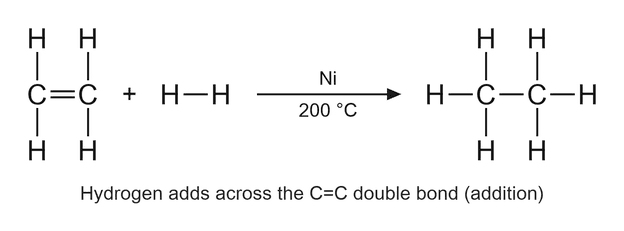
Watch out: Ethene + WATER would give ethanol (hydration); ethene + HYDROGEN gives ethane (hydrogenation).
Therefore, conversion of ethene to ethane is an example of hydrogenation.
- 21 mark
Board paper question 2
Write balanced chemical equations for each of the following:
Preparation of ethanol from Ethyl Chloride.
Solve with AIWritten solution
Solution:
Concept: Dehydrohalogenation: boiling a haloalkane with alcoholic KOH removes a hydrogen halide (H from one carbon, halogen from the next), forming a double bond. With aqueous alkali the halogen is replaced by –OH instead, giving an alcohol.
Step 1 — Choose the reagent.
Ethyl chloride (chloroethane, ) must keep its two carbons and swap Cl for –OH, so it is boiled with aqueous sodium hydroxide.
Step 2 — Write the balanced equation.
The –OH of the alkali replaces the chlorine atom, and sodium chloride forms. Check: C 2 = 2, H 5 + 1 = 6, Cl 1 = 1, Na 1 = 1, O 1 = 1.
Aqueous potassium hydroxide works the same way, giving KCl instead of NaCl.

Watch out: AQUEOUS alkali gives the alcohol; ALCOHOLIC alkali gives the alkene.
Therefore, C₂H₅Cl + NaOH (aqueous) → C₂H₅OH + NaCl.
- 31 mark
Board paper question 3
Identify the term/substance in each of the following:
The catalyst used in the conversion of ethyne to ethane.
Solve with AIWritten solution
Solution:
Concept: Hydrogen adds to ethyne in the presence of a finely divided metal catalyst, first giving ethene and then ethane.
Step 1 — Ethyne to ethene.
The first molecule of hydrogen opens one bond of the triple bond.
Step 2 — Ethene to ethane.
The second molecule of hydrogen saturates the double bond.
Step 3 — Name the catalyst.
Both steps use the same catalyst, finely divided nickel at about 200 °C (platinum or palladium also work).
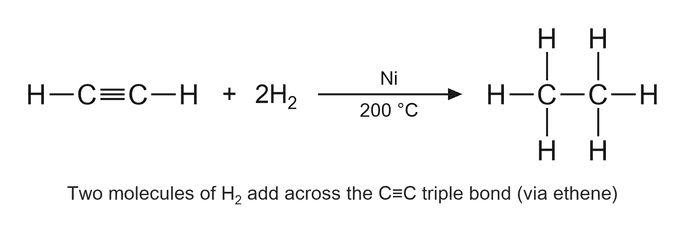
Therefore, the catalyst is finely divided nickel.
- 41 mark
Board paper question 4
Identify the term/substance in each of the following:
The type of reactions alkenes undergo
Solve with AIWritten solution
Solution:
Concept: Unsaturated hydrocarbons (alkenes C=C, alkynes C≡C) react by addition: one bond of the double or triple bond opens and a molecule such as H₂, Cl₂ or Br₂ adds across it, giving a single product.
Step 1 — Look at the bond in an alkene.
An alkene has a C=C double bond, so it is unsaturated and can take on more atoms.
Step 2 — Name the reaction type.
Molecules such as , , or HCl add across the double bond to give a single saturated product, so alkenes undergo addition reactions. Hydrogenation of ethene is one such reaction.
Watch out: Substitution is the typical reaction of ALKANES, not alkenes.
Therefore, alkenes undergo addition reactions.
- 55 marks
Board paper question 5
(i) Write the IUPAC names of each of the following:

(ii) Rewrite the following sentences by using the correct symbol > (greater than) or < (less than) in the blanks given:
(a) The ionization potential of Potassium is .............. that of Sodium.
(b) The electronegativity of Iodine is .............. that of Chlorine.
Solve with AIWritten solution
Solution:
Concept: An IUPAC name is built as locant + prefix (branch or halogen) + root + suffix. The root counts the carbons of the longest chain that contains the functional group or multiple bond (meth 1, eth 2, prop 3, but 4, pent 5). The chain is numbered from the end that gives the lowest number to the functional group (a –CHO or –COOH carbon is always C-1), then to the double or triple bond, then to the branches. The suffix shows the family: -ane, -ene, -yne, -ol, -al, -oic acid.
Step 1 — (i)(a) Name the first structure.
The chain has 3 carbons with a double bond between C-1 and C-2: , so it is prop-1-ene (propene).
Step 2 — (i)(b) Name the second structure.
The chain has 4 carbons with a triple bond between C-2 and C-3 (the same from either end): , so it is but-2-yne.
Step 3 — (i)(c) Name the third structure.
There are 2 carbons and the end carbon carries the aldehyde group (–CHO is C-1): , so it is ethanal (acetaldehyde).
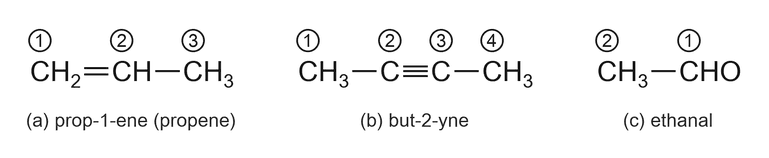
Step 4 — (ii)(a) Compare the ionisation potentials.
Potassium is below sodium in Group 1. Its outermost electron is in a shell farther from the nucleus and more shielded, so less energy is needed to remove it: the ionisation potential of K is less than that of Na.
Step 5 — (ii)(b) Compare the electronegativities.
Iodine is below chlorine in Group 17. It is a larger atom, so its nucleus attracts a shared pair of electrons less strongly: the electronegativity of I is less than that of Cl.
Watch out: Always find the longest chain first and number it from the end nearer the functional group, multiple bond or branch.
Therefore, (i) (a) prop-1-ene, (b) but-2-yne, (c) ethanal; (ii) (a) K < Na, (b) I < Cl.
- 63 marks
Board paper question 6
Write a balanced chemical equation for each of the following:
(i) Burning of ethane in plentiful supply of air.
(ii) Action of water on Calcium carbide.
(iii) Heating of Ethanol at 170°C in the presence of conc. Sulphuric acid.
Solve with AIWritten solution
Solution:
Concept: Write the correct formula of every substance, then balance the atoms of each element.
Step 1 — (i) Burning of ethane in plenty of air.
Ethane burns completely to carbon dioxide and water. Two give 4 and 6 , which need 8 + 6 = 14 O atoms, that is 7 . Check: C 4 = 4, H 12 = 12, O 14 = 14.
Step 2 — (ii) Water on calcium carbide.
Calcium carbide reacts with water at room temperature, giving ethyne (acetylene) and calcium hydroxide. Check: Ca 1 = 1, C 2 = 2, H 4 = 2 + 2, O 2 = 2.
Step 3 — (iii) Ethanol with conc. sulphuric acid at 170 °C.
Dehydration: concentrated sulphuric acid (in excess, at 170 °C) removes a molecule of water from ethanol (–OH from one carbon, –H from the next), forming the C=C double bond of ethene.

Watch out: In (i), multiply the whole equation by 2 to avoid writing 7/2 O₂.
Therefore, (i) 2C₂H₆ + 7O₂ → 4CO₂ + 6H₂O; (ii) CaC₂ + 2H₂O → Ca(OH)₂ + C₂H₂; (iii) C₂H₅OH → C₂H₄ + H₂O (conc. H₂SO₄, 170 °C).
All 96 board paper questions for this chapter, solved the same way.
Class 10 Chemistry Ch 12 questions students ask
How many questions are there in Class 10 Chemistry Ch 12?
150 questions. Every one is solved step by step on this page.
Are these Class 10 Chemistry solutions free?
Yes. Every question and its full working is free to read, with no account needed.
Can I download the Class 10 Chemistry Ch 12 solutions as a PDF?
There is no PDF to download. Every solution is on this page instead, which means it is searchable, always the current syllabus, and readable on a phone. Use your browser's print option if you want it on paper.