
Question 555 marksEasy
Under what conditions does ethane get converted to :
(a) ethyl alcohol, (b) acetaldehyde,
(c) acetic acid.
Confirming your payment
Sign up now and get 250 free tokens.
Organic Chemistry · Question 55 of 150
Under what conditions does ethane get converted to :
(a) ethyl alcohol, (b) acetaldehyde,
(c) acetic acid.
Solution:
Concept: On controlled (catalytic) oxidation ethane gives an alcohol, an aldehyde or an acid; the catalyst and conditions decide which one forms. The two-carbon skeleton is kept each time.
Step 1 — (a) Ethyl alcohol.
Ethane and oxygen are compressed to about 120 atm and passed over copper tubes at 475 K:
Step 2 — (b) Acetaldehyde.
Ethane and oxygen are passed over heated molybdenum oxide:
Step 3 — (c) Acetic acid.
The ethanol formed as in (a) is oxidised further by oxygen over platinum at 300 °C:
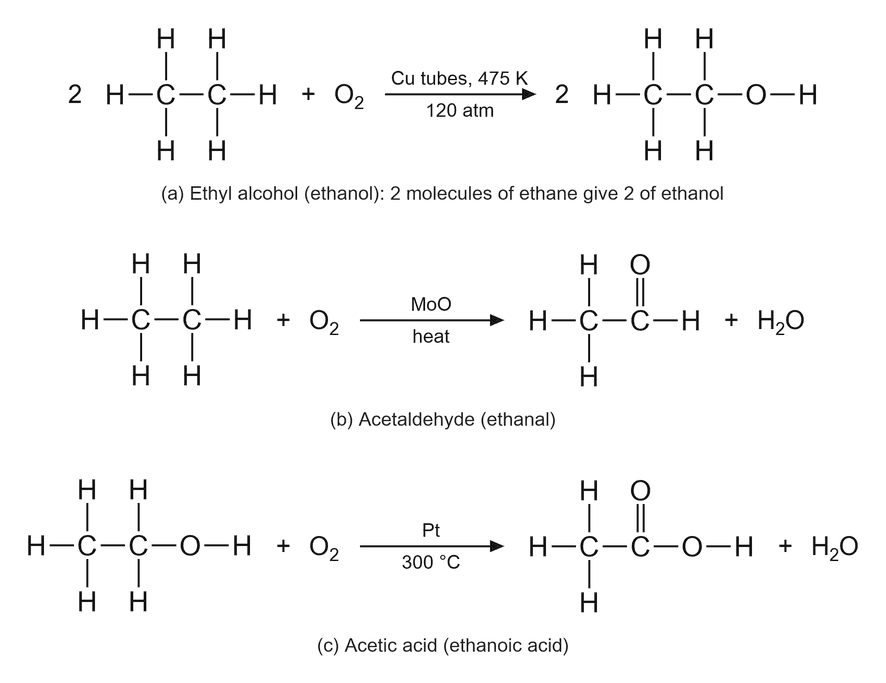
Therefore, (a) ethyl alcohol forms over copper at 475 K and 120 atm, (b) acetaldehyde over heated molybdenum oxide, and (c) acetic acid when the ethanol is oxidised over platinum at 300 °C.