
Question 14 marksEasy
(a) What are organic compounds?
(b) What is vital force theory? Why was it discarded?
Confirming your payment
Sign up now and get 250 free tokens.
Organic Chemistry · Question 1 of 150
(a) What are organic compounds?
(b) What is vital force theory? Why was it discarded?
Solution:
Concept: Organic chemistry is the chemistry of carbon compounds. The old belief that only living things could make them (the "vital force" theory) was disproved when an organic compound was made in a laboratory from an inorganic one.
Step 1 — (a) Define organic compounds.
Organic compounds are the compounds of carbon, that is, hydrocarbons and their derivatives (compounds formed when hydrogen atoms of a hydrocarbon are replaced by other atoms or groups).
A few simple carbon compounds are not counted as organic: the oxides of carbon, metal carbonates and hydrogen carbonates, and metal cyanides and carbides. Examples of organic compounds: methane , ethanol , sugar and urea.
Step 2 — (b) State the vital force theory.
Berzelius suggested that organic compounds can be made only by living things (plants and animals) through a mysterious "vital force" present in them, so they could never be made in a laboratory.
Step 3 — (b) Explain why it was discarded.
In 1828 Friedrich Wöhler made urea, an organic compound found in urine, in the laboratory simply by heating ammonium cyanate, an inorganic compound. No living cell was involved:
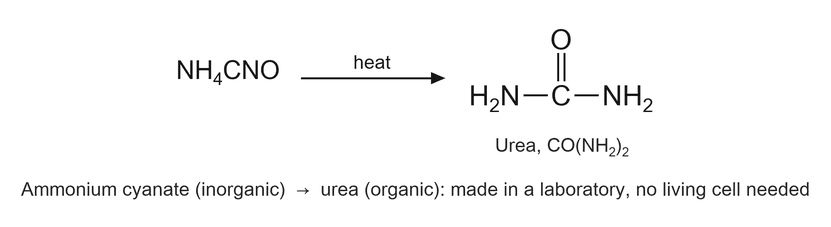
Later, Kolbe (1845) made acetic acid and Berthelot (1856) made methane from inorganic starting materials. So the idea of a vital force was not needed, and the theory was given up.
Watch out: The carbonates and oxides of carbon contain carbon but are studied as inorganic compounds.
Therefore, (a) organic compounds are hydrocarbons and their derivatives; (b) the vital force theory said only living things can make them, and it was discarded after Wöhler made urea from ammonium cyanate in 1828.