Answer: (A) (1)
Concept: In an assertion–reason item, judge the Assertion (A) and the Reason (R) separately as true or false; only when both are true do we ask whether R correctly explains A. The more carbon a hydrocarbon has (by mass), the harder it is to burn all of it in ordinary air; unburnt carbon particles make the flame sooty.
Step 1 — Judge the Assertion.
Acetylene (ethyne) burns in air with a sooty flame. A is true.
Step 2 — Judge the Reason.
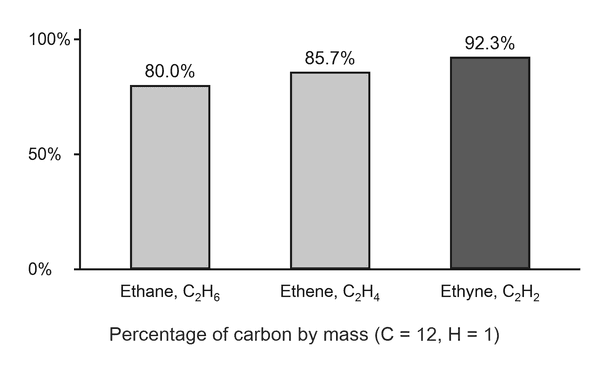
With C = 12 and H = 1, the percentage of carbon in C2H2 is:
% C=2624×100=92.3%
This is more than in ethene (85.7%) or ethane (80.0%), so R is true:
Step 3 — Decide whether R explains A.
Because the carbon content is so high, not all the carbon is oxidised in air, so the flame is sooty. R explains A.
Why the other options are wrong:
- (B) (2): code (2) says R does not explain A, but R is the exact reason.
- (C) (3): code (3) says R is false, but R is true.
- (D) (4): code (4) says A is false, but A is true.
Therefore, both A and R are true and R explains A, option (A).
