Solution:
Concept: Match the H count: CnH2n = alkenes (C=C), CnH2n−2 = alkynes (C≡C), CnH2n+2 = alkanes (single bonds). A multiple bond needs two carbons, so alkenes and alkynes start at n = 2.
Step 1 — Complete the table.
Each column is filled from its general formula:
| General Formula | CnH2n | CnH2n−2 | CnH2n+2 |
|---|
| IUPAC name of the homologous series | Alkenes | Alkynes | Alkanes |
| Characteristic bond type | Double bond (C=C) | Triple bond (C≡C) | Single bonds |
| IUPAC name of the first member | Ethene | Ethyne | Methane |
| Type of reaction with chlorine | Addition | Addition | Substitution |
Step 2 — Draw the first members.
The first member of each series is shown below:
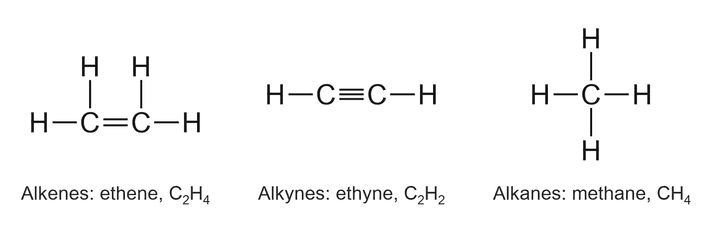
Therefore, CₙH₂ₙ: alkenes, C=C, ethene, addition; CₙH₂ₙ₋₂: alkynes, C≡C, ethyne, addition; CₙH₂ₙ₊₂: alkanes, single bonds, methane, substitution.
