Solution:
Concept: Alkenes are unsaturated and react by addition; alkanes are saturated and react by substitution.
Step 1 — (a) Fill in the blanks about alkenes.
Alkenes are the (i) homologous series of (ii) unsaturated hydrocarbons. They differ from alkanes due to the presence of (iii) double bonds. Alkenes mainly undergo (iv) addition reactions.
Step 2 — (b) Pick the compound that undergoes substitution.
We test each formula against the general formulae:
- C2H6: 2 × 2 + 2 = 6, an alkane, saturated → substitution;
- C2H4: 2 × 2 = 4, an alkene, unsaturated → addition;
- C2H2 and C10H18: 2n − 2, alkynes, unsaturated → addition.
So (v) is C2H6 (ethane).
Step 3 — (c) Draw the two isomers of butane.
Butane, C4H10, has a straight-chain and a branched-chain isomer:
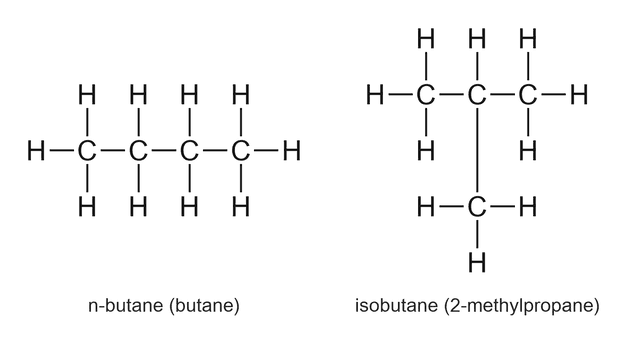
Their IUPAC names are butane (n-butane, straight chain) and 2-methylpropane (isobutane, branched).
Therefore, (a) homologous, unsaturated, double, addition; (b) C₂H₆; (c) butane and 2-methylpropane.
