
Opening your dashboard
Class 10 Chemistry Chapter 12 Organic Chemistry: Competency-Based Questions (CBQ)
40 questions on Chapter 12, each worked through on its own page with the AI tutor. Class 10 Chemistry, ICSE 2026-27.
40 questions
1–5 marks · Mixed difficulty
- 11 mark
Question 1
Cognitive domain: Recall & Understanding · CISCE Competency-Focused Practice Questions 2024, Q4
Which of the following statements about ethane is false?
- 21 mark
Question 2
Cognitive domain: Understanding · CISCE Competency-Focused Practice Questions 2024, Q14
The diagram below represents the molecule of an organic compound.
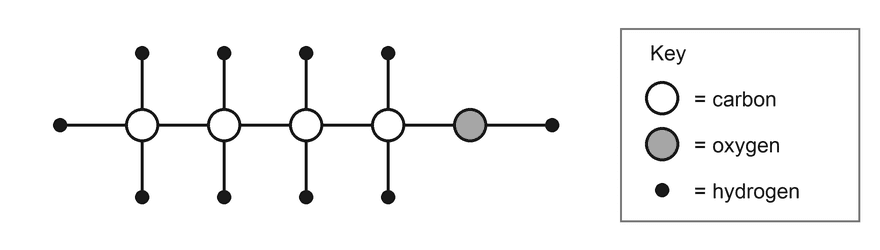
What is the name of this compound?
- 31 mark
Question 3
Cognitive domain: Understanding & Analysis · CISCE Competency-Focused Practice Questions 2024, Q16
Which of the following chains of hydrocarbons undergoes two steps of reactions to become saturated?
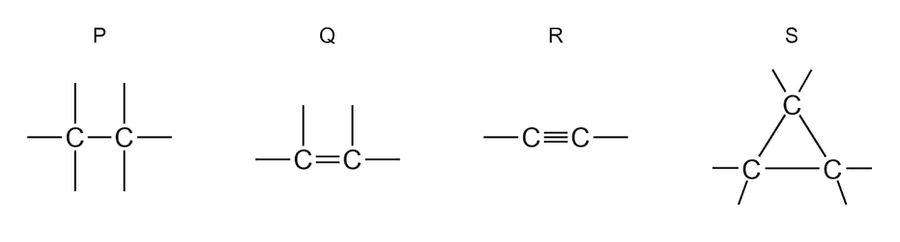
- 41 mark
Question 4
Cognitive domain: Application & Analysis · CISCE Competency-Focused Practice Questions 2024, Q18
When two organic compounds A and B react together in the presence of conc. , a fruity smell evolved from one of the products. If A has the functional group [-O-H], which of the following stands for the functional group of B?
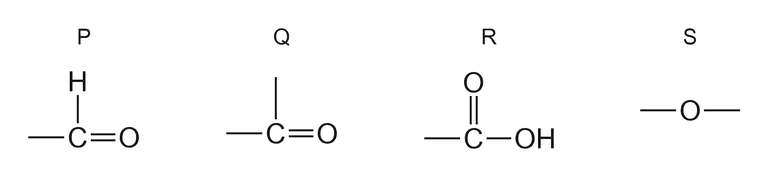
- 51 mark
Question 5
Cognitive domain: Understanding · CISCE Competency-Focused Practice Questions 2024, Q21
A distinctive reaction that takes place when ethanol is treated with acetic acid in the presence of concentrated sulphuric acid to give a fruity smell.
P: The reaction is called esterification.
Q: The reaction is called hydration.
- 61 mark
Question 6
Cognitive domain: Recall & Application · CISCE Competency-Focused Practice Questions 2024, Q29
The following are the structural diagrams of certain hydrocarbons:
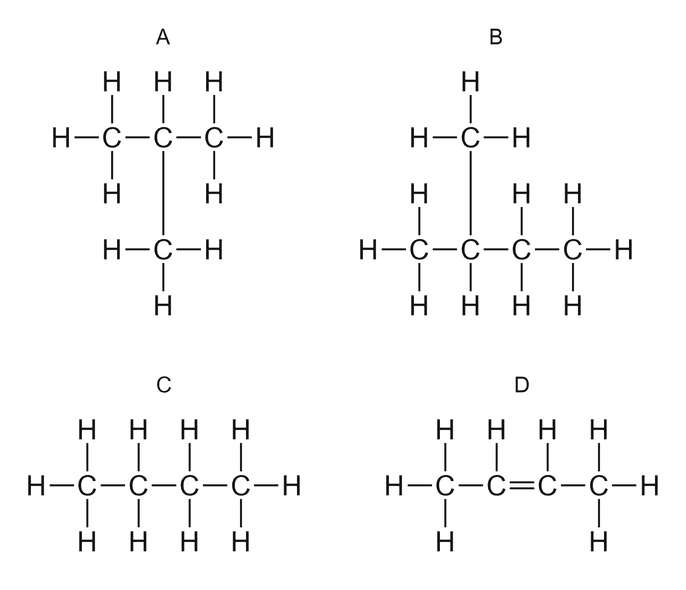
Which two structures are related to each other?
- 71 mark
Question 7
Cognitive domain: Recall & Understanding · CISCE Competency-Focused Practice Questions 2024, Q32
Baking soda (), when added to vinegar, evolves a gas. Which of these statements is true about the evolution of gas?
I. It turns limewater milky.
II. It extinguishes the burning splinter.
III. It acts as a non-metallic oxide.
IV. It has a pungent odour.
- 81 mark
Question 8
Cognitive domain: Understanding · CISCE Competency-Focused Practice Questions 2024, Q42
Hydrocarbon X decolourises bromine in carbon tetrachloride, and hydrocarbon Y does not decolourise bromine water. Both of the compounds burn with a sooty flame. The molecular formula of X and Y is ________ ( and / and ).
- 91 mark
Question 9
Cognitive domain: Application · CISCE Competency-Focused Practice Questions 2024, Q43
The number of chain isomers possible for an alkane with 5 carbon atoms are ________ (3 / 4).
- 101 mark
Question 10
Cognitive domain: Application · CISCE Competency-Focused Practice Questions 2024, Q45
If a hydrocarbon has the formula of , then it is likely to undergo a/an ________ (addition / substitution) reaction, and the hydrocarbon is a/an ________ (saturated / unsaturated) hydrocarbon.
- 111 mark
Question 11
Cognitive domain: Understanding · CISCE Competency-Focused Practice Questions 2024, Q60
How many electrons are present in one molecule of ?
- 121 mark
Question 12
Cognitive domain: Analysis & Application · CISCE Competency-Focused Practice Questions 2024, Q61
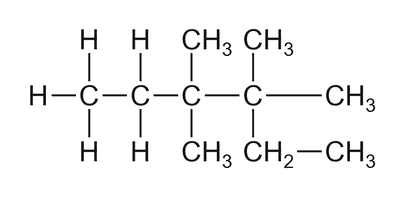
Identify the longest carbon chain and mention the number of carbons present in it.
- 131 mark
Question 13
Cognitive domain: Understanding · CISCE Competency-Focused Practice Questions 2024, Q65
Name the alkyl component of acetic acid.
- 141 mark
Question 14
Cognitive domain: Application · CISCE Competency-Focused Practice Questions 2024, Q69
Draw the structural diagram of the product obtained when ethene reacts with chlorine.
- 151 mark
Question 15
Cognitive domain: Understanding · CISCE Competency-Focused Practice Questions 2024, Q70
An organic acid on cooling below 16.5 °C crystallises out in the pure form, forming a crystalline mass resembling ice. Draw the structural diagram of this carboxylic acid.
- 161 mark
Question 16
Cognitive domain: Application · CISCE Competency-Focused Practice Questions 2024, Q72
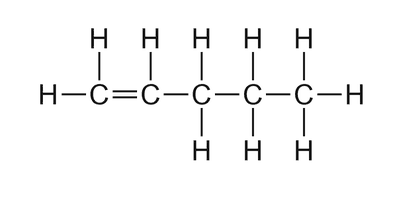
Draw the chain isomer for the following organic compound.
- 171 mark
Question 17
Cognitive domain: Create · CISCE Competency-Focused Practice Questions 2024, Q74
Draw the structure of the following organic compound:
2-methylbutane
- 181 mark
Question 18
Cognitive domain: Understanding & Application · CISCE Competency-Focused Practice Questions 2024, Q76
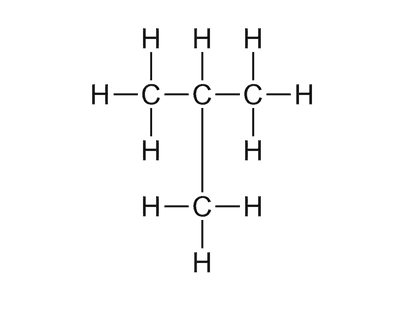
Draw an isomer of the given structure:
- 191 mark
Question 19
Cognitive domain: Understanding & Application · CISCE Competency-Focused Practice Questions 2024, Q77
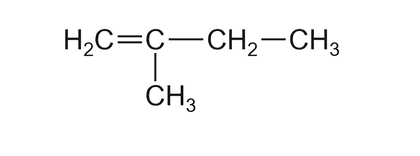
Give the IUPAC name of the following organic compound:
- 201 mark
Question 20
Cognitive domain: Understanding & Application · CISCE Competency-Focused Practice Questions 2024, Q78
Give the IUPAC name of the following organic compound:

- 211 mark
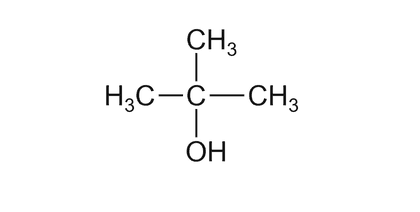
Question 21
Cognitive domain: Understanding & Application · CISCE Competency-Focused Practice Questions 2024, Q79
Give the IUPAC name of the following organic compound:
- 221 mark
Question 22
Cognitive domain: Understanding · CISCE Competency-Focused Practice Questions 2024, Q80
Give the IUPAC name of the following organic compound:

- 231 mark
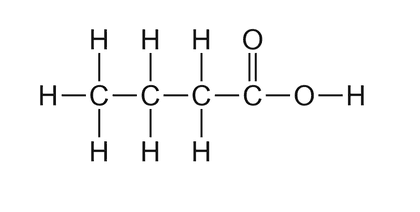
Question 23
Cognitive domain: Understanding · CISCE Competency-Focused Practice Questions 2024, Q81
Give the IUPAC name of the following organic compound:
- 241 mark
Question 24
Cognitive domain: Understanding & Application · CISCE Competency-Focused Practice Questions 2024, Q83
Give the IUPAC name of the compound represented below:

Where, C stands for carbon, O for oxygen, X for hydrogen, ● for ethyl group
- 251 mark
Question 25
Cognitive domain: Understanding · CISCE Competency-Focused Practice Questions 2024, Q87
Why is pure acetic acid also called glacial acetic acid?
- 261 mark
Question 26
Cognitive domain: Understanding · CISCE Competency-Focused Practice Questions 2024, Q89
Ethyl alcohol is a colourless liquid. It is used as a major constituent in alcoholic beverages and also in the manufacture of many chemicals. When a Chemical Manufacturing Unit ordered ethyl alcohol, they were supplied with a purple-coloured alcohol instead of a colourless one.
State the reason and the purpose of this colour change.
- 272 marks
Question 27
Cognitive domain: Understanding · CISCE Competency-Focused Practice Questions 2024, Q94
Give the structural formula and the name of the organic product formed when equal volumes of methane and chlorine react together.
- 282 marks
Question 28
Cognitive domain: Understanding & Application · CISCE Competency-Focused Practice Questions 2024, Q95
Complete combustion of one mole of a hydrocarbon produced four moles of carbon dioxide and four moles of water only.
(a) Write the equation for the combustion reaction.
(b) Draw the structure of the hydrocarbon.
- 292 marks
Question 29
Cognitive domain: Understanding · CISCE Competency-Focused Practice Questions 2024, Q106
Given above is the representation of the conversion of ethene to a saturated hydrocarbon X, where 'a' stands for the catalyst.
(a) Identify 'a'.
(b) Give the complete chemical equation for the conversion of to X.
- 302 marks
Question 30
Cognitive domain: Understanding · CISCE Competency-Focused Practice Questions 2024, Q107
The description of an organic compound is as follows:
(a) Molecular formula is .
(b) Functional group is attached to the first carbon atom.
(c) Reacts with sodium at room temperature with brisk effervescence, releasing hydrogen gas.
Identify the compound and draw its structure.
- 313 marks
Question 31
Cognitive domain: Understanding & Application · CISCE Competency-Focused Practice Questions 2024, Q119
Nita's father bought a basket of ripe mangoes. While opening it she found a small sachet containing a white crystalline powder along with the mangoes. She was told that it is a chemical that releases a gas when it comes in contact with moisture, that induces ripening of fruits.
(a) Name the chemical powder in the sachet.
(b) Name the gas.
(c) Give a balanced chemical equation for the reaction that results in the evolution of this gas.
- 321 mark
Question 32
Cognitive domain: Understanding
Assertion (A): A solution of ethanol in water turns red litmus paper blue.
Reason (R): Every molecule of ethanol contains a hydroxyl group, .
- 331 mark
Question 33
Cognitive domain: Understanding
Assertion (A): One mole of ethanoic acid is completely neutralised by one mole of sodium hydroxide.
Reason (R): Of the four hydrogen atoms in a molecule of ethanoic acid, only the hydrogen atom of the group can be replaced by a metal.
- 344 marks
Question 34
Cognitive domain: Application
Ria's family lives in a hill town. Their bathroom has a water heater that burns piped natural gas, which is almost entirely methane. One winter morning the door and the window of the bathroom were kept shut to keep out the cold. After a few minutes Ria noticed that the flame of the heater, which is usually blue, had turned yellow, and that a black deposit was forming on the wall above it. She began to feel dizzy and came out at once. The gas company's engineer explained that a poisonous gas, which lowers the ability of the blood to carry oxygen, had been forming in the closed room.
(a) Write the balanced equation for the burning of methane when the flame is blue.
(b) Name the black deposit and the poisonous gas. Explain why they formed only when the room was closed, and write the balanced equation for the formation of the poisonous gas.
(c) The heater burns 48 g of methane during one bath. Calculate the mass of oxygen needed to burn this methane completely, and suggest one change the family should make. (C = 12, H = 1, O = 16)
- 354 marks
Question 35
Cognitive domain: Analysis
A food-testing laboratory keeps a set of related organic acids on one shelf. Methanoic acid is the acid in the sting of red ants, and ethanoic acid is the acid in vinegar. A salt of propanoic acid is added to packed bread to keep mould away, while butanoic acid gives stale butter its unpleasant smell. Farah, the technician, enters the acids in the table below and leaves two entries blank for a trainee to complete.
Acid Formula Relative molecular mass Methanoic acid 46 Ethanoic acid 60 Propanoic acid 74 Butanoic acid ? ? (a) State two pieces of evidence from the table which show that these acids belong to the same homologous series.
(b) Complete the two blank entries for butanoic acid. Show how you get the relative molecular mass.
(c) An unlabelled bottle on the same shelf holds another acid of this series. Farah finds that 0.1 mole of it weighs 10.2 g. Deduce the formula of this acid and name it. (C = 12, H = 1, O = 16)
- 365 marks
Question 36
Cognitive domain: Evaluation
Kabir has to prepare one gas jar (5.6 dm³ at s.t.p.) of ethene in the school laboratory. He writes this plan in his notebook.
- Step 1: Take 23 g of ethanol in a round-bottomed flask and add dilute sulphuric acid.
- Step 2: Warm the flask on a water bath to about 100 °C.
- Step 3: Collect the gas in a dry gas jar by the downward displacement of air.
(a) His teacher says that steps 1 and 2 will not give any ethene. Correct both steps, giving a reason for the change in step 1.
(b) Write the balanced equation, with conditions, for the reaction that takes place in the corrected method.
(c) Evaluate step 3 and suggest a better way of collecting the gas, with a reason. (Relative molecular mass of ethene = 28; the average for air is about 29.)
(d) Is 23 g of ethanol enough to give 5.6 dm³ of ethene at s.t.p., if all of it is converted? Show your working. (C = 12, H = 1, O = 16; molar volume of a gas at s.t.p. = 22.4 dm³)
- 371 mark
Question 37
Cognitive domain: Analysis
In a workshop, a gas Y of the alkyne series is used in cutting torches. A technician collects a 6.5 g sample of Y. The relative molecular mass of Y is 26. (Hypothetical data.) He bubbles the sample through excess bromine dissolved in carbon tetrachloride until the product is a saturated compound. (Br = 80)
What mass of bromine is used up?
- 381 mark
Question 38
Cognitive domain: Evaluation
In a demonstration, 4.6 g of dry ethanol is added drop by drop to an excess of sodium metal in a dry flask, and the hydrogen gas formed is collected. (Hypothetical data.) Three students work out the volume of hydrogen at s.t.p. (C = 12, H = 1, O = 16, 1 mole of gas = 22.4 dm³ at s.t.p.)
Asha: 'Two moles of ethanol give one mole of hydrogen. There is 0.1 mole of ethanol, so 0.05 mole of hydrogen forms. The volume is 1.12 dm³.'
Binu: 'Each mole of ethanol gives one mole of hydrogen. There is 0.1 mole of ethanol, so 0.1 mole of hydrogen forms. The volume is 2.24 dm³.'
Chitra: 'Each mole of ethanol gives two moles of hydrogen. There is 0.1 mole of ethanol, so 0.2 mole of hydrogen forms. The volume is 4.48 dm³.'
Which student has worked out the volume correctly?
- 392 marks
Question 39
Cognitive domain: Creativity
Meera finds three colourless liquids in the school laboratory. The labels have peeled off, so she calls them P, Q and R. Her teacher says that one is dilute ethanoic acid, one is ethanol and one is water. Meera has only blue litmus paper, a dry china dish and a box of matches.
Design a plan of two tests that will tell which liquid is which. For each test, say what you do and what you see.
- 404 marks
Question 40
Cognitive domain: Analysis
In industry, hydrogen is added to unsaturated compounds by passing them over heated nickel. The same kind of reaction is used to harden vegetable oils into vanaspati. A quality-control chemist receives three unlabelled cylinders, P, Q and R. Each holds a gaseous hydrocarbon whose molecule has three carbon atoms, and each gas belongs to one of the series alkanes, alkenes or alkynes. She passes 1.12 dm³ of each gas, measured at s.t.p., with excess hydrogen over nickel at about 200 °C, and measures the volume of hydrogen used up, also at s.t.p. (Hypothetical data.)
Gas Volume of gas taken (dm³) Volume of hydrogen used up (dm³) P 1.12 0 Q 1.12 1.12 R 1.12 2.24 (C = 12, H = 1, 1 mole of gas = 22.4 dm³ at s.t.p.)
(a) Which gas is saturated? Which gases would decolourise a solution of bromine in carbon tetrachloride? Give a reason from the table.
(b) Work out how many molecules of hydrogen one molecule of Q and one molecule of R take up. Hence give the molecular formula and the IUPAC name of Q and of R.
(c) A plant converts 8 g of R completely into a saturated product. Name the product, write the equation, and calculate the volume of hydrogen at s.t.p. that is needed.